



South-east Asia’s family conglomerates at a turning point: New growth, fresh talent key to keeping their edge
Without intervention, their inherent advantages could wane


Inside Asia’s family empires: How they are transforming to seize the next stage of growth
[SINGAPORE] From Indonesia’s Sinar Mas Group to Ayala Corporation in the Philippines, family conglomerates are a major economic force in South-east Asia.
Many of these powerhouses have transformed themselves over the years, and their success offers lessons to other family businesses on how to keep their edge.
Experts who spoke to The Business Times cited three key ingredients: being able to identify and expand into growth sectors; embracing professional talent; and having a timely succession plan.
Finding new growth
Many South-east Asian family conglomerates started out by securing early positions in “licence-based, capital-intensive” sectors such as property, energy and infrastructure, said Sam Garg, a management professor at Essec Business School.
These industries have high barriers to entry, with relationships and regulatory access being key, said Prof Garg, whose expertise is in corporate governance and leadership. Having such access allowed family conglomerates to “compound advantages over decades”.
“In many Asean markets, they also stepped in where formal institutions were underdeveloped, giving them a central economic role that persists today,” he added.
However, these family conglomerates need to diversify into new growth sectors to continue their trajectory.
There are signs that these companies’ inherent advantages are waning, based on an analysis of 36 publicly listed regional conglomerates – of which about a third are family businesses – by consultancy EY-Parthenon.
From 2005 to 2014, these conglomerates produced annual total shareholder returns of 31 per cent on average. This far outperformed the 18 per cent returns of 220 listed conglomerates from other parts of the world.
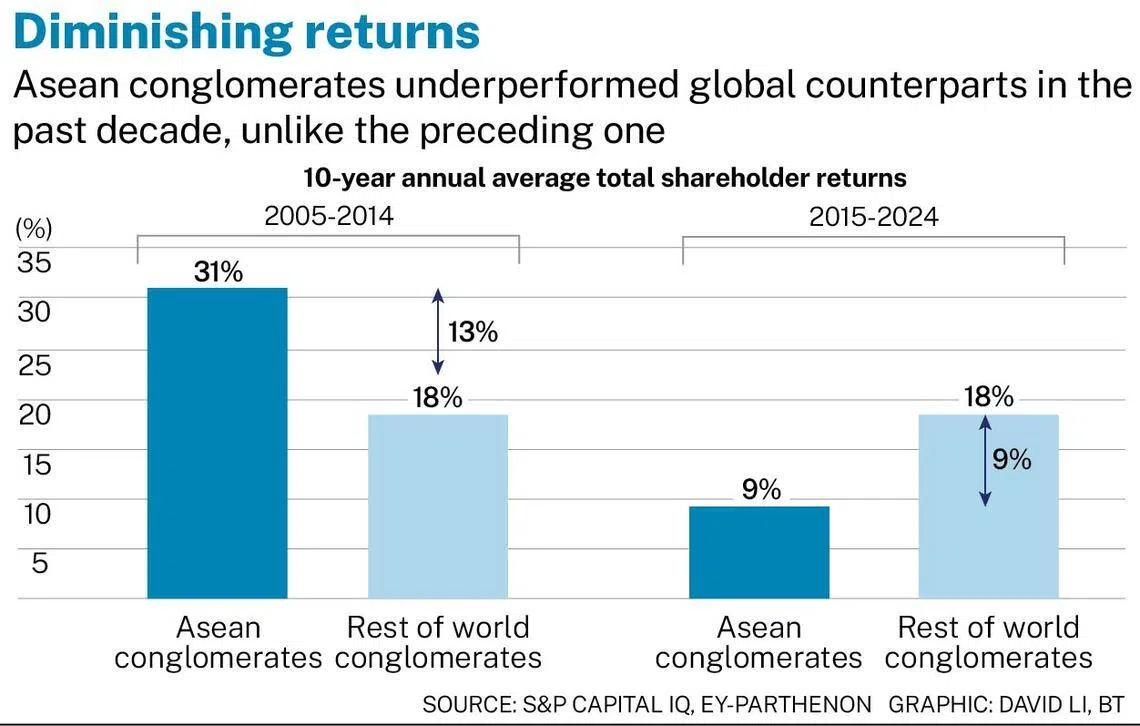
However, these conglomerates’ returns from 2015 to 2024 stood at just 9 per cent, half that of their global counterparts, the EY-Parthenon data – shared exclusively with BT – showed.
One reason for the diminished returns is the continued focus on sectors such as energy, commodities and industrials. Even as energy demand is surging across South-east Asia, regulatory risks spell a challenging business landscape.
“The energy and commodities sectors are highly regulated in Asean countries. Hence, the ability and volume to export and, correspondingly, the returns are dependent on government policies,” said Andre Toh, EY-Parthenon’s Asean valuation, modelling and economics leader.
At the same time, conglomerates in the region have limited exposure to growing or emerging sectors, such as technology and healthcare, due to a lack of risk appetite.
Regulatory complexity and the presence of other dominant players are additional barriers to expansion into healthcare, Toh noted.
However, these challenges do not mean that South-east Asia’s conglomerates cannot break into growth sectors.
For instance, Thailand’s agro-industrial conglomerate Charoen Pokphand (CP) Group has set up a digital arm, Ascend Commerce, and expanded into e-commerce with the purchase of a Hong Kong platform in the sector.
The CP Group chief executive’s son, Korawad Chearavanont, has also established a generative artificial intelligence (AI) startup called Amity.
Asian family conglomerates will need to view disruption as an “opportunity for wealth regeneration, rather than just preservation”, said Balagopal Vissa, professor of entrepreneurship and family enterprise at business school Insead.
He suggested that scions “rediscover the founder spirit”. They could tap their family assets to build new businesses, engage in transforming the current business, or back other entrepreneurs with long-term – or “patient” – capital via their family offices.
“After all, every Asian family business was once started by the entrepreneurial dream of the founders,” Prof Vissa said.
Looking outside the family
Breaking into growth sectors also requires a mindset change on talent and leadership. Growth sectors such as technology and healthcare rely more on human capital.
“They require fast learning, experimentation and respect for specialist talent. That’s a very different leadership model from the hierarchical, founder-centric structures that built these conglomerates,” said Prof Garg.
Family conglomerates can be slow to renew leadership, with many founders staying in control well into later life. In addition, capable female successors and executives remain overlooked, “narrowing the leadership pipeline unnecessarily”, he added.
It is important for the conglomerates to be open to fresh talent, including professional talent outside the family, said Associate Professor Yupana Wiwattanakantang of the National University of Singapore Business School.
These companies have stakeholders beyond family members – from employees to shareholders and supply-chain partners – to whom they are accountable. Their sheer size also means that they have an impact on the broader economy.
“Anything that affects these business groups easily affects the economy. You cannot say that it’s a family affair, they can do whatever they want… it affects employment, operations (and) the supply chains,” she said.
Dr Garg also emphasised the need for robust corporate governance. “(Stronger) processes, more empowered independent directors, and healthier CEO-board dynamics are essential as conglomerates diversify,” he said.
Beyond handing over to the next generation
These lessons are particularly important as South-east Asian conglomerates are now at a turning point – amid the rise of AI, climate change and geopolitical fragmentation.
“Up until now, succession usually meant handing over the keys of a successful business to the next generation – in ways that preserve family harmony while also ensuring the enterprise secures the needed talent,” said Prof Vissa.
“The current era of disruption means the (leaders) can no longer assume that they hand over the keys of a stable business to their next generation. Because of digital, climate and geopolitical disruptions, everything could be up for grabs,” he added.
Integrating environmental, social and governance factors into long-term business strategy is also vital, said EY-Parthenon’s Toh.
He called on the companies to focus on “establishing business resilience against ESG risks and actively monitoring the impact of ESG developments”.
As Dr Garg put it: “In short, Asean family conglomerates have the financial base to thrive, but future relevance requires new approaches.”
This calls for “faster leadership transitions, stronger governance, openness to professional and female leadership, and deliberate experimentation in new sectors”.
In the first parter, read about how Philippine real estate developer Active Group of Companies continues to thrive in a competitive sector.
TRENDING NOW

Once staunchly pro-China, Malaysian Chinese businesses are now distancing themselves from Beijing

Looking beyond looming CEO succession, should UOB potentially pursue a transformative merger?

Could stablecoins be the future of money?

Grab CEO’s wife Chloe Tong on life with Anthony Tan and finding her purpose

