



State-backed South-east Asia budget carriers handle elevated fuel prices better
Those with government or parent company support are better positioned to take on higher costs

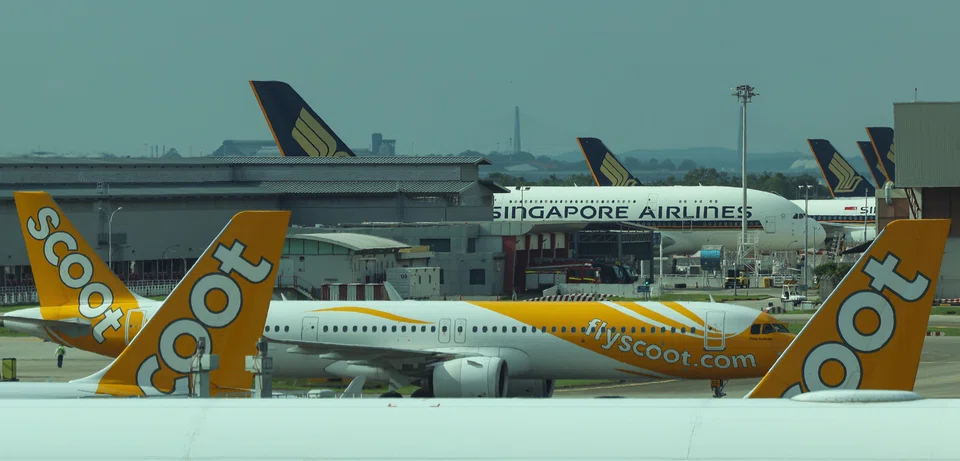
[SINGAPORE] Budget airlines in the South-east Asia region could see a divided outlook amid elevated fuel prices caused by the US-Iran war, an aviation consultant said.
AirAsia, Lion Air and other airlines with no or limited access to support from a group or government are likely to have greater direct exposure to increased fuel costs than their counterparts, such as Garuda Indonesia’s Citilink and Singapore Airlines’ (SIA) Scoot, that enjoy some protection within larger groups.
Deirdre Fulton, partner at consultancy firm Midas Aviation, wrote in a blog on Oct 28 (Wednesday) that low-cost carriers (LCCs) in the region cut capacity by 1.3 per cent year on year in 2026 whereas full-service carriers increased theirs by 4.9 per cent as higher fuel prices bite.
She noted that carriers’ recovery from the start of the Middle East war earlier this year has been slower in South-east Asia than in most regions. “The impact has not been uniform, with the scale and shape of capacity changes varying significantly by market, route type and airline business model.”
Fulton said short-haul markets and low-cost carriers have absorbed the greatest pressure from higher fuel prices, while mainline carriers have been better positioned to maintain and rebuild capacity.
International Air Transport Association data showed that jet fuel price has rocketed to nearly US$200 a barrel during the period of Oct 16 to 23, from slightly under US$100 a barrel pre-war.
LCCs are particularly exposed to fuel price movements as they hedge far less than the mainline airlines, leaving them fully exposed to spot prices, Fulton noted.
As fuel prices climb, the expense’s proportion of LCC operating costs rises in tandem. However, their price-sensitive customer base limits them from passing on the extra costs without reducing demand.
Currency depreciation against the US dollar – for currencies such as the ringgit, Thai baht, Indonesian rupiah and Philippine peso – further increase pressure on operating costs as fuel and aircraft leases are typically priced using the greenback, observed Fulton.
Consequently, carriers culled short, price-sensitive routes within the region, she added, with LCCs in Vietnam, Malaysia and Singapore having cut capacity by 7.8 per cent, 5.8 per cent and 2.1 per cent, respectively.
Rico Merkert, professor of transport at the University of Sydney, said South-east Asia’s aviation market is unlikely to shrink dramatically. However, the era of ultra-cheap short-haul flying is under pressure.
Major business routes such as Singapore-Kuala Lumpur, Singapore-Jakarta and Bangkok-Singapore will be fine, the academic said.
“The routes most at risk will be secondary city pairs, leisure-oriented short-haul markets and highly competitive routes where multiple LCCs compete primarily on price,” he added.
Fulton said LCCs will not be affected equally – as the impact varies by airlines and individual markets.
Lion Air cut domestic seats by 15.2 per cent, and AirAsia reduced domestic capacity by 9.1 per cent and international capacity by 1.1 per cent, for example.
In contrast, Citilink capacity was up by 30.7 per cent year on year – from a low base though – as it received funding from Danantara, Indonesia’s state investment fund, as part of a Garuda Group recapitalisation.
The Indonesian market therefore demonstrates that balance sheet strength and group structure can materially influence an LCC’s ability to maintain or raise capacity amid high fuel costs.
Thailand and Malaysia rely heavily on the AirAsia group, which has eliminated routes that are not profitable and released 25 older aircraft to lessors in a bid to rein in costs.
Malaysia has made no agreement or commitment to provide financial assistance to AirAsia, the finance ministry recently said, though it acknowledged a jump in jet fuel prices.
Vietnam Airlines’ international capacity rose by 13.5 per cent and domestic capacity was up by 3.8 per cent. LCC Vietjet, by contrast, has culled international capacity by 14.4 per cent and domestic capacity by 2.4 per cent.
Scoot stood out as its operating loss nearly doubled year on year to S$32 million for the quarter ended Jun 30, from S$17 million, as passenger unit cost rose 21.7 per cent.
This was in spite of higher capacity and fares, robust demand and lower fuel cost under parent SIA’s fuel-hedging programme.
Capacity rise and healthy demand do not necessarily translate to better profitability when the underlying cost base is rising rapidly, Fulton said.
The key question is not simply whether South-east Asian capacity changes for the rest of the year, she said, but which airlines can afford to keep flying, which routes can support higher costs, and the extent to which the region’s short-haul network can remain economically viable in such a fuel environment.
The resilience of LCCs is likely to depend increasingly on their financial structure as well as on underlying demand if fuel prices do not drop, she said.
TRENDING NOW

AEM tumbles 11% along with Singapore and regional chip peers following Alphabet’s record plunge

If Europe goes to war, the fallout will be felt in East Asia

Singapore Q3 retrenchments rise to 4,800; resident unemployment edges up to 3%: flash data

FTI Consulting, WongPartnership among seven members on specialist panel for haze probes

