

‘Career bridges’, earlier retrenchment support among ESR’s final proposals for workers facing disruption
The committee calls for creating ‘meaningful and sustainable careers’ by ensuring technology augments rather than replaces workers


[SINGAPORE] Earlier retrenchment support and “career bridges” to help workers move into more resilient occupations were among the proposals featured in the Economic Strategy Review’s (ESR) final set of recommendations.
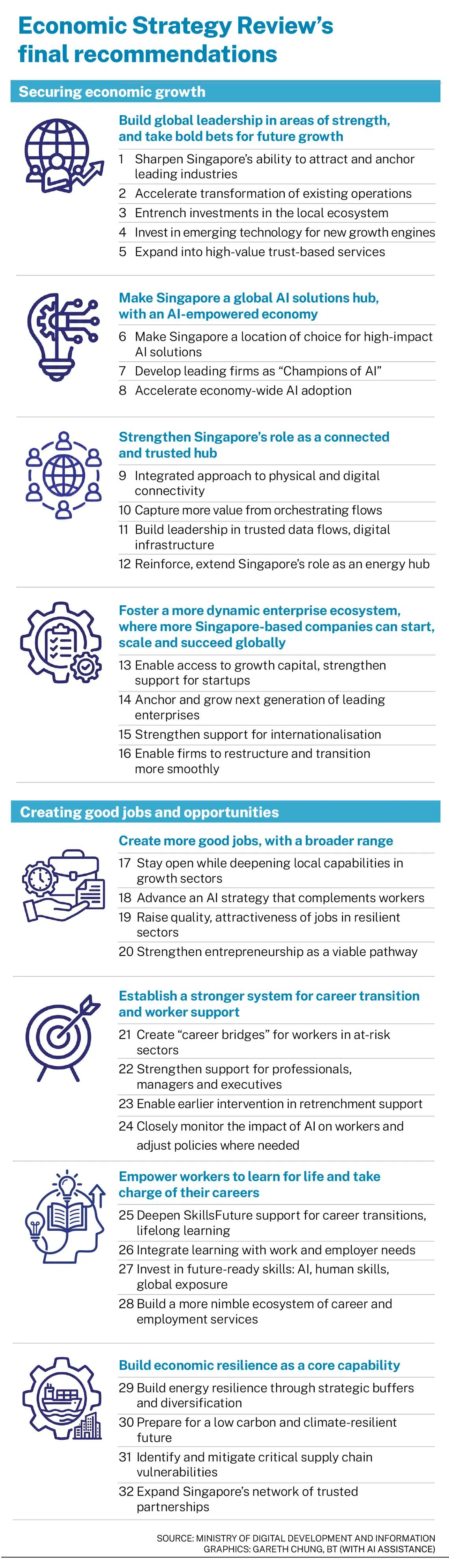
These recommendations – 32 in total, of which about a third are related to jobs – were submitted to the government by the ESR committee on Wednesday (May 13).
While the ESR’s full report will be released later, an executive summary shows that the 12 job-linked proposals fall under three of the committee’s eight broad “thrusts”, or strategic themes.
Supporting workers through change
Under the theme addressing career transitions and worker support, the committee outlined four recommendations to provide workers with earlier and more proactive support during career disruptions.
These include “career bridges” to help those in at-risk roles move into more resilient occupations through targeted training, career guidance and job-matching support.
The committee suggested prioritising sectors facing greater disruption pressures, where industry partners and trade associations could help support such transitions.
It also called for earlier intervention in retrenchments, arguing that transition support should not begin only after workers lose their jobs.
It proposed giving those affected earlier access to counselling, career guidance, skills assessments and job-matching support to improve their chances of redeployment.
In addition, the ESR highlighted the need for stronger transition support for professionals, managers and executives affected by restructuring.



This includes reviewing existing support schemes and studying ways to cushion temporary income losses during career switches.
And as the full effects of artificial intelligence on the labour market are still unfolding, the committee also suggested monitoring the impact of AI on workers and adjusting policies where needed.
Integrating learning with work
As for the second theme, centred on empowering workers to learn for life and take charge of their careers, the committee noted that “skills are becoming obsolete more quickly”, and that efforts to create good jobs would fall short if workers cannot acquire relevant skills in time.
To address this, it proposed four measures, including expanded funding for post-graduate programmes at institutes of higher learning, as well as more modular and stackable learning pathways that allow workers to build skills progressively while remaining employed.
The committee also said learning should be more closely integrated with work through programmes that combine classroom instruction with on-the-job training, such as the Institute of Technical Education’s work-study Diploma.
Employers should play a larger role in identifying in-demand skills and providing hands-on learning opportunities, it added.
Further, it noted that “human skills” such as critical thinking, communication and empathy will become increasingly important in complementing evolving technologies and business models.
Nonetheless, workers would still need stronger artificial intelligence literacy and deeper sector-specific expertise, the committee said.
It also pointed out that greater global exposure would help them operate across different cultural contexts and support firms’ internationalisation efforts.
In calling for a more “nimble” ecosystem of career and employment services, the ESR said the newly formed Skills and Workforce Development Agency (SWDA) should be complemented by greater use of private-sector providers offering specialised support for mid-career professionals.
These providers, it said, could offer more tailored advice and access to specialised job networks, while companies’ human resources capabilities should also be strengthened to better support skills development and job redesign.
Creating good jobs
In the third theme, on creating more and a broader range of good jobs, the committee said that roles that once offered stability are “now more exposed to disruption”.
However, Singapore should not hold back the deployment of AI and automation in an attempt to preserve existing jobs.
Doing so would “erode our competitiveness and ultimately weaken opportunities for our firms and workers”, even as AI and automation improve productivity, the committee said.
It pointed out that technology adoption should augment rather than replace workers, while creating a wider range of “meaningful and sustainable careers”.
To that end, the ESR laid out four recommendations related to openness and local capability-building, worker-centric AI adoption, improving jobs in resilient sectors, and strengthening entrepreneurship.
While the Republic should remain open to global talent “with the expertise needed to keep Singapore competitive”, the committee said more opportunities for locals should also be created through skills development, mentorship and leadership pathways.
On AI adoption, the committee reiterated that technologies which augment rather than replace workers should be prioritised – particularly in areas where human judgment and interaction remain central – while improving job quality.
It also said that government support for AI adoption should be tied to workforce outcomes such as job redesign, skills upgrading and helping affected workers transition into new roles.
The committee noted that sectors such as early childhood education, allied health and social services are likely to be more resilient to AI disruption and will remain important sources of employment.
There is a need to “raise the quality, productivity and wages of these jobs” through job redesign, skills recognition and technology adoption so that they become more attractive, it added.
These efforts should be “complemented by a gradual shift away from reliance on low-cost, low-skilled labour” to encourage firms to invest in productivity and local workers.
Aside from promoting more resilient jobs, the ESR noted that entrepreneurship is becoming an increasingly viable pathway as digital tools lower barriers to entry.
Stronger entrepreneurial mindsets should be fostered from an early age, it said, calling for better access to mentorship, skills development and startup support for founders as well.
The committee noted that a more vibrant startup ecosystem would create jobs and boost innovation.
Commenting on these recommendations, the National Trades Union Congress (NTUC) said the directional shifts proposed by the ESR are timely as workers face greater job uncertainty, more frequent career transitions, and rising pressure to continuously adapt their skills amid a faster-changing economy.
“The ESR’s recommendations are therefore critical in setting out how workers can be better supported through these changes,” said NTUC, adding that successful implementation of the recommendations will require strong tripartite collaboration among the government, employers and workers.
On its part, the Singapore National Employers Federation (SNEF) agreed that it is in the “broader interest of the economy and employers to enable workers affected by restructuring or skills obsolescence to quickly get back on their feet and rejoin the labour force”.
To that end, it said will work with the Ministry of Manpower and NTUC to encourage employers to provide early notification of retrenchments and shorten mandatory retrenchment notification timelines.
This, said SNEF, will enable the newly formed SWDA, together with the Employment and Employability Institute, to mobilise its employment facilitation services and help affected workers return to the labour force swiftly.
Decoding Asia newsletter: your guide to navigating Asia in a new global order. Sign up here to get Decoding Asia newsletter. Delivered to your inbox. Free.
Copyright SPH Media. All rights reserved.
TRENDING NOW

DBS, OCBC, UOB rout lops billions off STI as inflation, rate concerns spook investors

Grab CEO’s wife Chloe Tong on life with Anthony Tan and finding her purpose

OCBC sheds S$8 billion in value as shares close nearly 6% down; analysts cautious on banks

Deal between tycoon friends sparks scrutiny of Philippine power sector

