



US tariff threat clouds Asean’s 2027 export outlook, with Vietnam most exposed
Proposed duties of 18% to 35% raise pressure on South-east Asian economies to secure trade deals
SOUTH-EAST Asia faces renewed trade uncertainty after Washington proposed higher tariffs on six Asean economies, threatening to weigh on regional export momentum in the coming year.
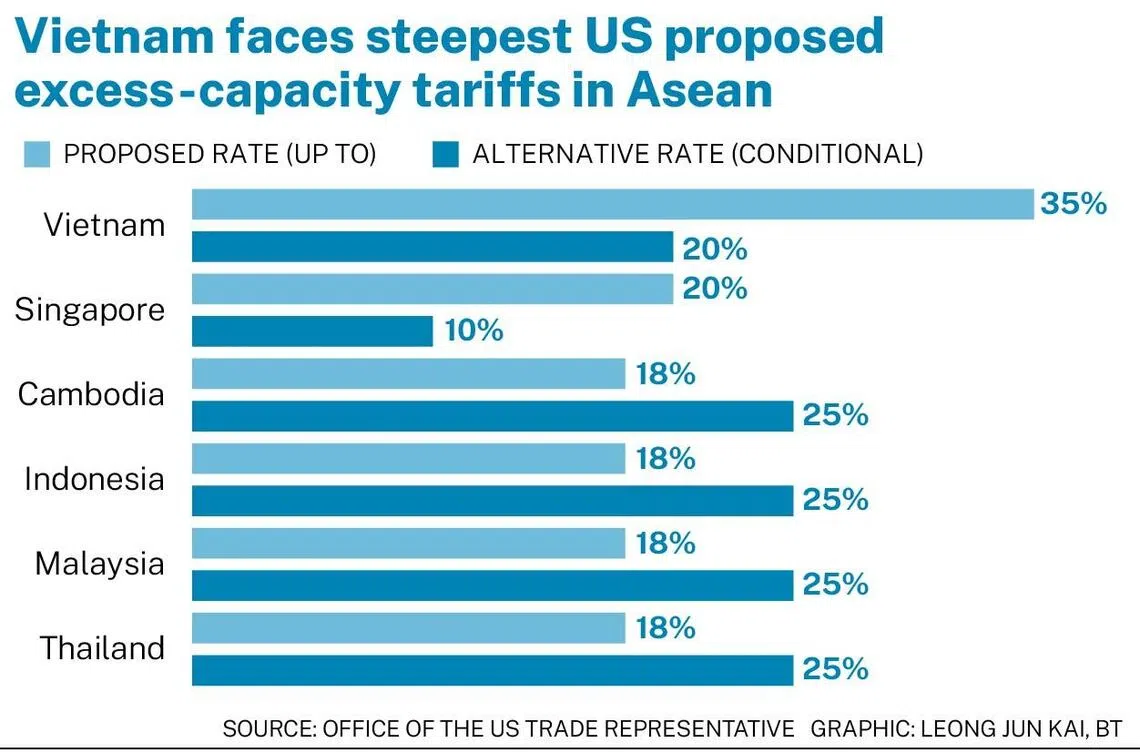
Vietnam faces the steepest proposed tariff among the six, at up to 35 per cent, compared with 20 per cent for Singapore and 18 per cent for Cambodia, Indonesia, Malaysia and Thailand.
OCBC senior Asean economist Lavanya Venkateswaran said the latest announcement point to higher effective tariff rates across the region than those announced in July.
That was when Washington imposed additional duties of 10 to 12.5 per cent, following a separate investigation into inadequate safeguards against imports of goods made with forced labour.
“This could pose a headwind to export growth in 2027, coinciding with an already pencilled-in normalisation of semiconductor export growth,” she said.
On Thursday (Nov 25), the Office of the US Trade Representative (USTR) announced the findings of its investigation into excess industrial capacity under Section 301 of the Trade Act, targeting 14 economies.

The USTR cited common concerns across the six Asean economies, including state-led industrial policies, inadequate labour protections, and their failure to address global industrial overcapacity linked to imports and investment from non-market economies.
Washington also cited “financial repression” in Vietnam, Indonesia and Singapore, while criticising Thailand’s market access barriers, Malaysia’s preferential financing for manufacturers and Cambodia’s incentives to attract foreign manufacturing capacity.
Adam Farrar, senior Asia-Pacific geoeconomics analyst at Bloomberg Economics, noted that the latest tariff proposals come amid a broader reconfiguration of Asian supply chains, with South-east Asia having emerged as a major beneficiary of shifting trade flows away from China in recent years.
SEE ALSO



US imports from Thailand and Vietnam, for example, surged 131.1 per cent and 105.6 per cent, respectively, in the first nine months of 2026 compared with the same period in 2024, while those from China fell 33.3 per cent, according to data presented by Farrar at Bloomberg Businessweek Vietnam’s economic summit on Thursday.
BMI, a Fitch Solutions company, identified Vietnam as the Asian economy most sensitive to higher US tariffs, followed among Asean economies by Cambodia, Singapore, Malaysia, Thailand, the Philippines and Indonesia, with Brunei and Laos the least exposed.
Under its worst-case assumptions, Vietnam could lose around 0.4 per cent of gross domestic product for every percentage-point increase in the effective US tariff rate on its goods. However, product exemptions could substantially limit the increase in effective duties.
BMI also expects the latest tariff threat to trigger another wave of Asian export front-loading in early 2027, followed by weaker shipments as US buyers run down inventories.
“We still expect artificial intelligence infrastructure investment to support Asia’s growth through 2027,” the research firm said. “Demand for chips, servers and related equipment has helped the region withstand earlier tariff rounds and the energy shock from the Iran war.”
Mohd Afzanizam Abdul Rashid, chief economist at Malaysia’s Bank Muamalat, said the primary concern is whether the new tariff rates will curb US demand by raising operating costs for American firms that source globally.
“Nonetheless, the tariff shock is not new, and businesses have likely grown accustomed to these challenges,” he said.
That uncertainty is already priced into growth outlooks. “We have projected a slower export growth trajectory (of Malaysia) for 2027 due to 2026’s high base, meaning that softening momentum is already built into our forecasts and scenario modeling,” Afzanizam said.
Pressure to seal deals
The proposed tariff rates, which take into account existing Section 301 duties related to forced labour, remain subject to further negotiations.
Tariffs on Cambodia, Indonesia, Malaysia and Thailand could rise from 18 to 25 per cent if Washington deems existing trade commitments and ongoing consultations unsatisfactory, the USTR said.
Conversely, Vietnam and Singapore could see their proposed rates lowered to 20 per cent and 10 per cent, respectively.
Ahead of public hearings in Washington scheduled to begin on Jan 25, 2027, South-east Asian governments are stepping up efforts to secure more favourable terms.
Vietnam’s Ministry of Industry and Trade said Hanoi is seeking to expedite a reciprocal trade agreement with Washington that could bring the proposed tariff rate down from 35 to 20 per cent.
The country has also moved to address US concerns, issuing a five-year plan on Nov 21 to manage trade surpluses, prevent industrial overcapacity and combat illegal transhipment and origin fraud.
Indonesia, meanwhile, plans to work with businesses and industry associations to maximise product exemptions through Washington’s public consultation process, said Haryo Limanseto, spokesperson for the country’s Coordinating Ministry for Economic Affairs.
In Thailand, Deputy Prime Minister and Commerce Minister Suphajee Suthumpun noted the proposed rate of up to 18 per cent is in line with expectations and reflects progress in bilateral trade negotiations.
Both sides are preparing for a legal review of their agreement ahead of its signing.
While seeking more favourable tariff terms, several South-east Asian governments have also challenged the basis of Washington’s findings.
Bangkok disputed Washington’s findings, maintaining that it did not subsidise industrial overcapacity and that its investment promotion policies comply with World Trade Organization rules.
Singapore’s Ministry of Energy, Trade and Industry said it was “very disappointed” by the proposed measures, arguing that the city-state’s trade surplus reflects its open economy and role as a global trading hub rather than protectionist industrial policies.
Malaysia, which is seeking to cap its combined Section 301 tariffs at 19 per cent, similarly rejected allegations that its manufacturing capacity distorts global markets. Its trade ministry, however, pledged to review imports from third countries to avoid contributing to global oversupply.
Seeking relative advantages
Quan Trong Thanh, head of research at Maybank Investment Bank Vietnam, said the latest tariff proposals remain part of a “negotiation and bargain” game, with Hanoi needing to assess what tariff rates its export competitors can secure and what concessions it can make to remain competitive.
“We believe that 20 per cent tariffs will make Vietnam stay competitive,” he said, adding that he expects the government to take the necessary steps to secure a trade deal.
Bloomberg Economics’ Farrar also noted that despite various tariff threats, Vietnam has so far been a major beneficiary of shifting global trade flows, with much of its export growth to the US driven by electronics – many of which have benefited from tariff exemptions.
“Vietnam has not only weathered the tariff shock, but it has actually come out stronger,” he said on Thursday.
For Indonesia and Malaysia, lower proposed tariffs than those facing export rivals could help sharpen their competitive edge.
Lee Heng Guie, executive director at Malaysia’s Socio-Economic Research Centre, noted that Malaysia’s indicative rate is below those of Vietnam and China, and on par with regional peers Thailand, Cambodia and Indonesia, helping preserve its export competitiveness.
Meanwhile, ministry spokesperson Haryo said that Indonesian manufacturers, particularly those in textiles, footwear, metal products and renewable energy components, could capture a larger share of the US market and attract investment as companies reposition their production bases in response to shifting trade dynamics.
“The significant tariff differential compared with competing countries offers a comparative advantage and strategic opportunity for Indonesia’s manufacturing industry,” he said. THE BUSINESS TIMES
Decoding Asia newsletter: your guide to navigating Asia in a new global order. Sign up here to get Decoding Asia newsletter. Delivered to your inbox. Free.
Share with us your feedback on BT's products and services
TRENDING NOW

Nvidia halts chip shipments to 4 countries in South-east Asia, including Singapore: FT

Should Keppel swoop in to snare Mapletree Investments?

OCBC opens 100-tonne gold vaulting facility to meet growing institutional demand
‘Very disappointed’: Singapore disagrees with US tariff rationale, to seek lower levies

