Vietnam elects army general as new president, reinforces four-pillar leadership
Luong Cuong’s predecessor To Lam relinquishes role to serve only as Communist Party chief
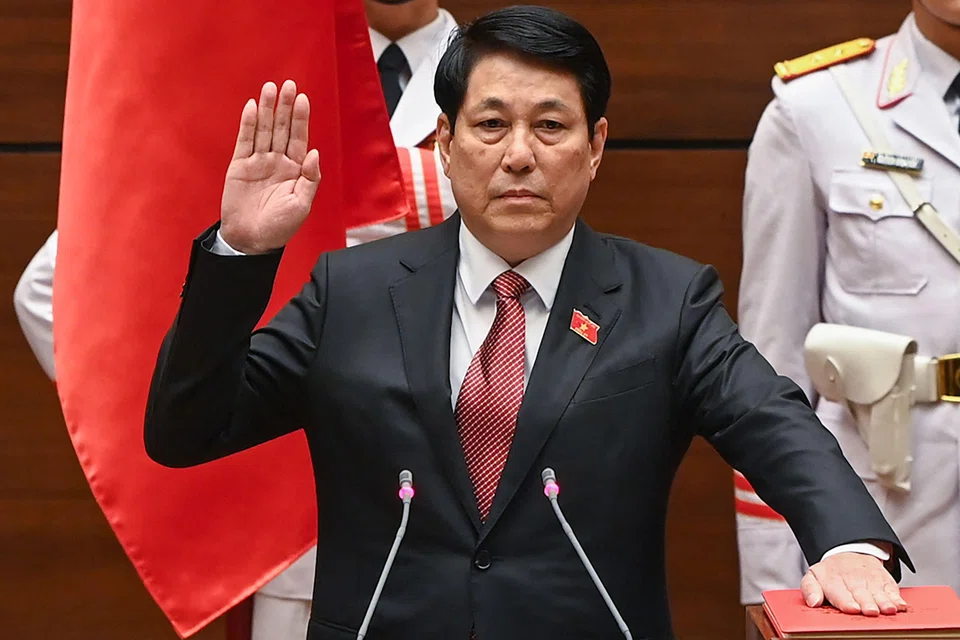
VIETNAM’S parliament has elected Luong Cuong, a military general, as the new state president on Monday (Oct 21) after his predecessor To Lam relinquished the role to serve only as Communist Party chief.
Cuong, 67, is set to be at the helm until the next party congress in 2026 when leadership posts are renewed.
Prior to the latest personnel reshuffle, Lam, 67, held both top roles in the country’s political hierarchy following the passing of the late leader Nguyen Phu Trong in July.
The promotion of Cuong to the second-highest political post has reverted Vietnam to its collective power-sharing known as “the four pillars” structure, with separate leaders holding roles of the party chief, state president, prime minister, and chairman of the National Assembly.
Although the president holds less political influence compared with the other three posts, the rise of Cuong has continued to boost the army’s presence in the country’s elite institutions. This also helped balance against the dominant public security apparatus, with both Lam and Prime Minister Pham Minh Chinh being former security officials.
“The presidential appointment should bring a measure of political stability, at least internally, given that it’s almost certainly going to be a military representative and thus a balancer vis-a-vis the police,” noted Le Truong Giang, an analyst at global risk and strategic consulting firm Control Risks.
The political stability, however, is not going to last long, as Giang expects another round of senior-level party rotations by the end of this year.
In terms of economic and foreign policies, experts and market watchers do not expect any policy shifts following the new presidency, which is largely a ceremonial role, as these decisions are made by consensus within the Communist Party’s collective leadership.
Born in the northern province of Phu Tho, Cuong has served in the army since 1975 and headed the General Department of Politics under the Vietnam People’s Army since 2016.
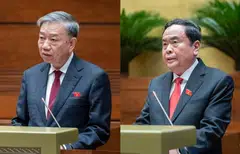
He become a member of the Politburo, the country’s highest decision-making body, in 2021. In May, Cuong replaced Truong Thi Mai – Vietnam’s fifth-ranking leader – as the permanent member of the Secretariat, which is responsible for daily party affairs.
Mai was relieved from the position after being accused of violating party rules amid a politically unstable environment, marked by an unprecedented series of high-level resignations, including the departures of two state presidents and a parliament head.
While officially, their exits were said to be related to “violations” and “shortcomings” amid the late leader Trong’s sweeping anti-graft crackdown, dubbed the “blazing furnace”, there were rumblings that they were the result of infighting in the Communist Party.
As three of the current four holders of the top jobs have either a police or military background, there have been emerging concerns among market watchers about the diminished technocratic expertise among the country’s top leaders.
“It’s quite likely the 2026 (National Party Congress) will see a restocking of the technocratic ranks,” said Giang of Control Risks, while underlining that technocrats can only be effective if the politics at the top are conducive and stable.
Over the past year, the extensive investigations on corruption and strict penalties for business wrongdoings have made bureaucrats and business people risk-averse, causing the ongoing bureaucratic paralysis in the South-east Asian country.
“We’d expect risk aversion among bureaucrats to continue at least until the party congress in 2026,” said Giang. “But under To Lam’s leadership, there have already been some improvements that trickle down to real business activity”. THE BUSINESS TIMES
Decoding Asia newsletter: your guide to navigating Asia in a new global order. Sign up here to get Decoding Asia newsletter. Delivered to your inbox. Free.
Share with us your feedback on BT's products and services