



Vietnam’s VinFast puts US$1 billion into expanding Indonesia plant, targets 350,000-unit annual output
The West Java facility is designed to produce right-hand-drive models, reinforcing its role as a regional export hub

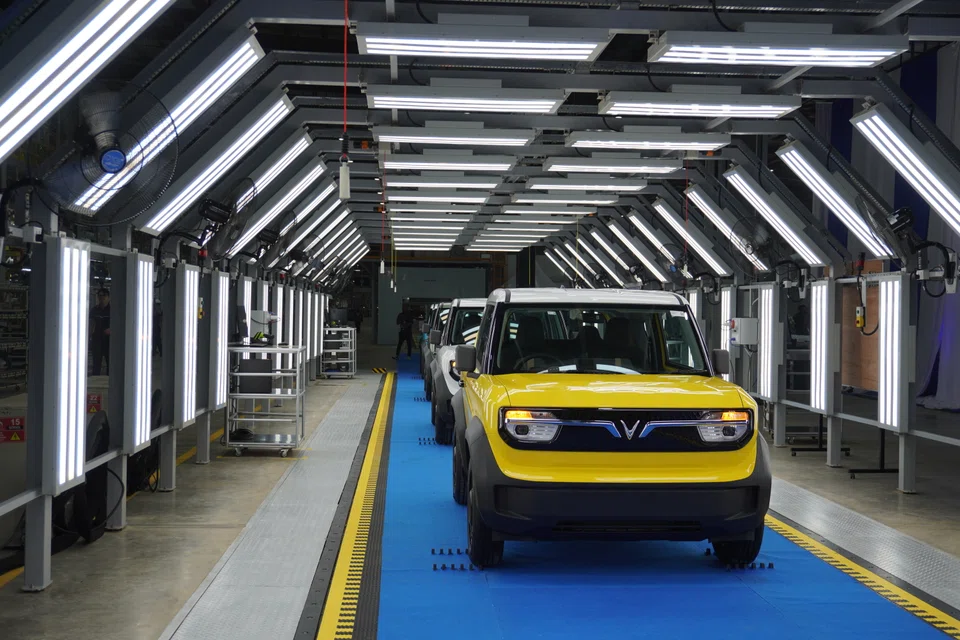
[JAKARTA] Vietnamese electric-vehicle (EV) maker VinFast has committed up to US$1 billion to expand its manufacturing plant in Indonesia, in a major escalation of its investment as it positions the country as a regional production and export hub for right-hand-drive vehicles.
The company said that the fresh investment will lift total spending on its plant in West Java to around US$1 billion, from an initial US$300 million; annual production capacity will go up to 350,000 units, from 50,000 previously.
The announcement was made on Monday (Dec 15) at the grand opening of VinFast’s manufacturing facility in Subang in West Java, an event attended by senior Indonesian officials and VinFast executives.
The Subang facility marks VinFast’s first factory in South-east Asia outside Vietnam, and its second in Asia after India.
Unlike its Vietnam plants, which focus on left-hand-drive vehicles, the Indonesian plant is designed to produce right-hand-drive ones, underscoring its role as a regional export base.
“We have decided to invest more than US$1 billion going forward,” Pham Sanh Chau, chief executive of VinFast Asia, said on the sidelines of the event.

“So far, we have invested around US$300 million, which allows us to produce 50,000 vehicles per year. To increase capacity sevenfold to 350,000 units annually, we need to significantly raise our total investment.”
The US$1 billion figure excludes spending on battery infrastructure, the company said.
VinFast plans to start mass production at the plant next month, initially focusing on meeting domestic demand, and then moving on to exporting its ouput to other right-hand-drive markets in South-east Asia.

The plant will focus on producing the VF3, a mini electric sport utility vehicle (SUV) that VinFast expects to drive the bulk of its sales in Indonesia.
Chau said that export volumes will be determined after the company assesses market response and production performance.
“When we chose Indonesia as a manufacturing base, exporting beyond Indonesia was always part of our plan,” he noted. “Once domestic demand is sufficiently met, we intend to export to right-hand-drive markets in the region. Practically any right-hand-drive country in South-east Asia could become a potential destination.”
The launch of VinFast’s plant in Indonesia comes as the government prepares to end tax incentives for fully built, imported electric vehicles in January.
Coordinating Minister for Economic Affairs Airlangga Hartarto said after the event that Indonesia would not extend the value-added tax incentives for imported electric cars, and urged global brands, including Chinese giant automaker BYD, to move quickly on their planned manufacturing investments in the country.
The push by Indonesia comes as VinFast accelerates its global expansion. In the last year, the company has stepped up its presence in India, launching electric SUVs, onboarding dealers and signalling more product launches.
In August 2025, it inaugurated its first manufacturing plant outside Vietnam in Tamil Nadu, India.
Indonesia is South-east Asia’s largest automotive market and a key battleground for global EV makers; Chinese brands and established Japanese manufacturers have been accelerating their electrification strategies there.
VinFast’s Subang plant, located about a two-hour drive from Jakarta, occupies an estimated 171 hectares (ha) and was completed in just 17 months, reflecting VinFast’s aggressive expansion strategy, said Kariyanto Hardjosoemarto, chief executive of VinFast Indonesia.
The first phase takes up about 10 ha and can churn out 50,000 vehicles a year with about 900 workers on the payroll.
“Production volumes will be adjusted in line with market demand,” Kariyanto added. “We are committed to continuously developing the facility and fully utilising the entire site over time.”
As the plant scales up, VinFast expects job creation to go up significantly.
The company targets the creation of around 5,000 jobs in the early stages, and ramp up to 15,000 workers by Phase 3. The company also aims to increase the use of locally sourced components to meet Indonesia’s domestic content requirement of up to 60 per cent in the next two years.
The company sees particularly strong potential in the multi-purpose vehicle segment, a dominant category in the Indonesian market, and has prioritised hiring local workers.
In addition to electric cars, the Subang facility is also slated to assemble electric scooters in a later phase, broadening VinFast’s product footprint in Indonesia.
When asked about how it will compete with other global EV manufacturers, Kariyanto said that VinFast is leaning heavily on the broader Vingroup ecosystem. This includes cooperation with charging-infrastructure unit V-Green, which has already deployed around 2,000 charging points across Indonesia.
VinFast is also rolling out a resale value guarantee to address consumer concerns over EV depreciation.
Under the programme, the company guarantees up to 90 per cent of the off-the-road price for vehicles that have been used for a maximum of six months.
In addition, VinFast plans to leverage the ecosystem of Vietnamese taxi operator Xanh SM, which is expanding its electric taxi and ride-hailing services across Indonesia.
Xanh SM is currently VinFast’s main client in the country, although the carmaker has yet to disclose its total unit sales target for the Indonesian market. Chau said that any supply of vehicles from the Indonesian plant to Xanh SM will be based on commercial terms.
Decoding Asia newsletter: your guide to navigating Asia in a new global order. Sign up here to get Decoding Asia newsletter. Delivered to your inbox. Free.
Copyright SPH Media. All rights reserved.






