

Asia’s clean energy boom pushes fossil fuel power generation to sharpest fall in a century
Renewables have also overtaken coal in the global mix for the first time in more than 100 years
 Add BT as a preferred source
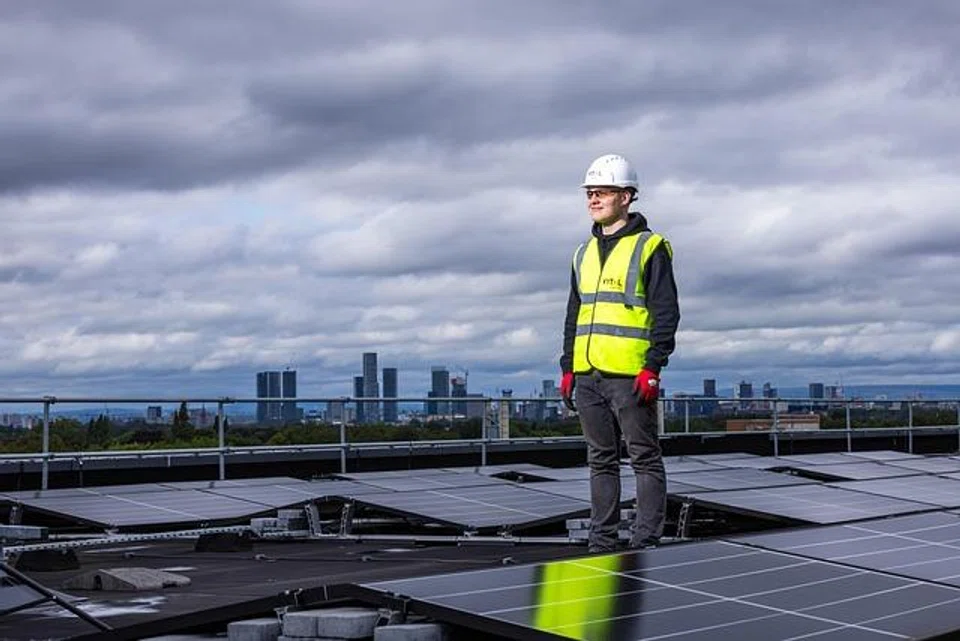
[SINGAPORE] Asia recorded a 0.9 per cent fall in power generated from fossil fuels in 2025 – the largest decrease in a century – thanks to a boom in solar energy and other renewables, a report by energy think tank Ember on Tuesday (Apr 21) showed.
Fossil fuel generation fell in China by 56 terawatt-hours (TWh) or 0.9 per cent in 2025. Similarly, India recorded a 52 TWh or 3.3 per cent fall that year.
These decreases came as Asia experienced a 36 per cent rise in solar power generation last year, driven by massive investments in photovoltaic solar infrastructure and battery storage.
“Solar power is the dominant driver of change in the global power system,” said Aditya Lolla, Ember’s managing director. “Along with battery storage, solar is opening a path to fast-scaling, round-the-clock clean power. Asia is leading the charge.”
Solar power has grown exponentially, rising by 29.7 per cent to reach 2,778 TWh globally in 2025, on a par with nuclear and wind power.
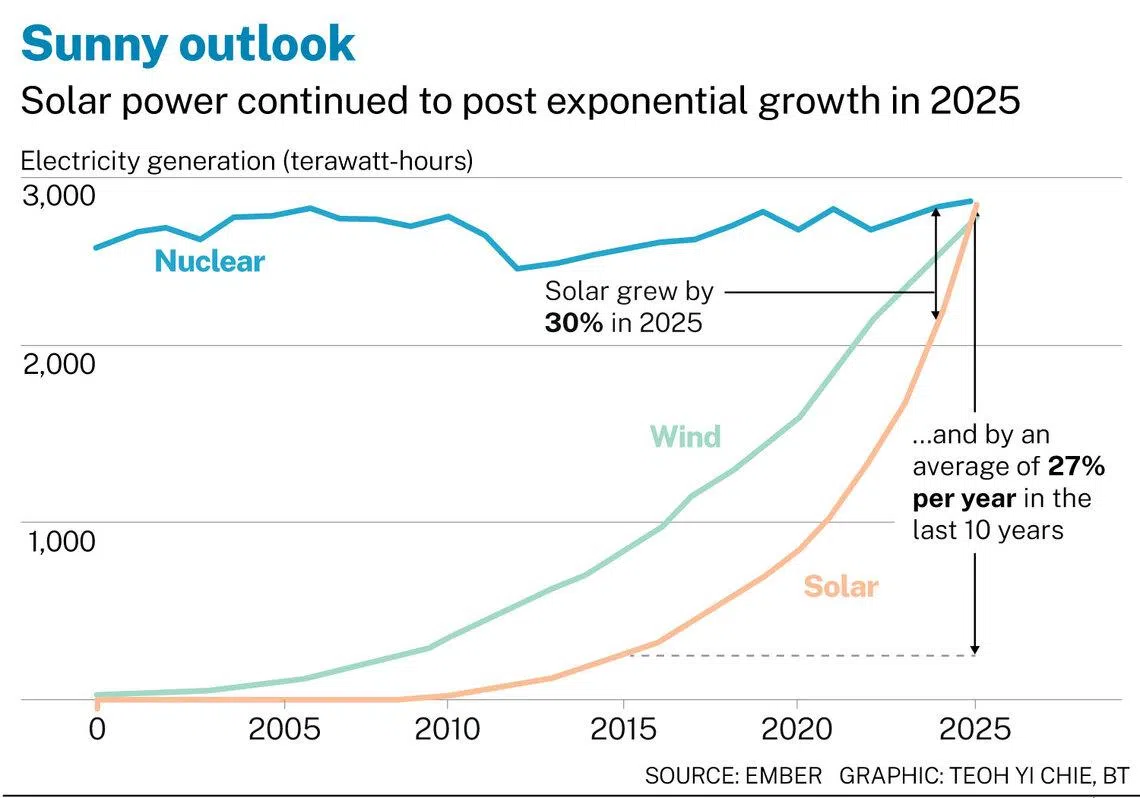
Ember noted in its report that this new solar generation “would be sufficient to displace gas-fired electricity equivalent to all liquefied natural gas exports through the Strait of Hormuz last year, estimated at 550 TWh”.
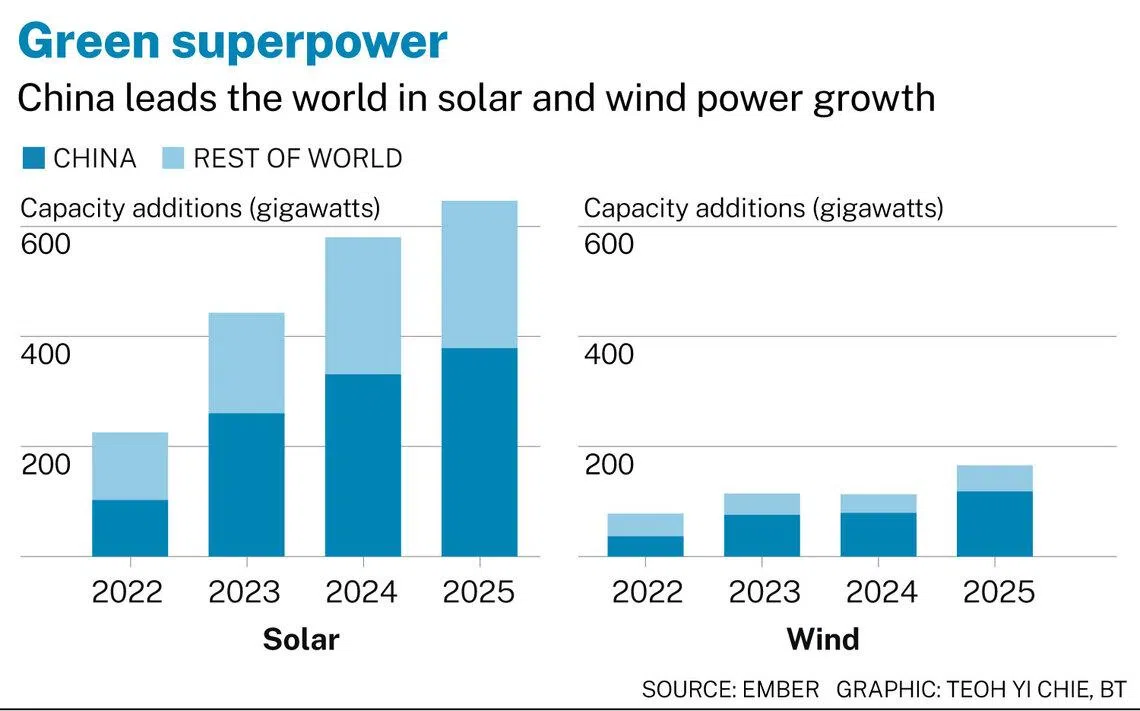
China led the solar boom, deploying 378 gigawatts (GW) of the clean power source in 2025. This accounted for 58 per cent of global solar installations and exceeded the US’ total solar capacity of 274 GW.
China also had 119 GW of wind power installations in 2025, marking a 50 per cent increase over deployment in 2024.
“As a result of the fast-paced clean power deployment, China’s consistent rise in fossil generation has come to a halt. Fossil power output has been flat for nearly two years,” Ember said.

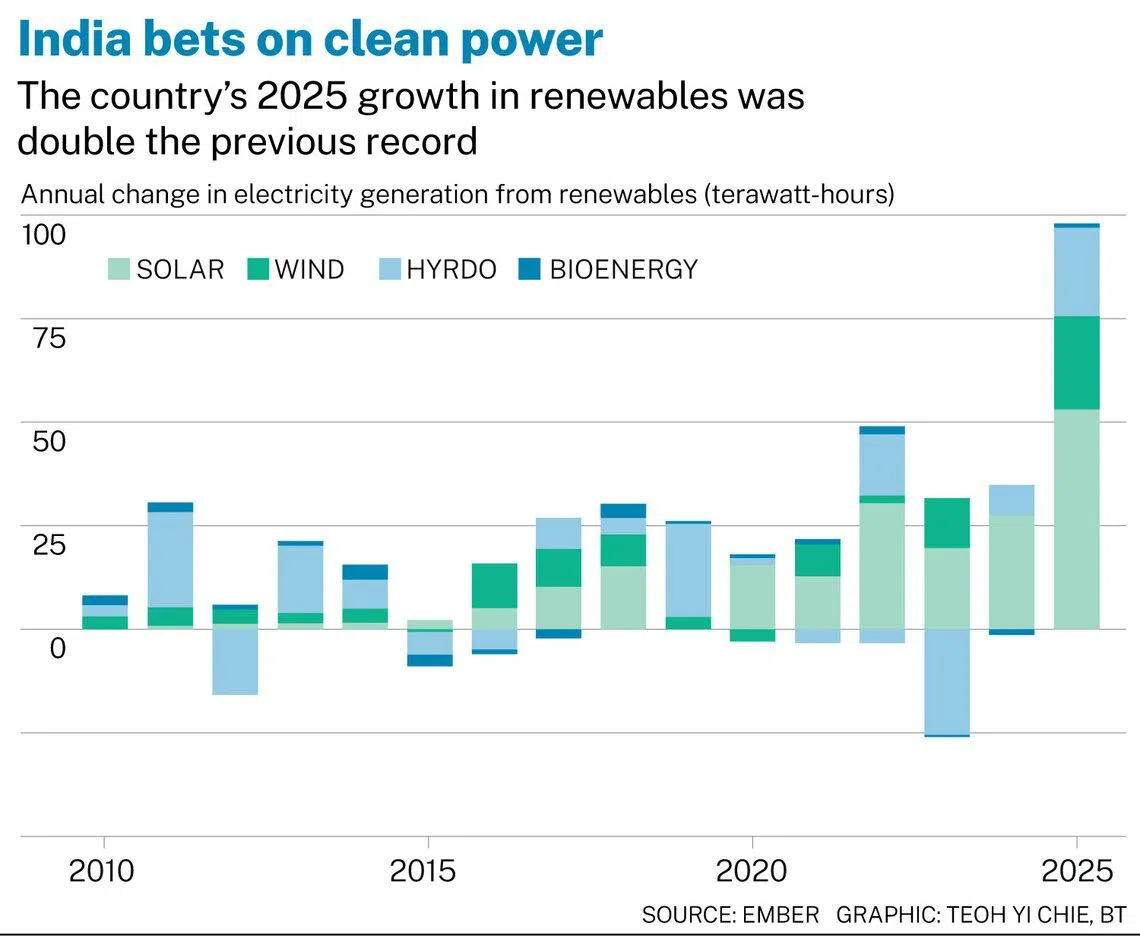
India has also doubled down on renewables.
Its power generation from solar, wind, hydropower and bioenergy rose by a record 24 per cent, or 98 TWh, last year. This is twice as large as the previous record increase in 2022, Ember noted.
Solar and wind power in India also hit new records in 2025 for year-on-year increases: 37 per cent for solar and 28 per cent for wind.
Smaller Asian countries are also moving fast on clean power. Pakistan posted an 84 per cent rise in solar generation to a record 37 TWh. Similarly, Thailand’s solar generation increased by 72 per cent to 9 TWh, or 5 per cent of its energy mix.
Racing ahead of coal
Overall, renewables accounted for 33.8 per cent of electricity generation in 2025, slightly above coal at 33 per cent. This is the first time in more than a hundred years that renewables have overtaken coal power in the global electricity mix, said Ember.
The last time this happened was in 1919, when global electricity demand was nearly 300 times smaller, and renewables comprised mainly hydropower.
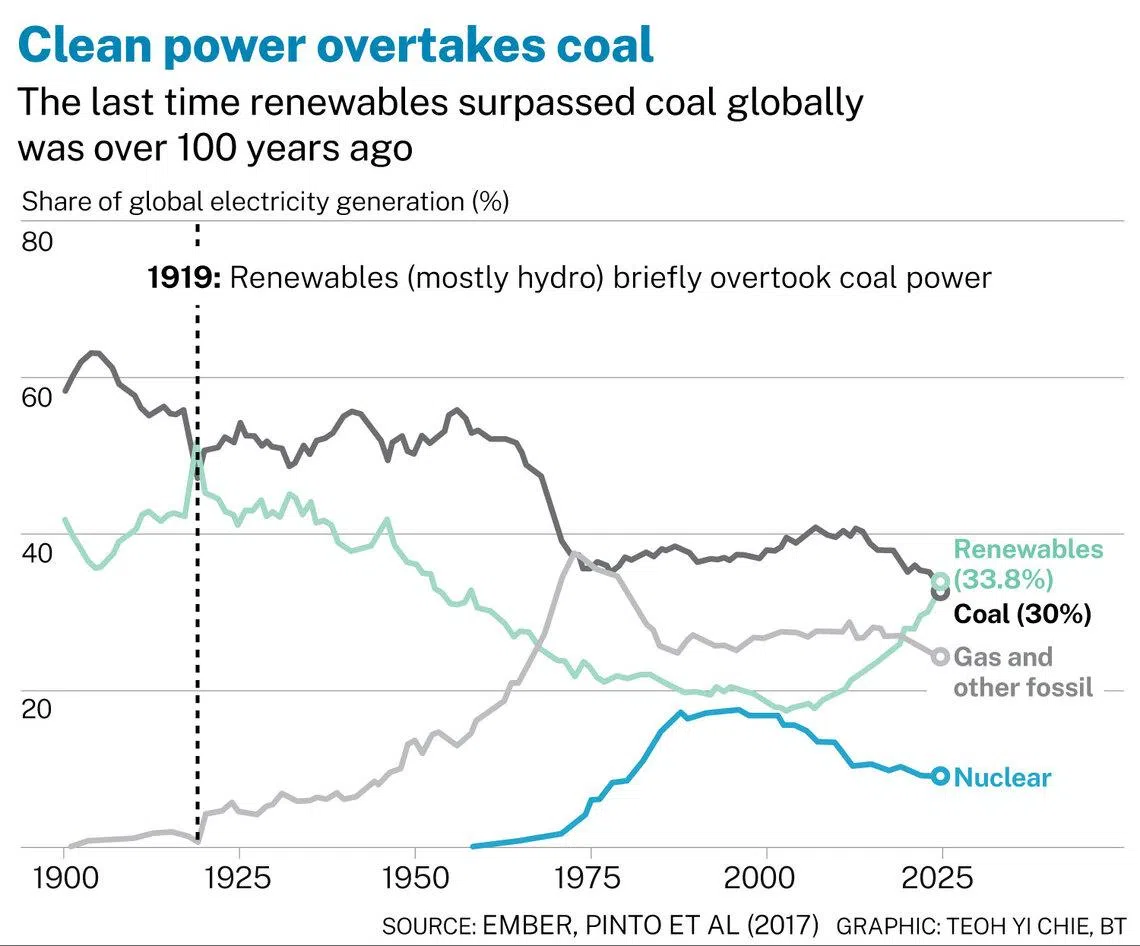
That said, Asia is now the only region where coal still exceeds renewables in the power mix, with coal at 52 per cent and renewables at 32 per cent in 2025.
Dr Dinita Setyawati, Ember’s senior energy analyst for Asia, said that more green investments will be needed.
“Going forward, investments to strengthen grid infrastructure to handle more variable renewable energy in the system, as well as interconnectors and storage to adequately utilise renewable resources, will be crucial to keep accelerating the transition,” she added.
Decoding Asia newsletter: your guide to navigating Asia in a new global order. Sign up here to get Decoding Asia newsletter. Delivered to your inbox. Free.
Copyright SPH Media. All rights reserved.
TRENDING NOW

Singapore private housing is ‘decoupling’ from HDB market as buyer pools diverge: NUS survey

Simba’s 5G spectrum hurdle may accelerate Singapore’s telco market reset

Yen hits 40-year low in historic slide that’s rattled Japan

Malaysian tycoon Vincent Tan’s sell-downs point to pruning rather than an exit plan

