With Boris Johnson on his way out, a growing field of candidates emerges to replace him
Market reaction was generally positive after the expected announcement, with the pound rallying slightly.
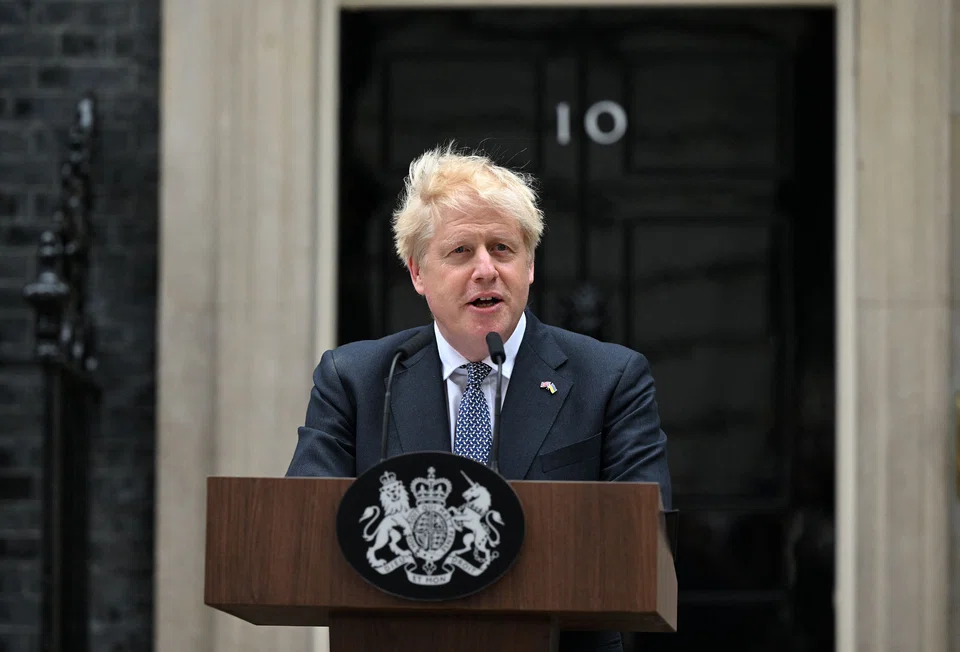
BATTERED into a corner and having lost the support of dozens of his own ministers and Conservative lawmakers, British Prime Minister Boris Johnson finally threw in the towel and announced his resignation on Thursday (Jul 7).
The scandal-plagued leader appeared outside 10 Downing Street, where the world’s media had been camping for hours in anticipation of the big announcement, and said that it is “clearly now the will” of the parliamentary Conservative party that there should be a new party leader, who in turn will be the next prime minister.
“The process of choosing that new leader should begin now and the timetable will be announced next week. And I’ve today appointed a cabinet to serve, as I will, until the new leader is in place,” he said in a brief speech.
“The reason I have fought so hard in the last few days to continue to deliver that mandate in person was not just because I wanted to do so, but because I felt it was my job, my duty, my obligation to you to continue to do what we promised in 2019. I know that there will be many people who are relieved, and perhaps quite a few who will also be disappointed. I want you to know how sad I am to be giving up the best job in the world.”
The market reaction was generally positive after the expected news of Johnson’s departure, which came at around 7.30 pm (Singapore time). The FTSE 250 index rose to a one-week high, while the FTSE 100 index was up 1 per cent.
Against the dollar, the pound was at $1.1964 at 8.30 pm, up around 0.4 per cent on the day but below the high of $1.2024 just before Johnson’s announcement. The pound reached a March 2020 low of $1.1877 on Wednesday. Overall, the pound is down 11 per cent this year alone and is increasingly at the mercy of global risk sentiment.
“I don’t believe this resignation will have a big impact on markets,” said Micheal Keusch, a fund manager at Bellevue Asset Management, in a Bloomberg report. “It certainly brings incremental uncertainty, but in the grand scheme of things, with all the real big uncertainties around, I don’t think this will be moving the needle much.”
With Johnson’s imminent departure, the UK remains mired in a political crisis as 59 conservative MPs, including Cabinet ministers and junior ministers, have resigned in the last few days.
Attention now turns to who will eventually replace Johnson and take up the hot seat. For now, the normal process is that the incumbent will stay on in a caretaker role until his successor is chosen. The duration of this process can vary from several weeks to a couple of months, depending on how many candidates are in the running.
SEE ALSO

Theresa May became prime minister less than 3 weeks after David Cameron resigned in 2016 and all the other contenders dropped out half-way. Johnson himself faced former health minister Jeremy Hunt in the run-off ballot of Conservative members to replace May in 2019, and only took office 2 months after May announced her intention to resign.
At this time, there are several potential candidates who could realistically become the next prime minister and more are expected to throw their name into the hat in the coming days, although there are no clear favourites just yet.
They include former Chancellor of the Exchequer Rishi Sunak, whom many regard as capable and charismatic but the extent of his wealth and concerns about his wife’s tax affairs have hurt his reputation somewhat. His so-called “tax-and-spend” budget in 2021 put the UK on course for its biggest tax burden since the 1950s.
There’s also Sajid Javid, the former health secretary who resigned along with Sunak on Wednesday. The former banker and a champion of free markets came from a poor family and worked his way up the ladder, serving in a number of cabinet roles including as Johnson’s finance minister in 2020.
All eyes are also on Liz Truss, the current foreign secretary who is a popular figure among Conservative Party members for her libertarian views on economics and trade. She had negotiated numerous post-Brexit trade agreements when she was international trade secretary.
Defence minister Ben Wallace has also grown in prominence of late due to his confident handling of the ongoing Ukraine crisis. He was security minister from 2016 and took on his current role in 2019.
Jeremy Hunt, a former foreign secretary and health secretary is regarded as a heavyweight in the party. He came second in the leadership campaign when Johnson succeeded May as PM in 2019. In the past year, he has been vigorously opposed to Johnson’s style of governance.
Decoding Asia newsletter: your guide to navigating Asia in a new global order. Sign up here to get Decoding Asia newsletter. Delivered to your inbox. Free.
Share with us your feedback on BT's products and services