Carbon tax likely to be raised to S$10-15, but rate needs to be higher to drive change: watchers

SINGAPORE is likely to raise its carbon tax to a previously-announced rate of S$10-15 per tonne with effect from 2024, but there could be mounting pressure for a steeper hike as the urgency of the climate crisis grows, watchers told The Business Times.
"The pressure is definitely on to frontload more in the future years. Even the carbon credit offset market price is higher than S$10-15," said OCBC chief economist Selena Ling.
The Republic in 2019 became the first country in South-east Asia to impose a rate of S$5 per tonne on firms that emit at least 25,000 tonnes of carbon dioxide equivalent (tCO2e) greenhouse gasses.
The rate, applicable for 5 years, is expected to net about S$1 billion in revenue, although Ajay Kumar Sanganeria, partner and head of tax at KPMG Singapore noted that environmental taxes are generally introduced as "a mechanism to change the behaviour of taxpayers rather than with specific revenue collection targets in mind".
"To be a genuine driver of change, the carbon tax needs to be set at a level which makes it more cost effective for taxpayers to redirect funding and resources towards greener solutions," said Sanganeria.
Most observers now agree that the current rate is too low, and Sustainability and the Environment Minister Grace Fu has also indicated that a "stronger price signal" will be needed, with the new rate expected to be revealed at Budget 2022.
Yvonne Zhang, Deloite's South-east Asia risk advisory climate and sustainability leader, said some companies in Singapore are already operating at higher carbon prices, which may indicate preparedness to deal with more ambitious carbon prices.
For example, Temasek Holdings has set an internal carbon price of US$42/tonne, giving the sovereign wealth fund a "bottom-line incentive" to move away from carbon-intensive practices, Zhang said.
Temasek's rate is not too far off from a recommendation by the World Bank's high-level commission on carbon pricing and competitiveness, which had estimated that a rate of US$50-100 per tCO2e is needed by 2030 to achieve the Paris Agreement target of limiting global warming to 1.5 degrees Celsius.
Currently, most countries charge about US$1-30, and Sweden's rate is the world's most expensive at 1,200 krona (S$177).
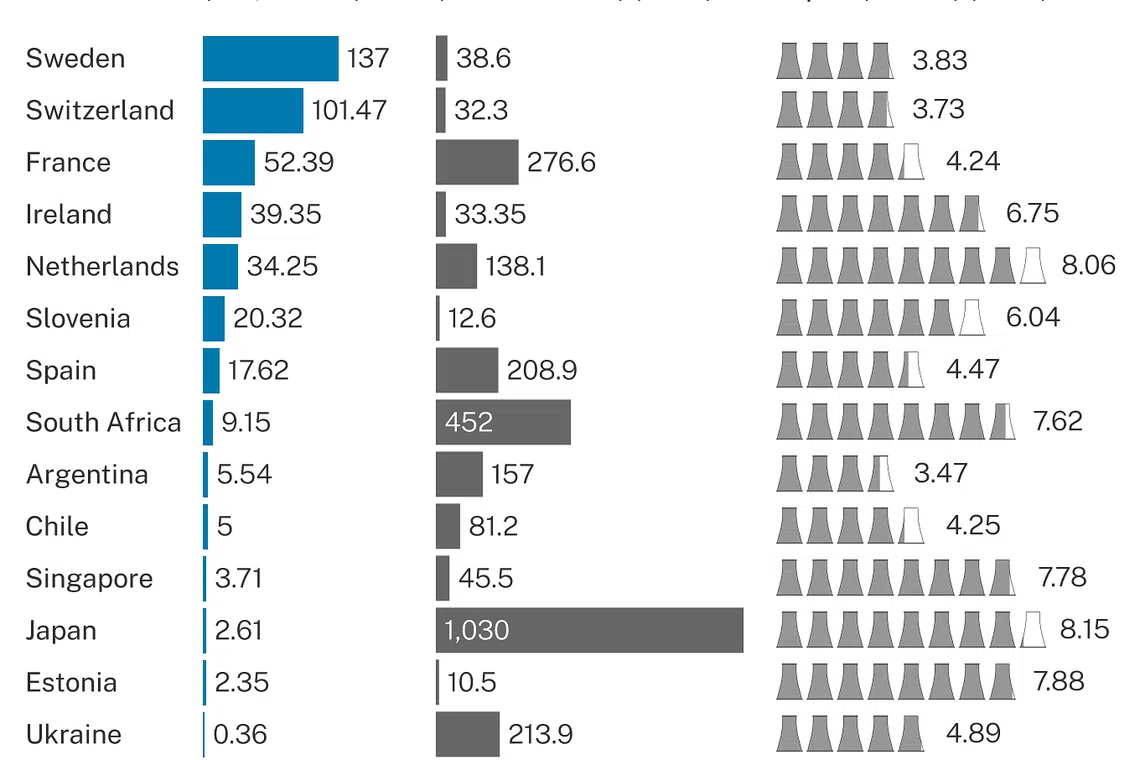
Still, watchers believe the government is likely to keep the post-2023 rate to the earlier-announced level of S$10-15 per tCO2e, which would be double or triple the current rate.
"When the government issues a rate, it is so that businesses can plan ahead and have time to adjust," said Melissa Low, a research fellow at the Energy Studies Institute.
Gan Meixi, deputy director for sustainability at the Singapore Institute of International Affairs, said Singapore needs to balance global, regional and local concerns when setting a price.
"A much higher carbon price than other countries, especially those in Asean, may cause 'leakage' where high-emissions businesses do not decarbonise but simply shift from one location to another. Indonesia, for instance, has set a carbon price of around S$2.80 per tonne," she said.
Mark Addy, energy and natural resources and tax partner at KPMG Singapore, said although carbon tax rates need to be "significantly increased" if the world is to reach net-zero emissions by 2050, a sharp increase could be "counter-productive in the short term and may even hinder broader economic progress", due to the increased costs for both businesses and consumers.
A researcher at the Lee Kuan Yew School of Public Policy had previously estimated that every S$5 per tCO2e of tax would increase the average energy bill by about 1 per cent.
Low noted that when it comes to competitiveness, much also depends on how other economies implement domestic mitigation too.
"It is possible that making energy efficiency improvements and decarbonising earlier would make companies operating here more competitive in an increasingly carbon-constrained world," she said.
Oxford Economics senior economist Sung-Eun Jung said from a macroeconomic perspective, higher carbon prices would have an impact on inflation and hence implicitly on growth.
"But their impact will also depend on the rate of the shift away from carbon-intensive goods towards low-carbon or carbon-free goods, supported by innovation and technological progress," she said.
Increasing carbon tax, however, is not the only way to tackle emissions, said KPMG's See. "It is worthwhile to also explore the widening of the tax base such that the coverage is expanded beyond the existing 80 per cent of Singapore's greenhouse gas emissions."
Deloitte's Zhang said the focus should not just be about the dollar figure, as attention should also be paid to areas such as who pays for this, the carbon liability calculation, and implementation mechanisms.
She noted that countries like Indonesia as well as the European Union have carbon taxes that are tied to the emission intensity of energy generation in each country, which is "a far more scientific and commercially relevant way of doing things that helps industries and businesses to actually reduce their emission while preserving productivity".
"What history has taught us is that carbon tax or emission trading schemes that aim to reduce the cost of compliance rather than promote the actual reduction of emissions fail," she said, adding that this was the case in the United Kingdom, Australia and the United States.
Instead, the level of comfort for businesses to adapt may lie in "how the schemes are promulgated rather than simply making the cost of compliance lower", she said, citing examples such as the Monetary Authority of Singapore's project Greenprint as well as the Singapore Exchange's mandatory climate disclosure.
"It is ever more important that businesses actively take up the support system and do something, rather than sit and wait to have change forced upon them," said Zhang.
Sanganeria also noted that in many other countries, carbon taxes often end up getting passed on to consumers through increasing commodity prices - disproportionately affecting lower-income households - while failing to sufficiently incentivise businesses to switch to lower carbon alternatives because the easier option would be to pass on the costs.
"A suite of complementary measures could be considered to counter these potential impacts, including subsidies for lower income households to offset rising electricity costs and incentives for businesses to redirect investments to projects focused on reducing emissions," he said.
Stay updated on Budget 2022 and sign up for our special newsletter here: bt.sg/budget22
READ MORE:
- Italy expects EU carbon price of 80 euros per tonne this year
- Upcoming GST hike seen as key to improving fiscal sustainability
- Will Singapore levy a property-related 'wealth tax' at Budget 2022?
- Singapore's carbon tax needs 'stronger price signal' amid decarbonisation push: Grace Fu
- Carbon tax changes will come with measures to ease costs for households: Gan