

China AI stocks, hyperscalers hit by signs of tougher US tech curbs
The country’s stock benchmark falls near 16-month lows as ex-Nvidia CEO Jensen Huang’s fall from grace signals heightened Sino-US tensions
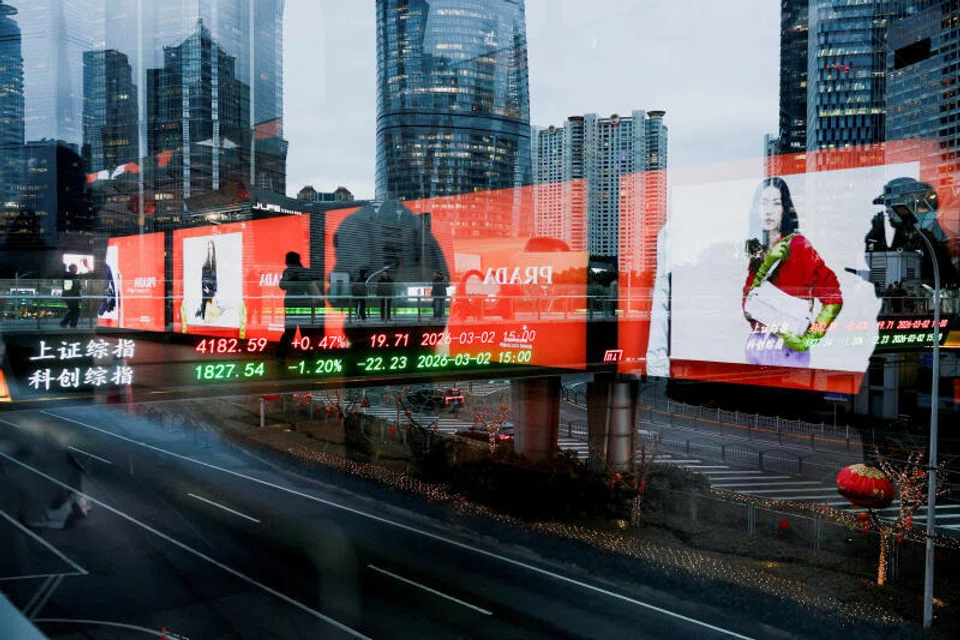
[SHANGHAI] Equities in China and Hong Kong fell as investors continued to offload Chinese artificial intelligence hardware exporters and AI hyperscalers, amid signs of hardening US tech curbs against China ahead of a meeting between leaders Xi Jinping and US President Donald Trump.
China’s stock benchmark was near 16-month lows as former Nvidia chief executive officer Jensen Huang’s fall from grace following Republicans’ defeat in the US midterm election foreshadowed an escalation in Sino-US tensions.
“The downfall of Jensen Huang could have consequences far beyond the AI sector, as tighter financing threatens the investment boom and political tensions reshape US-China relations,” Louis-Vincent Gave, founding partner of Gavekal Research, said in a note.
Both China’s blue-chip index CSI300 and the Shanghai Composite Index were down roughly 0.4 per cent by the midday break, flirting with the lowest level since mid-2025.
The Trump administration plans to press ahead with efforts to block imports of Chinese data centre equipment despite pushback from US technology companies.
Reuters reported in August that the Federal Communications Commission was seeking to ban US imports of new models of Chinese optical transceivers over national security concerns.

And in a sign the US is tightening exports of advanced chips to China, Nvidia said the company would not rehire co-founder Jensen Huang as CEO, and that its outlook assumes no data centre chip sales to China.
Huang had supported keeping sales open to China.
Chinese optical parts makers Zhongji Innolight and Eoptolink, which are heavily reliant on the US market, extended declines. They are down more than 70 per cent from their peaks.
Hong Kong’s Hang Seng Tech index lost 1.5 per cent, dragged lower by AI model developer MiniMax, as well as tech giants Alibaba and Tencent, whose businesses rely on advanced computing power.
However, China’s Star Chip Index rose 0.5 per cent and an index of China’s semiconductor industry gained, on bets that homegrown AI chipmakers will benefit from tighter US chip restrictions.
In other signs of geopolitical tensions, Trump met the leaders of key regional allies India, Japan and Australia in the Philippines on Tuesday, ahead of a much-anticipated trilateral meeting with his Chinese and Russian counterparts during the Asia-Pacific Economic Cooperation forum in Shenzhen.
The Quad expressed “grave concerns” about “economic coercion” in a statement, without naming China.
Meanwhile, US Democratic Senator Tammy Baldwin on Tuesday introduced legislation to revoke China’s normal trade status and favourable tariff treatment.
In China, gold stocks tumbled nearly 5 per cent on higher expectations of US rate hikes, while defence stocks also fell sharply. REUTERS
Decoding Asia newsletter: your guide to navigating Asia in a new global order. Sign up here to get Decoding Asia newsletter. Delivered to your inbox. Free.
Share with us your feedback on BT's products and services
TRENDING NOW

South-east Asia has lost Nvidia’s best salesman
UN says Singapore’s Penguin International broke Libya arms embargo; company disputes panel’s findings
Is Singapore still South-east Asia’s headquarters haven?
CapitaLand, Far East, Sing Holdings team up for S$1.82 billion bid for Jurong Lake District site

