

China-Canada relations more stable, Carney says as he meets Xi
Carney aims to reduce Canada’s heavy economic reliance on the US
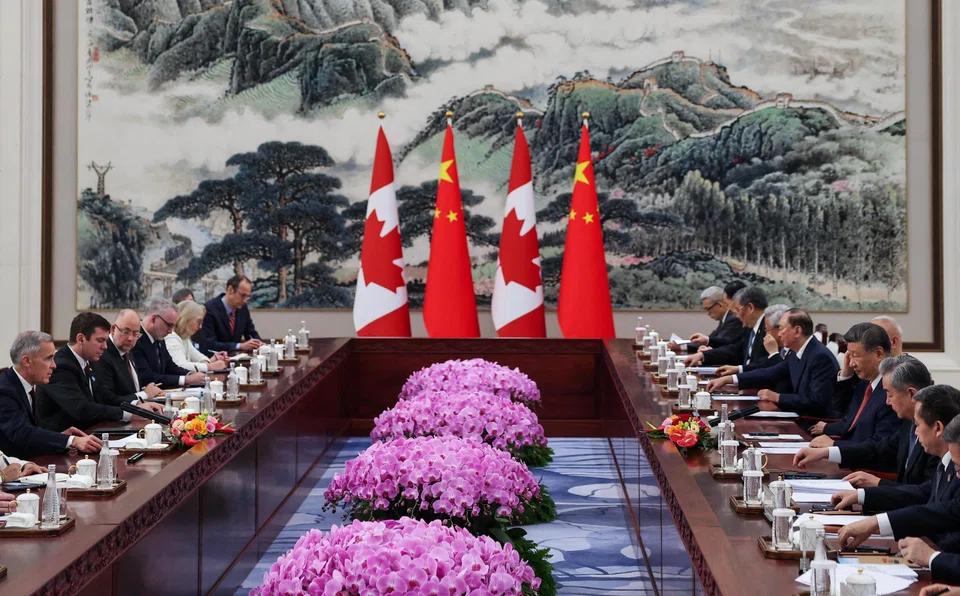
[SHENZHEN] There is “greater predictability and stability” in China-Canada relations, Canadian Prime Minister Mark Carney said on Tuesday (Nov 17) in a meeting with Chinese President Xi Jinping ahead of the Asia-Pacific Economic Cooperation (Apec) summit.
Carney, who in January became the first Canadian prime minister to visit China in nearly a decade, said bilateral exchanges had “increased significantly” and that Canada was well ahead of schedule in its goal of boosting exports to China “by 50 per cent by the end of this decade.”
A major plank of Carney’s strategy is to reduce Canada’s heavy economic reliance on the United States.
Xi said that since the two countries agreed in January to advance the China-Canada strategic partnership, exchanges and cooperation across various fields have fully resumed. Both sides are expected to deepen ties on food, energy and financial services.
“Stronger communication and cooperation between China and Canada will benefit not only our two countries but also Asia-Pacific and the world,” Xi told Carney during their meeting in the southern Chinese tech and manufacturing hub of Shenzhen.
Tuesday’s talks marked the third meeting between Carney and Xi since Carney became prime minister; the two also met on the sidelines of last year’s Apec summit in South Korea.

Chinese automakers BYD, Geely and Chery have taken steps to enter the Canadian market since Ottawa approved annual imports of 49,000 cars at a tariff rate of 6.1 per cent. The quota is set to rise to 70,000 cars over five years.
China also lowered tariffs on Canadian canola seed following Carney’s January visit, and recently extended tariff relief for Canadian canola meal, lobsters, crabs and peas for two more years.
Shipments of Canadian crude oil to China have risen about 37 per cent in 2026, according to a Reuters calculation based on LSEG data.


Still, security analysts and human rights groups have warned that closer ties with Beijing could compromise Canadian security and values.
Critics have pointed to the imprisonment of Hong Kong pro-democracy media mogul Jimmy Lai, China’s secret execution of four Canadians last year and Canadian intelligence findings that Beijing interfered in at least two federal elections.
China has said it has no interest in interfering in Canada’s internal affairs. REUTERS
Decoding Asia newsletter: your guide to navigating Asia in a new global order. Sign up here to get Decoding Asia newsletter. Delivered to your inbox. Free.
Share with us your feedback on BT's products and services
TRENDING NOW

Simba admits to unauthorised spectrum use; director Richard Tan to resign

‘If there’s a price to be paid, so be it’: George Yeo says Singapore must safeguard its reputation
Beyond the greenback, Vietnam’s big borrowers turn to Asian-currency bonds

Could the proposed COE changes mean higher premiums for all car buyers?

