China hails ‘landmark’ year in US ties despite widening Iran war
Disruptions of production and shipment from the region have sent energy prices soaring
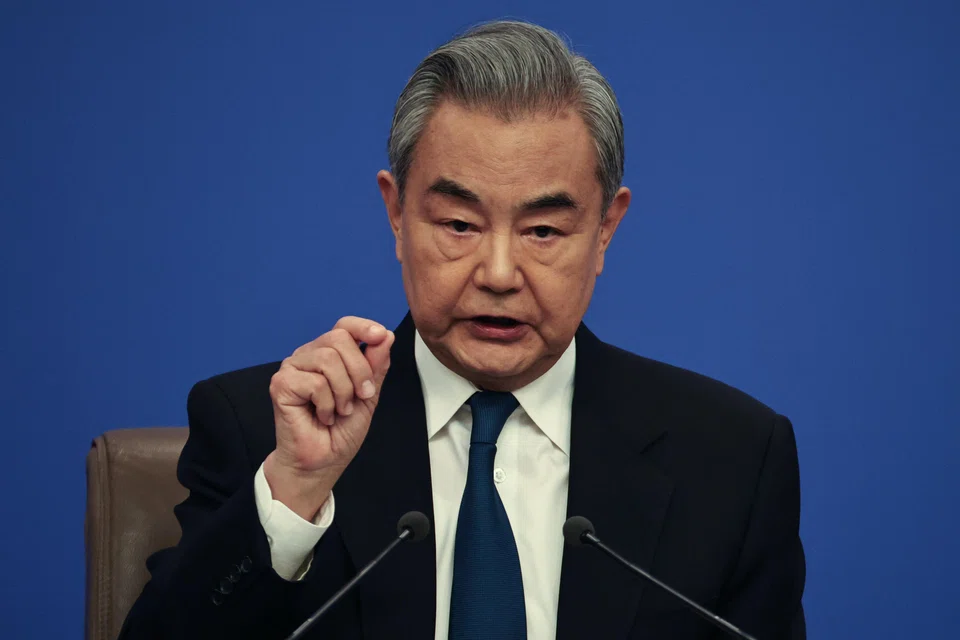
HOURS after US President Donald Trump threatened to expand strikes on Iran and hit Beijing’s strategic partner “very hard”, China’s top diplomat took the stage before the world’s press and declared this could be a defining year for US-China ties.
“When the two sides treat each other with sincerity and good faith,” Foreign Minister Wang Yi said, both powers could “make 2026 a landmark year of sound, steady and sustainable development of China-US relations”.
The Sunday (Mar 8) statement amounts to the clearest signal yet that Beijing intends to shield its relationship with Washington from the US-led attack despite maintaining an upgraded partnership with Teheran that Wang himself signed just five years ago.
Beijing is also vulnerable to the escalating turmoil in the Middle East. Disruptions of production and shipment from the region have sent energy prices soaring. And a destabilised Iran, which made up about 13 per cent of China’s seaborne oil intake, puts a dent in Beijing’s effort to diversify supply.
At his high-profile annual briefing on the sidelines of the National People’s Congress, Wang urged a ceasefire and lamented the conflict as a war that “should never have happened”. Yet he suggested that the hostilities would not affect Chinese leader Xi Jinping’s plan to host President Trump when he visits China from Mar 31 to Apr 2.
“The significance of stabilising and improving China-US relations cannot be overstated,” said Zhu Junwei, executive director of Horizon Insights Center, a Beijing-based independent think tank. “What happens in Iran and the whole Middle East is unlikely to destabilise China-US relations or cause the summit to be cancelled.”
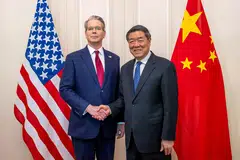
Even before the press conference, there were signs that both sides are preparing a potential agreement for the leaders to announce, including major commercial deals. US Treasury Secretary Scott Bessent, US Trade Representative Jamieson Greer and China’s Vice-Premier He Lifeng are expected to convene next weekend in Paris to lay that groundwork.
Wang’s apparent restraint on Iran reflected a calculated bet that steadying ties with the world’s largest economy takes precedence as Beijing confronts slowing growth at home and rising global pushback against its exports. A successful summit could see a tariff truce extended and stabilise an external environment for trade that made up almost a third of the country’s economic expansion last year.
“Beijing has a greater interest in maintaining its detente with Washington than protecting Tehran or Caracas,” said Jeremy Chan, a senior analyst at Eurasia Group and former US diplomat. He was referring to China’s response to the earlier US move to snatch Venezuelan leader Nicolas Maduro, another of Beijing’s partners, from his home.
SEE ALSO
The calculation carries a potential reputational cost. China has advocated for its Global Security Initiative as a better framework than what it criticises as the law of the jungle and Washington’s interventionist approach. The lack of meaningful Chinese support for its friends risks undermining the very message that China offers a reliable alternative to American power.
“Recent global conflicts in Ukraine, Gaza, and now Iran prove the limits of China’s vision,” Chan said, adding that Beijing “will need to develop a more muscular toolbox than the GSI if it wants to provide quasi-security guarantees for partner countries”.
Beijing has tried to fill that credibility gap with rhetoric. Wang on Sunday painted China as a steward of a rules-based world – the counterweight to what he described as a “might makes right” approach, in an apparent reference to US foreign policy.
When asked whether Beijing endorsed the idea of a G2, a world steered jointly by Washington and Beijing, Wang rejected the framing, insisting the world could not be “run by major countries” alone and advocated for more nations to have a say.
But Beijing’s tolerance for compromise does not extend to its own backyard.
Wang reiterated Beijing’s claim on Taiwan and warned that any pursuit of independence for the self-ruled democracy was “doomed to fail”. The comments came as cross-strait tensions remain a flashpoint that could ultimately prove far more destabilising to US-China ties than the Iran conflict.
“Resolving the Taiwan question and realising the complete reunification of our motherland is a historic process that cannot be stopped,” Wang said. “Those who support it are on the right side of history and those who defy it shall perish.”
Xi raised the Taiwan issue in a call with Trump last month, when he urged the US to handle arms sales to Taipei with the “utmost caution”. Washington approved arms sales to Taiwan worth as much as US$11.15 billion last year, one of its biggest ever, in a bid to strengthen the island’s defences.
Underscoring Beijing’s sensitivity over the island, which Wang called the “core of China’s core interests”, the foreign minister repeated sharp remarks warning Tokyo against interfering. Prime Minister Sanae Takaichi angered Beijing in November by suggesting that Tokyo could deploy its military if China uses force to try and seize Taiwan.
Josef Gregory Mahoney, a professor of international relations at East China Normal University in Shanghai, said the summit could be threatened by further deterioration in the Iran situation, particularly if the US blames China for its struggles there, or by Washington’s action on Taiwan.
“Should we see new provocations related to Taiwan, including the possibility of another US$20 billion in weapons sales offered to Taipei,” he said, “then we can consider the meeting imperilled”. BLOOMBERG
Decoding Asia newsletter: your guide to navigating Asia in a new global order. Sign up here to get Decoding Asia newsletter. Delivered to your inbox. Free.
Share with us your feedback on BT's products and services