

China lowers spending most in six months in blow to economy
The Asian nation will likely increase infrastructure spending to shore up growth

CHINA scaled back government spending at its fastest pace in six months in April, a move that contributed to an unexpected slowdown in the economy across the board.
A broad measure of public expenditure fell 7.3 per cent from a year ago, accelerating from the 2.5 per cent decrease in March to mark its sharpest decline since October, according to Bloomberg calculations based on Ministry of Finance data released on Wednesday (May 20). By contrast, broad fiscal revenue rose 2 per cent.
The data helps explain a surprising contraction in fixed-asset investment that China recorded in April, which followed a rebound earlier this year. Combined with sluggish consumer spending, the investment downturn outweighed booming exports, dragging down overall economic activity.
Economists have pointed to several reasons for the fiscal pullback.
Solid economic growth in the first quarter may have reduced the impetus for authorities to step up spending. Others noted a potential funding gap in April, as some construction projects were moved from late 2025 to early 2026 while new projects had yet to receive approval. Officials may also have faced pressure to repay arrears to companies.
Infrastructure-related expenditure under China’s main budget plunged 17.7 per cent in April from a year earlier, worsening from the 8.5 per cent drop in March, according to Bloomberg calculations.
The fiscal “spend-through” ratio, an indicator developed by Goldman Sachs to measure how much of the funds raised by the government have actually been spent, dropped to 98.2 per cent in April from 99.1 per cent in March.
“The extent of fiscal policy easing has been scaled back,” Huatai Securities economists, including Wang Mingshuo, wrote in a report on Thursday. “Under the backdrop of an energy shock, some companies and consumers’ cash flow may have been hit. A continued recovery in domestic demand still requires fiscal support.”
There were mixed signals in the data about the property market.


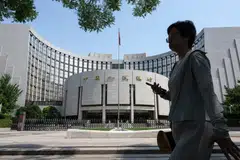

The on-year decline in government income from land sales widened in April from March. But the drop in property-related tax revenue narrowed to 0.7 per cent from 12 per cent, reflecting a rebound in home transactions in big cities, according to Huatai Securities.
China will likely increase infrastructure spending to shore up growth. Some economists estimate that China’s economic expansion slowed to roughly 4 per cent in April, tracking below the government’s official full-year target of 4.5 to 5 per cent.
In April, the Communist Party’s decision-making Politburo pledged to accelerate the construction of infrastructure networks spanning water, electricity, computing power, telecommunications, urban underground pipes and logistics.
Investment in those projects could exceed seven trillion yuan (S$1.3 trillion) this year, Sinolink Securities estimates. BLOOMBERG
Decoding Asia newsletter: your guide to navigating Asia in a new global order. Sign up here to get Decoding Asia newsletter. Delivered to your inbox. Free.
Share with us your feedback on BT's products and services
TRENDING NOW

DBS, OCBC, UOB rout lops billions off STI as inflation, rate concerns spook investors

Grab CEO’s wife Chloe Tong on life with Anthony Tan and finding her purpose

OCBC sheds S$8 billion in value as shares close nearly 6% down; analysts cautious on banks

Deal between tycoon friends sparks scrutiny of Philippine power sector

