

China’s AI trade favours global winners over local champions
Export-oriented firms are outperforming more domestically-focused peers

CHINA’S push for global artificial intelligence supremacy is increasingly benefiting companies that supply the rest of the world, with investors favouring such stocks as fierce competition hurts their domestically focused peers.
A Bloomberg gauge tracking 30 Chinese technology stocks with the biggest overseas revenue exposure has delivered a return of 36 per cent in 2026 so far, versus 9 per cent for those more dependent on local sales.
A separate measure of the export-oriented firms’ outperformance over the other group is set for the strongest-ever reading this year.
The contrasting fortunes partly result from Beijing’s ambition to build its own AI ecosystem. The self-sufficiency campaign has led to intense local competition and a vicious price war that has eroded profit margins on chips to robotics.
Meanwhile, export-oriented Chinese companies have thrived on surging global demand for AI infrastructure such as data centres.
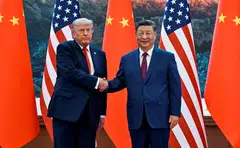
The future of China’s AI industry is back in the spotlight this week ahead of a closely-watched summit between US President Donald Trump and Chinese President Xi Jinping.
All eyes are on whether the two countries can put guardrails around the disruptive technology amid a heated race for global dominance.
“Domestic competition is tough no matter what industry. That is the major concern,” said Elinor Leung, managing director of Asia telecom and internet research at CLSA. “If you can sell internationally, the margin is much higher.”
Among the big winners of China’s AI export boom are optical component makers Zhongji Innolight and Eoptolink Technology, both of which derive more than 90 per cent of their revenues overseas. The two stocks have each rallied about 50 per cent in 2026 so far.


Fuelling the gains is a strong outlook for global AI spending.
Nvidia chief executive officer Jensen Huang recently said that he expects the company to sell twice as many chips in the coming year, while the initial success of Meta Platforms’ new AI agent offers further evidence that demand for semiconductors and computing power will likely stay robust.
Localisation trade hit
Many emerging-market funds remain underexposed to China’s localisation trade and favour exporters leveraged to the US AI capital expenditure cycle, Bank of America strategists wrote in a note last week.
The so-called localisation trade, namely bets on Chinese AI firms with an inward focus, has lost steam in recent years after the industry fell victim to cut-throat domestic competition that also engulfed other sectors from electric cars to food delivery.
In order to gain market share, companies have rushed to roll out new, cheaply-priced products including AI models and apps at the expense of sustainable profitability.
Shares of Moore Threads Technology, a leading Chinese AI designer that generates nearly all of its sales locally, are down about 25 per cent in 2026 so far. Those of AI tools developer SenseTime Group, with over 90 per cent of its sales derived locally, have fallen over 40 per cent in the same period.
Meanwhile, social media firm Kuaishou Technology, which also runs an AI video business and generates less than 5 per cent of revenue overseas, has slumped about 51 per cent.
To be sure, some observers still consider the China AI localisation trade valid at a time of unabated geopolitical uncertainties that may hurt exports.
Morgan Stanley analysts wrote in a note last week that AI sovereignty and semiconductor localisation remain structural opportunities for Chinese equities regardless of the outcome of the upcoming summit, while AI infrastructure, biopharmaceuticals and other cross-border sectors are most vulnerable to a re-escalation of geopolitical tensions.
Still, others say the race-to-the-bottom style of competition, known in China as involution, is far from over and will continue to plague domestically-oriented AI firms.
“In some industries, domestic demand is already well served, or there may even be excess supply,” said Matty Zhao, co-head of China equity research at Bank of America. “Against that backdrop, the ability to export or grow internationally can be an important differentiator.” BLOOMBERG
Decoding Asia newsletter: your guide to navigating Asia in a new global order. Sign up here to get Decoding Asia newsletter. Delivered to your inbox. Free.
Share with us your feedback on BT's products and services
TRENDING NOW
Companies still in search of AI use cases with worthwhile ROI, says Broadcom’s CEO

Malaysian king buys stake in Singapore-listed mining firm expanding into rare earths

Once staunchly pro-China, Malaysian Chinese businesses are now distancing themselves from Beijing

Singapore’s wealth management success should extend to everyday families

