

China’s capital crackdown: Why Hong Kong will keep its edge among Asian markets
Analysts say move will strengthen, rather than diminish, the financial hub’s role


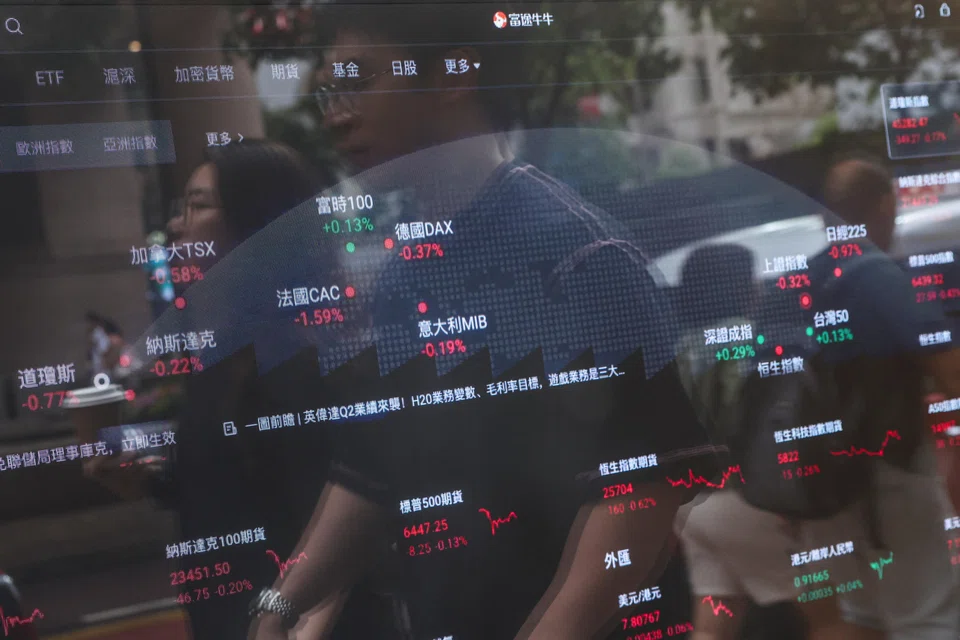
[SINGAPORE] Despite China’s recent move to target illegal overseas trading, Hong Kong will still be viewed as an attractive listing venue in Asia, according to analysts.
Morningstar’s head of equity research, Lorraine Tan, noted that capital continues to flow fluidly via official channels, such as the Stock Connect in Hong Kong.
Consequently, concerns that the closure of unofficial channels will present an immediate liquidity crisis or pressure Hong Kong’s initial public offering pipeline appear overstated.
After the clampdown, analysts from Citic Securities estimated that it could affect as much as HK$250 billion (S$41 billion) of assets in Hong Kong.
However, Morningstar anticipates a “strong IPO pipeline in the coming months”, citing upcoming listings such as Xiaohongshu and Unitree.
In Hong Kong, there are at least 17 in June set to raise as much as US$4.6 billion in total – the highest since December.
Chinese regulators recently mounted a crackdown on illegal cross-border stock trading in a push to prevent capital outflows – a move which is colliding with growing demand from mainland investors for access to overseas stocks.
It targets overseas trading outside of approved channels, and those not approved by the China Securities Regulatory Commission and other regulators.
DBS senior economist Samuel Tse noted these moves “should not pose a significant adverse impact on capital flow”.
SEE ALSO







Tommy Xie, head of Asia macro research at OCBC, added that Hong Kong’s market impact will be limited given its structural advantage as the “primary gateway to Chinese liquidity”.
Economists at the World Economic Forum in Dalian this week said that the crackdown would strengthen, rather than diminish, Hong Kong’s financial role, according to a South China Morning Post report.
US-listed Chinese stocks had fallen after the announcement. However, many Chinese giants also trade in Hong Kong and can be accessed through approved initiatives such as Stock Connect. This may drive Chinese companies to list in Hong Kong.
Programmes such as Stock Connect and Bond Connect boast mutual market access, as they link mainland China and global financial markets via the city.
Historically, Hong Kong offers greater depth in equity and debt capital markets – something Singapore is unable to beat due to its smaller investment universe, said Gary Ng, a senior economist at Natixis.
Hong Kong also serves as an “international gateway” to markets in mainland China, experts noted. They allow investors to trade eligible Chinese onshore equities (or A-shares) and fixed-income securities directly, without the need for specialised quotas or onshore licences.
Investors do not see the use of either hubs as a “binary choice”, said Nick Cheung, managing director and head of Greater China at Morningstar.
For example, a mainland Chinese entrepreneur may prefer listing their company in Hong Kong for greater capital raising, price discovery on China risk, IPO underwriting and prime brokerage support.
“The same person, once liquid, could set up the family office in Singapore for wealth preservation, portfolio construction (and enhanced support on) FX, alternatives and multi-jurisdictional planning,” said Kenneth Goh, director of private wealth management at UOB KayHian.
The only point of real competition lies in the type and amount of talent each city attracts, he added.
“Asia is better served by that dual-hub model than a winner-takes-all contest... with clients now using both hubs at different stages of the wealth journey.”
Broader trends versus capital flight
As the compliance landscape tightens, corporate relocation strategies are being driven by broader macroeconomic trends rather than simple capital flight.
DBS’ Tse highlighted the China+1 strategy and Asean supply chain reshoring as key catalysts for outward direct investment, positioning Singapore as a strategic conduit where “Chinese capital first reaches... before investing in Asean”.
While changes in regional supervision influence where companies consider listing, Singapore Exchange (SGX) market strategist Geoff Howie noted that they typically “do not drive immediate relocation”.
Instead, capital concentrates in jurisdictions where liquidity depth, investor access and policy align with scalable business models, he said.
“There are viable alternatives across Asia-Pacific, but each market has its own strengths rather than acting as a direct substitute,” Howie added. “International capital finds where it fits best, and that fit is shaped by multiple factors...
“Singapore will continue to benefit where companies are already aligned to governance standards, earnings visibility and capital discipline, which underpin listing readiness and sustained investor participation.”
While institutional funds map the broader Asia-Pacific region, OCBC’s Xie pointed out that SGX’s liquidity and valuations still significantly lag Hong Kong.
China’s regulatory tightening aligns with its newly formalised outbound investment framework, which establishes stronger state supervision over strategic sectors and cross-border mergers.
Crucially, the rules introduce a “national security review mechanism with unwinding powers” and explicitly include individual residents within the regulatory perimeter – moves that Xie noted will heavily impact outbound wealth flows and offshore founder structures.
Closer oversight of strategic technology sectors is an expected development to ensure alignment with national priorities, added Howie. However, he pointed out this does not eliminate corporate interest in foreign markets.
Firms that can demonstrate strong alignment across governance, data considerations and regulatory requirements remain well-positioned to explore overseas listings, including in Singapore, he said.
Will American depositary receipts be affected?
As legacy trading routes shift, this rigorous oversight is also accelerating a shift in international asset issuance.
Xie expects American depositary receipts, which allow US investors to trade shares of overseas companies on American stock exchanges, to increasingly become a “depreciating asset class” as Chinese issuers pivot towards Hong Kong primary or A+H dual listings.
A+H dual listings refer to a corporate structure where a mainland Chinese company simultaneously issues and trades its shares on a domestic mainland exchange, issuing A-shares, and the Hong Kong Stock Exchange, where it issues H-shares.
Conversely, there is growing thematic interest in alternative instruments.
Howie noted that trading of Singapore depository receipts (SDRs) in Hong Kong surged 166 per cent year on year to a record high of over S$13 million in the second quarter of 2026, driven by fractionalised units in Singapore dollars and the global relevance of the underlying stocks.
Overall SDR assets under management also more than doubled to surpass S$275 million.
Decoding Asia newsletter: your guide to navigating Asia in a new global order. Sign up here to get Decoding Asia newsletter. Delivered to your inbox. Free.
Copyright SPH Media. All rights reserved.
TRENDING NOW

Britain’s mansion tax shows the difficulty of targeting wealth

Once staunchly pro-China, Malaysian Chinese businesses are now distancing themselves from Beijing

The only common thing in S-E Asia is that we all eat rice: Cisco’s Asean president

Singapore data centre operator DayOne opts for US IPO at likely US$20 billion valuation

