China’s record state fund rescue masks deepening investor gloom
Beijing boosts efforts to restore market confidence as rout pushes CSI 300 Index into bear market
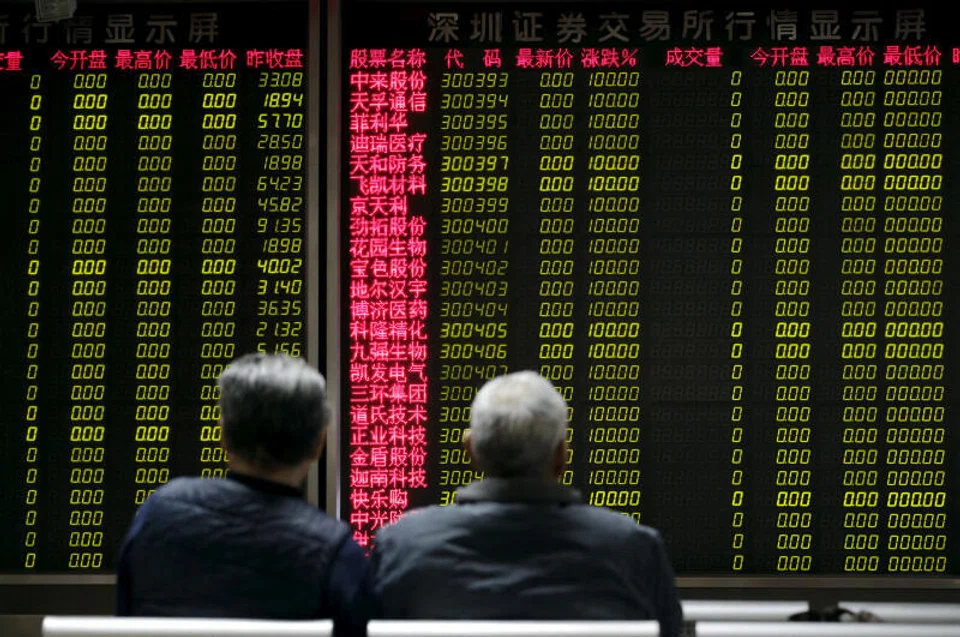
CHINA’S state-backed funds poured a record amount of money into the market on Friday (Nov 20) in another forceful attempt to stem a deepening sell-off.
Inflows into the nine exchange-traded funds (ETFs) known to be actively traded by the so-called national team totalled 90 billion yuan (US$13.5 billion) on Friday, according to data compiled by Bloomberg.
That surpassed the previous high of 87 billion yuan during the rout in April 2025 spurred by US tariffs. The Harvest CSI 300 ETF drew a record 23 billion yuan, while the ChinaAMC SSE 50 ETF attracted an all-time high of 21.7 billion yuan.
Beijing has intensified efforts to restore confidence after a months-long rout pushed the CSI 300 Index into a bear market, stepping up ETF purchases and easing margin-financing rules.
The measures have yet to put a floor under the market, with various indicators suggesting investor sentiment has failed to improve despite headline benchmarks being propped up with national team buying.
“I’m not sure we’ve hit rock bottom,” said Li Ying, a fund manager at Shanghai Zhenying Investment Management.

“Turnover has shrunk dramatically, but we haven’t seen the widespread margin calls typical of historical troughs, and some of the remaining trading activity is still being supported by the national team.”
On Sunday, authorities lowered the minimum requirement for investors buying securities with borrowed funds to 80 per cent from 100 per cent.
Still, the onshore benchmark fell as much as 1.3 per cent on Monday. The gauge has fallen in all but two weeks since August.
SEE ALSO




Market breadth remained weak, with the share of stocks trading above their 200-day moving averages slumping on Friday to just 8 per cent in Shenzhen and 12 per cent in Shanghai, the lowest since just before Beijing’s sweeping stimulus package in September 2024.
Technical indicators also show that losers are increasingly outnumbering winners.
Purchases of ETFs by the national team have mostly been confined to late-session buying that supports headline indices such as the CSI 300 while providing little lift to the broader market.
That contrasts with other parts of the market that typically receive less state support, with the small-cap CSI 2000 Index tumbling 14 per cent last week amid the global sell-off.
Short positions have climbed to around 30 billion yuan, the highest since July 2024, when regulators imposed new restrictions on short selling and made the trade more expensive.
While securities lending from China Securities Finance has yet to resume, the outstanding value of short trades has continued to rise, reflecting growing demand for hedges as the market’s sell-off deepens.
Meanwhile, leveraged buyers are pulling back. The outstanding balance of margin trades dropped by 1.9 per cent on Friday, the fastest pace of decline since Jul 20.
Authorities have also cut borrowing costs for corporate share buybacks and provided liquidity for financial institutions to increase stock purchases. But take-up of the buyback facility has remained muted. BLOOMBERG
Decoding Asia newsletter: your guide to navigating Asia in a new global order. Sign up here to get Decoding Asia newsletter. Delivered to your inbox. Free.
Share with us your feedback on BT's products and services