

Chinese markets to remain shaky as investors study Xi’s leadership reshuffle
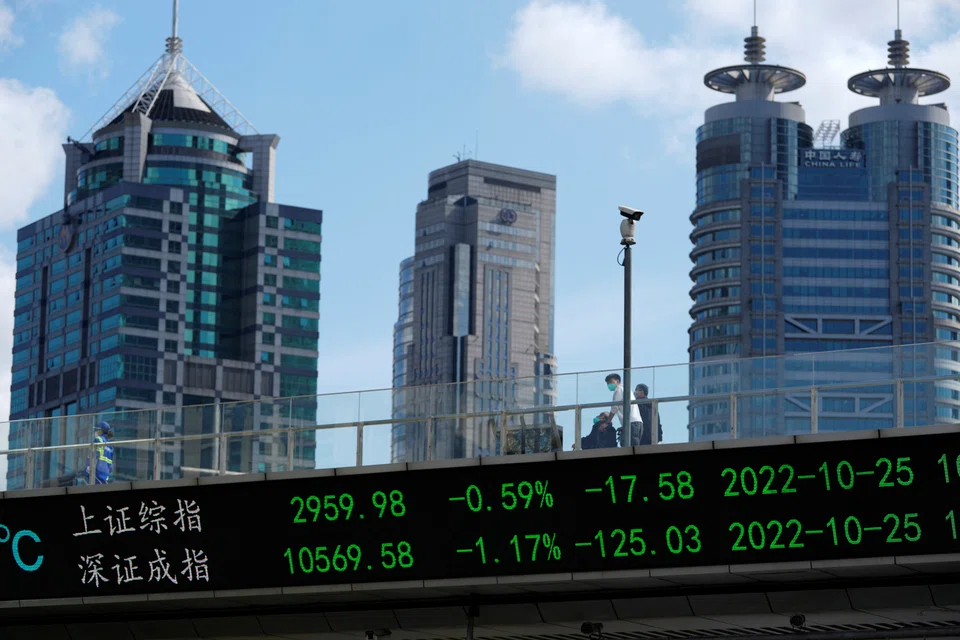
CHINESE markets could remain volatile in the coming weeks as investors – particularly those outside of Asia – continue to parse what Beijing’s new leadership has in mind for China’s economy.
Investors started picking up Chinese stocks on Tuesday (Oct 25) after a global sell-off a day earlier. In Hong Kong, where several mainland Chinese companies are listed, the Hang Seng China Enterprises Index was up 1.29 per cent at Tuesday’s close, while the Hang Seng Tech Index closed 2.96 per cent higher. The Hang Seng Index and the mainland China-based CSI 300 Index were level from Monday’s rout.
Some long-only investors in the region have been buying Chinese stocks including technology names, said Andy Maynard, the global head of equities at investment firm China Renaissance. Yet, market swings are likely to continue as investors from elsewhere try to familiarise themselves with the new Chinese leadership’s thinking.
“I’m very positive that in the short term we’re going to be experiencing volatility until foreign institutions or peripheral players have finished capitulation,” Maynard told The Business Times.
Chinese stocks’ slight recovery on Tuesday comes after a global sell-off in the previous session, when investors were uneasy over Chinese President Xi Jinping’s tightened grip on power. At the end of the Chinese Communist Party’s twice-a-decade congress last Sunday, Xi was voted in for an unprecedented third term and unveiled Beijing’s top governing body stacked with his loyalists.
Even though many of these moves and policy directions were well telegraphed before the meeting, market participants told BT that investors were still surprised by some of the personnel changes. Others expressed disappointment at the lack of easing of Covid-19 policies and economic support from Beijing.
That could mean that macroeconomic and political concerns could cloud investors’ decisions over Chinese stocks in the coming weeks.
A property market slump is also weighing on investors’ confidence in China as the sector is a major driver of economic growth. Chinese firms’ US dollar-denominated bonds continued to sell off on Tuesday as growth remains muted and exports slow.
“Investors at this point should assess their direct and indirect exposure to China and adjust accordingly depending on their risk tolerance, because clearly the macroeconomic and politics are not at the moment supportive of China assets,” said Pietro Ventani, a macro investment strategist at Singapore-based Swerve Advisors.
All these market gyrations in Chinese assets could ease somewhat next week, when the US Federal Open Market Committee (FOMC) is expected to announce its decision on how aggressive the Federal Reserve would hike rates, said Redmond Wong, Saxo Capital Markets strategist.
“Once the gap between the outcome and some investors’ prior expectations about the Communist Party of China’s national congress has been adjusted … the Hong Kong and mainland China stock markets may be able to sustain the bounce for the coming days (until the FOMC decision)“, he said.
“The risk premiums for all China assets have risen so not only equities but bonds and currency need to adjust to that,” he added.






