A different Japan is emerging in Asia
The global geopolitical chaos is forcing a normalisation of the country’s defence posture
FOR a nation where change comes at a glacial pace, the past week has been something of a headspinner for Japan.
Rather than a series of isolated moves, what is emerging is a clear pattern: Japan is no longer merely adapting within its post-World War II constraints but rather steadily and deliberately shedding them.
The drumbeats on the strategic front kept up by the government of Prime Minister Sanae Takaichi – the nation’s first woman leader – have been unmistakable. They include receiving a huge delegation of Nato ambassadors seeking to build closer ties with Japan, the lifting of restrictions on exports of advanced arms for the first time since World War II, and a massive deal to sell advanced frigates to Australia.
For those who follow Japan’s steady progress from a pacifist state that renounced war to one that has gradually expanded its remit over the years, these steps suggest an unambiguous direction. They are the latest in a series of moves that include the defence agency being renamed as a defence ministry, the lifting of the 1 per cent of gross domestic product (GDP) cap on defence expenditure, and the reinterpretation of its Constitution to allow for the Japanese military to come to the aid of close allies if the situation threatens Japan’s security.
A regional power arises
Japan has made a clear choice to step forward. Takaichi has drawn her lines. She has suggested that Tokyo would treat any attack on Taiwan as a survival issue for itself, thus meriting military intervention.
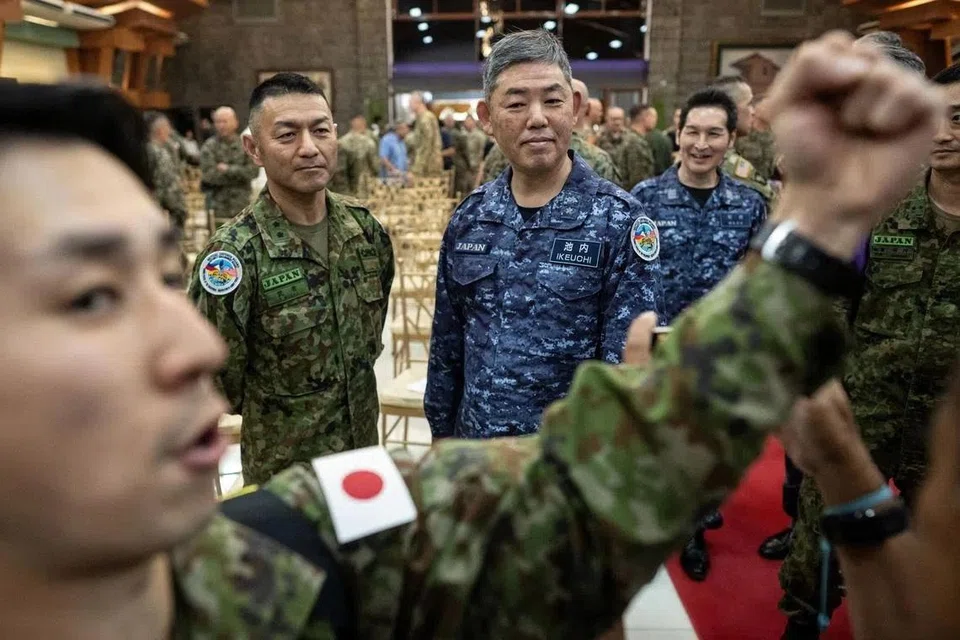
Beyond rhetoric, Tokyo is also testing the boundaries of what its forces can do abroad. This week, at the annual Balikatan US-Philippines joint exercise, Japan showed up as a full participant for the first time, sending some 1,400 Self-Defense Forces personnel to perform direct operational roles, including test-firing surface-to-ship missiles. It is Japan’s largest overseas conventional troop deployment since World War II.
Perhaps the most consequential shift lies in defence industrial policy. Tokyo’s decision to relax its ban on exporting lethal weapons such as fighters, missiles and destroyers, once politically unthinkable, opens the door to becoming a serious supplier of military hardware.
The recent US$10 billion (S$12.8 billion) agreement to sell 11 Mogami-class stealth frigates to Australia underscores that ambition and reflects a broader goal: building a sustainable military-industrial base that can support advanced research, including the next-generation fighter programme with partners such as the UK and Italy (Canada too is in talks to join).
Defence tech cooperation with Nato also advances that endeavour, especially since the Europeans are committed to raising defence spending to 5 per cent of GDP, and are keen to diversify their weapons sources.


Still, if military might is mostly multiplied through allies and partners, the toughest part of Japan’s journey lies in the search for new security partnerships. The Quad, the quasi security grouping that Japan shares with the US, Australia and India, is moribund at leadership level. US President Donald Trump has railed at Japan and Australia for not helping out in his war against Iran, even as he has moved marine expeditionary forces stationed in Japan to prosecute that conflict in western Asia.
Bad reactions?
Beijing isn’t thrilled by Japan’s evolving posture, naturally. A recent Xinhua commentary slammed Japan’s increased military spending, relaxed export rules and closer cooperation with Nato as “a clear departure from its pacifist, post-war principles”.
But Beijing’s objections have limited effect. The strategic environment that once constrained Japan has shifted. With an increasingly unpredictable US, the Europeans are recalibrating and Asian partners are hedging.
Canadian Prime Minister Mark Carney came close to describing his country’s close economic ties with the US as a curse. Since taking office, Carney has also implemented a “rebuild, rearm and reinvest strategy” that seeks to diversify defence ties to include Japan, Australia and Britain.
Britain itself will soon announce legislation meant to ignite a path towards reintegration with Europe – if not formally, at least through adopting matching policies in a strategy described as “dynamic alignment”. Germany just published its first-ever military strategy after World War II, vowing to rapidly scale up troop numbers and military readiness.
And France, which just three years ago put the brakes on Nato’s plans to set up a liaison office in Tokyo, has dialled back on much of its reservations. Who knows, the Tokyo liaison office could soon be a reality – enthusing Japan, which has been pushing for a closer linking of the European and Indo-Pacific theatres.
Japan was among the first to moot a “coalition of the willing” to ensure safe navigation in the Strait of Hormuz once the fighting ends, saying it would contribute two frigates for the mission.
In Asia, India, which has in recent years emerged as a major defence partner of the US, is making its own adjustments; this week, New Delhi and Moscow announced a defence agreement that permits each to station up to 3,000 troops, 10 aircraft and five warships in each other’s territories.
Seen in this light, Tokyo is simply adjusting accordingly. Upsetting China is a small price to pay. Still, what can one realistically expect from the nascent Japan-Nato link?
“In realpolitik terms, Nato amounts to little more than a church choir for Tokyo,” sniffs a senior figure in Japanese foreign policy circles. “What matters is the song they have come to sing, because it raises the bar Xi Jinping must clear if he is to realise his ‘China Dream’ of annexing Taiwan.”
Also, says a veteran Asian diplomat with strong connections to the Elysee Palace, Nato is splintering steadily over Ukraine and Israel, and needs credible new partners.
Japan-watchers have long suspected that it was only a matter of time that Tokyo showed its hand. It was just looking for the right timing to unveil what it already has. The “helicopter carriers” it built are now ready to host F-35B stealth fighters, after strengthening their decks.
And back in 2013, the Shinzo Abe government initiated talks with the Indian government to sell it advanced ShinMaywa US-2 amphibious military aircraft, verbally camouflaging them as “search and rescue” planes, though that deal did not materialise due to cost issues.
Regardless, in Japan, there is a clarity of direction that stands in contrast to the strategic confusion wrapping so much of the rest of the world. THE STRAITS TIMES
Decoding Asia newsletter: your guide to navigating Asia in a new global order. Sign up here to get Decoding Asia newsletter. Delivered to your inbox. Free.
Share with us your feedback on BT's products and services