

Fed to hold rates as political storm intensifies around Powell
The decision is likely to amplify the outrage of US President Donald Trump, who wants them slashed
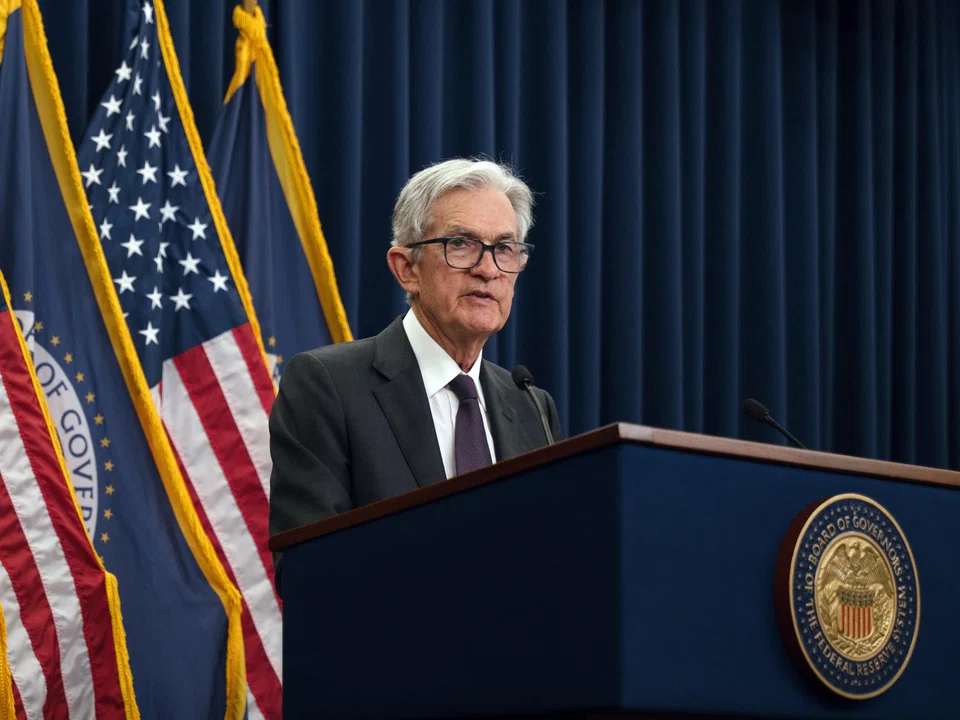
[WASHINGTON] The US Federal Reserve is widely expected to halt its interest-rate-cutting cycle this week, as a steadier job market restores a degree of consensus at the central bank after months of growing division.
Several officials, including some close to Fed Chair Jerome Powell, have been signalling that rates are now in the right place – after three consecutive cuts – to shore up employment and still keep downward pressure on inflation.
“They are now essentially within the strike zone of neutral estimates,” said Josh Hirt, senior US economist at The Vanguard Group, referring to the level where rates will neither restrain nor stimulate the economy.
This “brings about more caution, less urgency” for more cuts, he added.
The meeting offers Powell a chance to direct attention away from the political and legal dramas engulfing the Fed, and back to the central bank’s core job of controlling inflation and maximising employment.
Any respite may prove short-lived. The expected decision to hold rates is likely to amplify the outrage of US President Donald Trump, who wants them slashed.
The statement by the Federal Open Market Committee (FOMC) is due at 2 pm on Wednesday (Jan 28) in Washington, and Powell will address reporters at 2.30 pm.
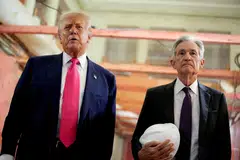
His remarks will be scrutinised for hints about how long the Fed might stay on hold, what could tilt the balance back towards cuts – and whether he has any new moves up his sleeve in the fight with Trump.
‘Not as urgent’
On the economic front, fresh data helped ease the tensions that tore the FOMC in opposite directions in recent months.

A sharp slowdown in hiring spooked officials, who worried the labour market might be near a tipping point.
But another camp remained wary of inflation – and pushed back more vociferously with each rate cut.
By December, Powell had a near-revolt on his hands, with as many as eight regional Fed presidents in opposition. The split was exacerbated by a lack of data due to the government shutdown.
Recent readings have taken some of the edge off the debate. Underlying consumer-price inflation for the year until December came in at a less-than-expected 2.6 per cent, helping settle the nerves of policy hawks.
After rising to a four-year high of 4.5 per cent in November, unemployment has ticked back down. Other labour-market gauges also offered the reassurance that there is no wave of layoffs in sight, even if hiring is sluggish.
Yelena Shulyatyeva, senior US economist at the Conference Board, said: “Overall, the situation is not so urgent as to require any Fed policy action.”
She remains more worried about jobs than inflation, but sees the labour market in a “fragile equilibrium” for now, with gains concentrated in a handful of industries.
Wall Street shift
Investors in the US$30 trillion US Treasury market have positioned for an extended hold on rates.
Swap contracts show the next cut is now expected in July, with the potential for another towards the end of the year. Wall Street analysts have pushed their 2026 rate-cut bets into the later part of the year – or, in JPMorgan’s case, scrapped them entirely.
“There is really no convincing argument that the Fed needs to really do anything here,” said Gregory Faranello, head of US rates trading and strategy for AmeriVet Securities. “They are on hold, short term.”
Not every policymaker has been placated.
Fed governor Stephen Miran, who is on unpaid leave from his post as a senior adviser to Trump, has called for 150 basis points in cuts in 2026. Vice-chair for supervision Michelle Bowman said officials should avoid signalling the central bank will pause the easing cycle.
But the pair appear isolated. Other policymakers who have spoken since the December gathering have sounded comfortable with leaving rates where they are – including New York Fed President John Williams, whose views are seen as closely aligned with Powell’s.
Aside from his post-meeting press conferences, Powell has not spoken publicly on his policy views since Oct 14.
Even governor Christopher Waller, who back in June was the first Fed official to advocate for rate cuts, has toned things down. “Because inflation is still up, we can take our time,” he said on Dec 17, a week after the last meeting.
‘Unusual times’
While internal harmony has nearly been restored, there is plenty of external heat.
Powell’s post-meeting press conference will be his first public encounter with reporters, since he was served grand jury subpoenas related to a Department of Justice (DOJ) investigation.
The DOJ is probing the Fed’s ongoing building renovations, and Powell’s testimony before Congress in 2025 about the project.
The move has rankled several Republican lawmakers – and outraged Powell, who blasted the subpoenas as a direct threat to the central bank’s ability to set interest rates free from “political pressure or intimidation”.
His extraordinary response triggered speculation that he may choose to remain as a Fed governor, even after his tenure as chair expires in May.
By doing so, he would deny Trump another opening on the board of governors, and potentially undermine the ability of the next chair to influence rates.
The Fed chief is sure to get questions about his intentions come May – as well as the DOJ probe and the hearing he attended last week at the Supreme Court over the administration’s attempts to fire governor Lisa Cook.
The political squalls around the Fed are a sign of “unusual times” that could make rate meetings harder to call, said Darrick Hamilton, an economist at the New School for Social Research.
“I do not expect that is going to cause the current membership to steer differently than they otherwise would,” he said. Still, “pressure is there, and I suspect it will have an impact”. BLOOMBERG
Decoding Asia newsletter: your guide to navigating Asia in a new global order. Sign up here to get Decoding Asia newsletter. Delivered to your inbox. Free.
Share with us your feedback on BT's products and services
TRENDING NOW

Once staunchly pro-China, Malaysian Chinese businesses are now distancing themselves from Beijing

Looking beyond looming CEO succession, should UOB potentially pursue a transformative merger?

Could stablecoins be the future of money?

Grab CEO’s wife Chloe Tong on life with Anthony Tan and finding her purpose

