Fed will wait out war, monitor oil shock impact before acting on interest rates
The US central bank hinted that it may not cut rates until the fog from the Iran war has cleared
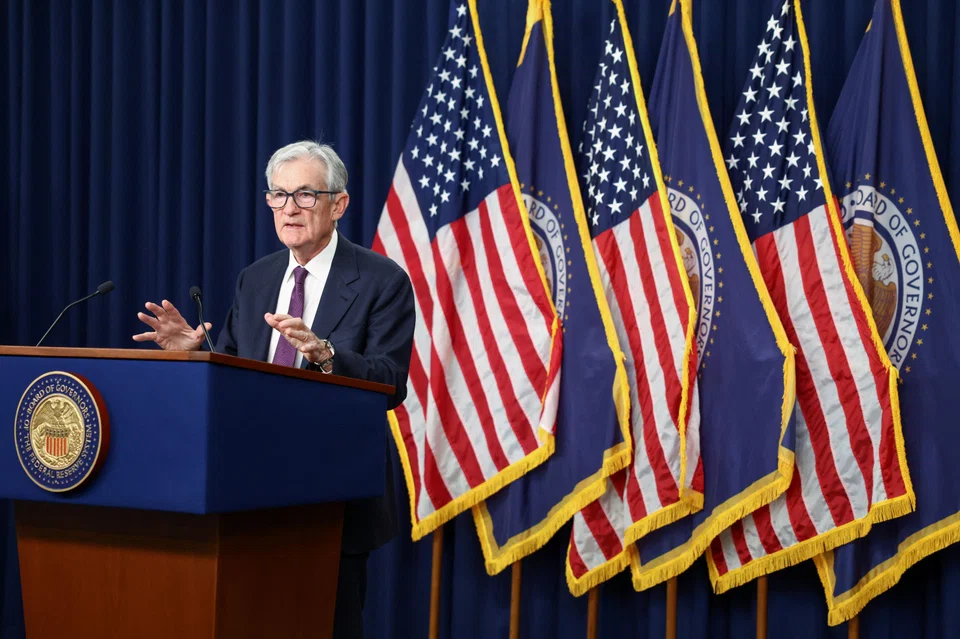
STOCKS fell after the Federal Reserve held rates steady as expected on Wednesday (Mar 18), with the central bank chair Jerome Powell hinting that the US central bank may not cut rates until the fog from the Iran war has cleared.
The Fed left its benchmark rates unchanged in a range of between 3.5 and 3.75 per cent, and raised targets for both inflation and economic growth.
Officials left the median number of rate cuts anticipated this year largely unchanged at one to two cuts.
During his post-meeting press conference, however, Powell indicated that those predictions were merely placeholders while the central bankers waited, along with the rest of the world, to see how the ongoing Iran war will play out.
He said that the Fed would need more clarity on how long the spike in oil prices would last and whether this will cause a prolonged increase in fuel, freight and product prices.
Typically, Powell said, economists “look through” oil shocks because central-bank policy moves much more slowly than energy markets.
But the Fed could be forced to respond if a surge in petrol prices causes either an increase in inflation expectations or a slowdown in consumer spending.
“Powell was extremely vague on how the Fed would respond to the war, repeatedly refusing to make conjectures on whether inflation or employment effects would dominate,” said economists at brokerage Standard Chartered, in a note to clients.
They also highlighted Powell’s frustration at the stubbornness of services inflation, noting that he was “very explicitly conditioning further policy rate cuts on inflation moving closer to target”.

The Fed’s biggest fear is that people begin to view inflation as a permanent feature of the US economy and change their behaviour accordingly. That’s when the cycle of wage demands and price hikes becomes vicious.
The only way to break such a cycle would be rate increases. Powell noted that the vast majority of the board didn’t anticipate the next move being a rate increase, but he did not rule that out completely.
He reiterated the tension between the Fed’s two mandates. “We are balancing these two goals, where the risk to employment is to the downside, which calls for cutting rates, and the risks to inflation are to upside, which calls for raising rates,” he explained.
In February, the producer price index, a measure of factory-gate inflation, rose 0.7 per cent from a month earlier, a far hotter reading than economists had anticipated. At the same time, the February payrolls report indicated an uptick in unemployment.
Wild cards in the mix
And that was before the Iran oil shock. The oil shock will “put some downward pressure on spending employment and some upward pressure on inflation”, Powell noted.
Oil futures have shot up above US$105 a barrel in London as Israel continues to attack Iranian energy facilities, triggering Iranian retaliation against energy infrastructure throughout its neighbouring Gulf nations.
American drivers and fliers will soon feel the shock, too. Oil futures have risen by 70 per cent in the US since the start of the year.
The last oil shock of this magnitude, the 1973 Middle East embargo, triggered a decade of stagflation. Powell said that it was premature to draw parallels with that era when unemployment rates and interest rates were twice what they are today.
Still, half a century later, the global economy still runs on Middle Eastern oil. That means the globe is once again heading in a stagflationary direction. The Iranian regime has warned that its blockade of the Strait of Hormuz will continue as long as it is capable of attacking ships in the choke point.
The other wild card for Fed policy, of course, is the central bank’s battle with the White House.
The Fed chair remains under investigation by the Department of Justice for alleged perjury, and senators have warned that they will not confirm his successor, Kevin Warsh, until the Trump administration drops the investigation.
Powell added that he would continue as interim chief until Warsh is confirmed. He also said that he would not step down from the Fed until the investigation was resolved.
The central banker, whose last meeting as chair comes at the end of April, sounded weary as he delineated the shocks that he has steered the Fed through. There was the pandemic, the tariff shock, the oil shock and the Fed-probe shock.
At times, Powell sounds like the owner of a porcelain-china shop, watching a bull charge around the store and knocking into his carefully balanced antiques.
The broad S&P 500 fell 1.4 per cent after the Fed’s statement and is now down roughly 3 per cent for the year to date. Those are relatively modest losses. The domestically focused Russell 2000 index has entered correction territory, however.
One thing is clear: The Fed is not coming to the stock market’s rescue any time soon, even if the sell-off continues.
Decoding Asia newsletter: your guide to navigating Asia in a new global order. Sign up here to get Decoding Asia newsletter. Delivered to your inbox. Free.
Share with us your feedback on BT's products and services