French bosses fear far right's vague economic plans
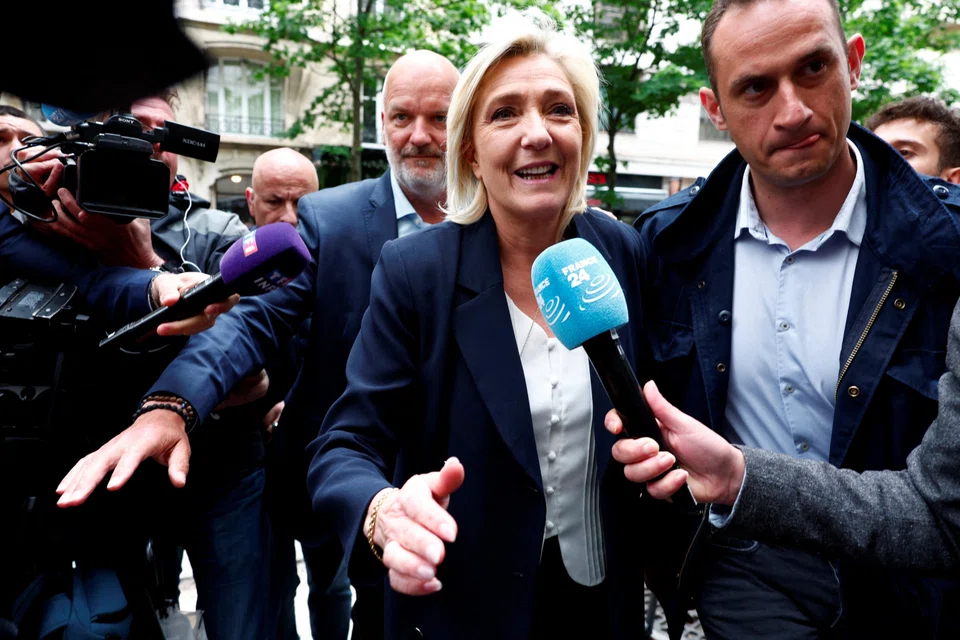
FRENCH business leaders have been pitched into fresh uncertainty by snap elections called by President Emmanuel Macron that risk strengthening the far right.
Federations are treading lightly with their public comments, aware that they could be sitting across the table from National Rally (RN) ministers if the party scores a major breakthrough in the Jun 30 and Jul 7 ballots.
Local business group U2P would “respect the people’s choice, but the RN has to say more precisely what it proposes on questions with a tax, social and economic effect on small firms”, its chief Michel Picon said.
At the last presidential election in 2022, the outfit had warned that RN chief Marine Le Pen’s manifesto promises “would have bad consequences for business”, he recalled.
At stake are issues such as returning to an official retirement age of 60 – raised to 64 in a wildly unpopular Macron reform last year – and a still-harsher crackdown on immigration.
“What does this mean for people working for us today?“ Picon asked.
“We’re business players who don’t get involved in politics,” said Thierry Cotillard, head of the Mousquetaires/Intermarche supermarket chain.
But “whoever the politicians are, we will fiercely defend our positions”, he warned.
‘Stick their neck out’
Centrist Macron’s time in office has been marked by reforms aimed at making life easier for businesses and high-profile courting of foreign investment.

By contrast, “we know nothing” about the RN’s plans, said the head of one major European industrial company’s French subsidiary on condition of anonymity.
“We’ve just seen the beginnings of a reindustrialisation for 10 years, with supply-side policies bearing fruit. Will all that be kept up?“ he asked.
Macron’s finance minister, Bruno Le Maire, on Tuesday (Jun 11) urged businesses to “stick their neck out” against the far right.
Groups including the big companies’ federation Medef should “clearly say what they think of the different parties’ economic programmes” and warn about “the cost of Marine Le Pen’s Marxist plans”, he added.
Without naming any party, Medef told AFP that “a new campaign is starting in which we do not share certain political visions, which are incompatible with business competitiveness and prosperity for our country and fellow citizens”.
The CPME small business group called for supply-side policy, greenhouse emissions reduction and welfare state reforms to continue.
It also warned about France’s staggering debt pile of three trillion euros (S$4.4 trillion), which ratings agency Moody’s said on Monday risked a downgrade due to the “potential political instability” from the upcoming election.
“Anyone taking on costly reforms without taking this element into account would be exposing France to a major risk,” the CPME said.
The head of a firm on France’s heavyweight CAC 40 stock market index, also speaking on condition of anonymity, said there was no reason to panic as the RN winning was “not a done deal”.
Even if party did, the person said, “everyone wants to upend things, but once in power, being responsible for things will make you responsible”.
Low-carbon electricity ‘essential’
One sector with particular fears for a far-right victory is renewable energy, which has already been waiting for months on a government road map stretching to 2035 and including items such as sites for massive offshore wind parks.
“What’s going on is serious,” said Jules Nyssen, president of France’s renewable energies union.
“We’re in a state of total instability, just when we need legal guarantees and clarity,” he added, saying “it’s going to cost us heavily”.
“We have a clear road map that we need to eliminate carbon emissions,” said Nicolas de Warren, president of the Uniden association of big industrial energy users.
“What’s essential for us is access to low-carbon electricity at competitive prices, whether it’s nuclear or renewable.”
In 2022, Le Pen promised a fleet of around 20 new nuclear reactors – although her 2031 timetable for delivering half of those was seen as unrealistic.
But she is also a committed opponent of wind energy, vowing a moratorium on new construction and the gradual dismantling of existing parks – plans incompatible with France’s climate commitments.
“The laws of economics and energy will catch up” with the RN if it comes to power, one electricity provider said, requesting anonymity.
“We need more cheap energy. Building nuclear takes 10 to 15 years. What do we do while we wait? And how do we attract battery factories if we don’t want any more electric cars?“ he added, citing another of Le Pen’s bugbears. AFP
Decoding Asia newsletter: your guide to navigating Asia in a new global order. Sign up here to get Decoding Asia newsletter. Delivered to your inbox. Free.
Share with us your feedback on BT's products and services