

AI’s next frontier? China and the US look to space in the computing race
It marks an extension of great-power competition from terrestrial cyberspace into Earth’s orbit

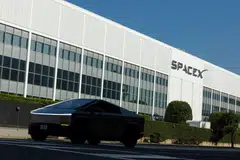
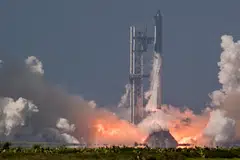
[BEIJING] When SpaceX founder Elon Musk unveiled plans earlier in 2026 to eventually launch up to one million data-centre satellites into space, he said these would overcome one of artificial intelligence’s biggest constraints on Earth: the enormous amounts of land, electricity and water needed to power AI.
The proposal by the world’s first trillionaire ignited excitement among investors, but also prompted scepticism about whether such an ambitious vision was scientifically and economically feasible.
In early June, China signalled it was pursuing its own ambitions in the field. It approved the establishment of Beijing’s first space computing innovation centre to bring together rocket and satellite manufacturers, semiconductor firms and AI companies to build orbital computing networks.
As AI creates unprecedented demand for computing power and satellites generate ever-growing volumes of data, tech giants and governments are exploring whether some of tomorrow’s AI infrastructure could transcend Earth.
Often described as orbital data centres or space computing, the emerging field has become a hot topic in the AI and commercial space sectors. SpaceX’s blockbuster initial public offering (IPO) on Jun 12, with a valuation of around US$1.8 trillion, is expected to help bankroll the company’s long-term ambitions in orbital computing and has only intensified interest.
But the field remains in its infancy, with unproven commercial potential, said analysts.
Even so, both China and the US are increasingly viewing space computing as another frontier in their competition over the infrastructure for next-generation AI.
Marina Zhang, an associate professor at the University of Technology Sydney (UTS), said the central issue is no longer simply who develops the best AI models or the most advanced chips.
“It is increasingly about who controls the physical, computational and communications infrastructure on which AI systems will operate at a global scale,” said Zhang, who researches the intersection of technology and geopolitics.
SEE ALSO


It marks an extension of great-power competition from terrestrial cyberspace into Earth’s orbit, she said.
“It is likely to intensify competition for scarce orbital and spectrum resources, broaden the meaning of national security and digital sovereignty, and contribute to a more fragmented global digital economy,” she added.
What is space computing?
For decades, satellites functioned much like cameras in the sky, albeit very high-tech and expensive ones, capturing vast amounts of photos and data that were sent back to Earth for analysis.
However, satellites gather far more information than Earth can handle given its bandwidth limits, and much of the collected data is either delayed or never used.
But advances in AI are prompting a rethink. Rather than merely collecting data, space computing can process it directly in orbit and send only the most relevant, refined information to users on the ground.
Proponents of space computing have argued that it could alleviate the unprecedented strain on land, electricity and water imposed by data centres on Earth, as satellites could use solar or possibly nuclear energy for power in orbit.
Instead of sprawling Earth-bound buildings full of graphics processing units (GPUs), powered and cooled by massive infrastructure, thousands or even millions of individual satellites could function in their place, circling the planet. Each would have its own solar panels and radiator arrays for cooling, and be interconnected via lasers.
Advances in launch technology, satellite manufacturing and AI chips have made orbital computing increasingly feasible.
In March, Nvidia said it would manufacture GPU chips specifically for space-based computing.
Svetla Ben-Itzhak, assistant professor of space and international relations at Johns Hopkins University’s School of Advanced International Studies, said: “In the US, some of the key concerns involve the energy and infrastructure requirements of artificial intelligence and large-scale commercial computing.
“In China, these concerns exist as well, along with broader goals related to technological self-reliance and national development.”
Aside from its commercial uses, the national security implications of space computing are drawing attention.
Clayton Swope, deputy director of the Aerospace Security Project at the Center for Strategic and International Studies (CSIS), a US think-tank, said the most obvious national security advantage from space computing is the ability to make sense of Earth observation data faster.
“That has strategic military and defence benefits in terms of intelligence, surveillance, reconnaissance, tracking and targeting,” he said.
Johns Hopkins University’s Ben-Itzhak said the technology remains at an early stage and its economic viability has not yet been proven.
Despite space computing’s uncertain commercial potential, the strategic national security implications are genuine because countries that control future space-based computing infrastructure could gain greater autonomy and influence over global information networks, Ben-Itzhak said.
US-China competition
Analysts said China and the US increasingly view computing power as central to economic competitiveness, military capability and digital influence, but approach it differently.
UTS’ Zhang said the US remains ahead of China in frontier AI chip development, hyperscale cloud platforms, launch capabilities and capital markets.
China, meanwhile, is still working to reduce its vulnerabilities through domestic chip development, expanded cloud capacity and state-backed industrial coordination, she said.
Space computing could, in a way, represent a “detour catch-up”, she added. “It opens an additional frontier in which China may build a stronger relative position over time.”
That strategy is taking shape.
China in May 2025 launched its first batch of 12 computing satellites that form the Three-Body Computing Constellation and plans to deploy up to 1,000-plus satellites.
In February, China said the constellation successfully completed nine months of orbital testing, demonstrating the ability to run large AI models directly on satellite hardware.
Zhang said: “The Three-Body project provides an early test bed for distributed computing, laser communications and space-ground integration. But the US retains a substantial advantage in absolute computing performance, advanced accelerators and the surrounding AI cloud ecosystem.”
Commercial companies are also racing to establish an early foothold.
Lan Tianyi, founder of Beijing-based space consultancy firm Ultimate Blue Nebula, said there has been no clear policy direction from the country’s top leadership, likely because the technology is still in its early stages.
However, companies are experimenting with different technical approaches and commercial models, like “a hundred flowers blooming”, he said, using a Chinese idiom. He expects more demonstration satellites for space computing to be launched over the next two years.
Among them is Chinese commercial space company STAR.AI, which plans to launch its first two computing satellites by the end of 2026 as part of a proposed constellation of 1,000 satellites.
STAR.AI senior vice-president Wang Pei said his company sees a “historic window of opportunity” in space computing.
While China’s pace of development in AI models and applications has already matched – and in some areas surpassed – that of the US, the supply of advanced GPU chips remains heavily constrained by geopolitics, he said.
Space computing, said Wang, offers a way to break through these constraints.
“The idea is to build a space computing network based on domestically developed chip architecture, allowing China’s strengths in AI models and applications to be combined with an entirely new infrastructure that does not rely on imported hardware,” he said.
Significant hurdles ahead
Whether space computing becomes the next frontier of AI infrastructure will depend not only on technological progress, but also on its ability to demonstrate clear commercial value.
Ultimate Blue Nebula’s Lan said Chinese companies venturing into space computing face three major challenges: developing viable business models, overcoming the engineering challenges of building the infrastructure and achieving global expansion.
Lan said the next five years will be critical.
“Although China has made a good start, solving these three challenges will be crucial if it is to move further ahead or even help define the direction of the industry,” he said.
Zhang said the late 2020s and early 2030s will likely prove decisive, with launch costs, reusable rockets, satellite manufacturing, in-orbit networking and international standards beginning to determine which countries secure the strongest positions.
The technology faces other hurdles. Unlike terrestrial data centres, which can be upgraded as chips become more powerful, satellites in orbit are far harder and more expensive to upgrade or repair.
Johns Hopkins University’s Ben-Itzhak said that space, being an extremely harsh environment, poses technical challenges, as electronic systems must withstand radiation and other environmental hazards. Cooling large computing systems in the vacuum of space will also be difficult, as heat does not dissipate in the same way as it does on Earth, she added.
Critics have also warned that deploying millions of satellites could worsen light pollution, increase orbital congestion and raise collision risks, while more frequent launches could come with environmental costs.
But the biggest hurdle, said CSIS’ Swope, is not whether orbital computing is technically possible, but whether customers will pay for it.
Experts said it is not clear whether savings in energy consumption or other operational benefits are sufficient to offset the substantial costs associated with the launch, maintenance, communications, insurance and system replacement of orbital computing systems.
A new report by Wood Mackenzie estimated that a space-based data centre costs about three times as much as an Earth-based equivalent. It said a hypothetical one-gigawatt orbital data centre would cost an estimated US$170 billion, with launch and satellite costs accounting for about US$100 billion of that total.
Launch costs would need to fall by 70 per cent to make them cost-competitive, added the report. That is one reason the industry is closely watching SpaceX’s efforts to develop fully reusable Starship rockets.
“Can it be done cheaply enough that it’s worth buying? And who would buy it if it’s more costly than doing compute on Earth?” said Swope. THE STRAITS TIMES
Decoding Asia newsletter: your guide to navigating Asia in a new global order. Sign up here to get Decoding Asia newsletter. Delivered to your inbox. Free.
Share with us your feedback on BT's products and services