



Asia on front line of economic risk if AI boom turns to bust: study
The region is ‘particularly exposed’ as it is at the centre of global supply chains, it adds

[SINGAPORE] Asia’s powerhouse economies are more at risk than most from a potential artificial intelligence bust, which could undercut surging exports and send shockwaves across markets, a new study found.
The region is “particularly exposed” because it is at the centre of global supply chains and “increasingly integrated into AI-related financial markets”, the Asean+3 Macroeconomic Research Office (AMRO) said in a report on Monday (Oct 5) that covers South-east Asia plus China, Japan and South Korea.
“A disorderly correction could therefore propagate through multiple channels”, from trade to capital flows and financing costs.
The global rush to build AI has propelled record-breaking exports in many Asian economies, which make the chips and other high-tech products needed for data centres.
But there are mounting questions about the sustainability of the AI boom, with investors concerned about high valuations for tech companies and circular deals in which they appear to be funding each other.
The Asean+3 region accounts for two-thirds of the growth in global AI-related trade, according to AMRO.
The group estimates that a slowdown in demand could cut as much as 1.5 percentage points from economic growth in 2027, currently forecast at 4.1 per cent – making it by far the biggest risk factor.
Other risks highlighted in the report include prolonged disruption in the Strait of Hormuz – with a potential impact of 0.6 percentage point – and El Niño weather disruptions.
Some of the region’s equity markets, like South Korea’s, are heavily concentrated on AI, exposing them in case of a drastic repricing.



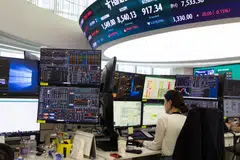
Other markets like Japan and Hong Kong have come to move closely in line with US AI and technology assets, meaning shocks could be transmitted even absent a domestic trigger, according to AMRO.
“A sharp correction in AI-related financial assets could spill over to the broader financial system through forced deleveraging and tighter credit conditions,” AMRO noted.
The group is monitoring a wide range of indicators to assess the likelihood of an AI correction, including company valuations, leverage, funding sources and underlying demand.
“There are some warning signals, but we would say that they are not grave yet,” its lead economist Runchana Pongsaparn said at a briefing on Monday. BLOOMBERG
Decoding Asia newsletter: your guide to navigating Asia in a new global order. Sign up here to get Decoding Asia newsletter. Delivered to your inbox. Free.
Share with us your feedback on BT's products and services






