



BMW’s first Asian head for Asia-Pacific sales wants to foster more talent from region
Ritu Chandy says staying agile is a key advantage for the German carmaker

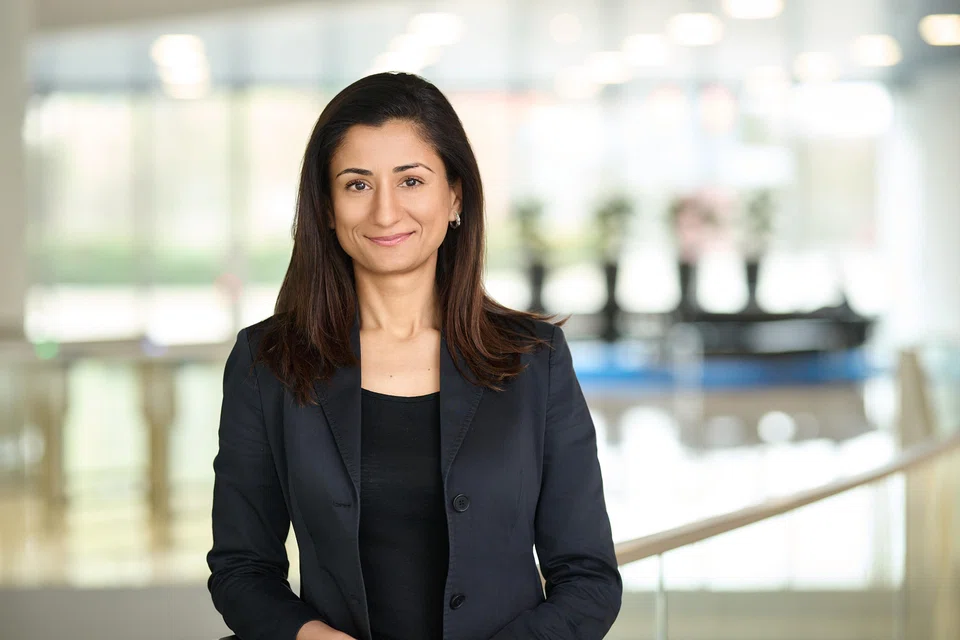
[SINGAPORE] Ritu Chandy is the first Asian to take up one of BMW Group’s most significant roles for this part of the world – and more.
In October 2025, Chandy became BMW Group’s sales region head for the Asia-Pacific, Eastern Europe, Middle East and Africa. This covers more than 60 markets and nearly 15 per cent of the German automaker’s total sales, though it does not include China.
“I suppose it is unique, as we have not had a non-European senior vice-president leading the region,” she told The Business Times in the first media interview in her new capacity.
Besides the core concern of increasing car sales, the 47-year-old Australian wants to increase the prominence of talent from the regions she is heading – including the Asia-Pacific.
She aims to foster local talent and champions from the region. “They know how business is done (in the Asia-Pacific)... They understand how BMW ticks, its DNA.”
Driving diversity
Chandy started at BMW Australia as an intern in 1998, while completing her degree.
She has spent most of her career at the company, including a stint in Singapore as chief executive officer of BMW Financial Services for Asia-Pacific, where she helped develop corporate finance and treasury aspects with the Republic as a regional hub.
Chandy credits her experience in Singapore and the Asia-Pacific as a crucial step in learning to manage diverse markets.
“We know that no two markets in Asean think the same way. It’s also been very revealing to see how business is done differently,” she said.
SEE ALSO




These markets also have hugely contrasting levels of development, especially in comparison to other parts of the world, but also unique demographics, tastes and regulatory environments.
Singapore and Thailand, for example, do business very differently, she noted, in the way that investors and partners work and relationships are built.
In contrast, European markets have many more fundamental common denominators among them.
“There is no ‘one size fits all’, and having an appreciation and respect for those differences itself makes the difference,” she said.
This means choosing what is best for each market, which could include the choice of software on board the car, for example.
Understanding those nuances also colours her approach to bringing up leadership talent.
“I (want to be) forging a path for a lot of local talent... I think being raised in (the) Asia-Pacific makes you a lot more aware of those differences,” said Chandy, who grew up in India and Australia.
The first new appointment under Chandy is of South Korean Yangye Kris Joo, who will become president and chief executive officer of BMW Group Thailand on Feb 1, 2026.
“(Kris) has been with the company over 20 years. She’s done literally every function you can do, so she really is a regionally grown talent.”

BMW is one of the more cosmopolitan carmakers in terms of management.
Milan Nedeljkovic, who will assume the role of BMW group CEO from May 2026, is Serbian.
Regionally, the leadership roles in Japan, South Korea and India are held by executives from those countries or with ethnic links to those markets.
Driving agility
Both Chandy and the regional leadership have their work cut out for them with the challenges ahead, though.
Like other German carmakers, BMW is facing competition from Chinese companies, which have not only flooded the mainstream segment, but also are positioning themselves as high-tech rivals with luxury ambitions.
German luxury carmakers have suffered in the China market on strong home-grown competition – and this has happened in the rest of Asia, too.
For 2025, Mercedes-Benz suffered a 21 per cent drop in Asia sales year on year (yoy), including China, to 747,000 units, amid an overall 10 per cent dip in sales to 2.2 million cars in 2025, compared with 2024.
Audi does not report figures for Asia, but its sales in China were down 5 per cent at 617,514, and overall sales fell 2.9 per cent to 1.7 million across the same time frame.
On the whole, BMW fared better than its competitors, with a 0.5 per cent yoy increase in deliveries to 2.5 million cars.
But BMW’s China sales for 2025 were down 12.5 per cent at 625,527, and its Asia sales decreased 9.3 per cent to 871,550.
The group attributed the dip to new market entrants, macroeconomic headwinds and a changing regulatory environment. Industry observers say China brands making major inroads into the Asia-Pacific are a key factor.
While BMW “admits and respects” what the Chinese competition is bringing to the industry, Chandy added that the true long-term competitiveness of those brands remains to be seen, especially with price wars that have shaken consumer confidence even in Asia.
On its part, BMW will continue to invest in its brand heritage, customer experience and service support, with a view to long-term stability.
A new hope
Chandy remains bullish, given that some major markets did well in 2025 even as BMW’s biggest bet in history could be coming to fruition.
Five out of the 10 major growth markets for the BMW brand were in her realm: New Zealand (30 per cent), India (15 per cent), South Africa (14 per cent), the Middle East (10 per cent) and Australia (5 per cent).
She attributes that growth to BMW’s diversified electrification strategy, offering electric vehicles (EVs) and retaining internal combustion engine power in hybrids, and plug-in hybrids, unlike some carmakers which went all in on EVs.
The Asia-Pacific is a “very varied picture”, which means diversified offerings are the key to success. While EVs are the future, adoption will not be a clear “zero to 100” progress, she said, which is why cars with combustion engines are still a crucial part of the group’s portfolio.
In 2025, the group delivered around 440,000 EVs, a 3.6 per cent increase yoy.
This year, however, is when the company’s biggest bet in its history may start to pay off.
That is Neue Klasse, a 10 billion euro (S$15 billion) product reboot that will spawn 40 new models in the next two years, and includes EVs with ranges of more than 800 km and advanced computing and software.
The first model in that range, the iX3, has nearly sold out its initial run in Europe last December, with BMW ramping up production to meet demand.
“The reception the iX3 has had so far internationally gives us confidence for the launch in the Asia-Pacific, where we expect the extended range and advanced software features to be a hit in this tech-forward market,” she said.
Decoding Asia newsletter: your guide to navigating Asia in a new global order. Sign up here to get Decoding Asia newsletter. Delivered to your inbox. Free.
Copyright SPH Media. All rights reserved.
TRENDING NOW

Britain’s mansion tax shows the difficulty of targeting wealth

Once staunchly pro-China, Malaysian Chinese businesses are now distancing themselves from Beijing

The only common thing in S-E Asia is that we all eat rice: Cisco’s Asean president

Singapore data centre operator DayOne opts for US IPO at likely US$20 billion valuation

