Global Enterprise logo
BROUGHT TO YOU BYsc logo

Businesses call for Hong Kong’s eased Covid-19 measures to be dropped entirely

Travellers are deterred by the new rules, and current steps not enough to reinvigorate the economy
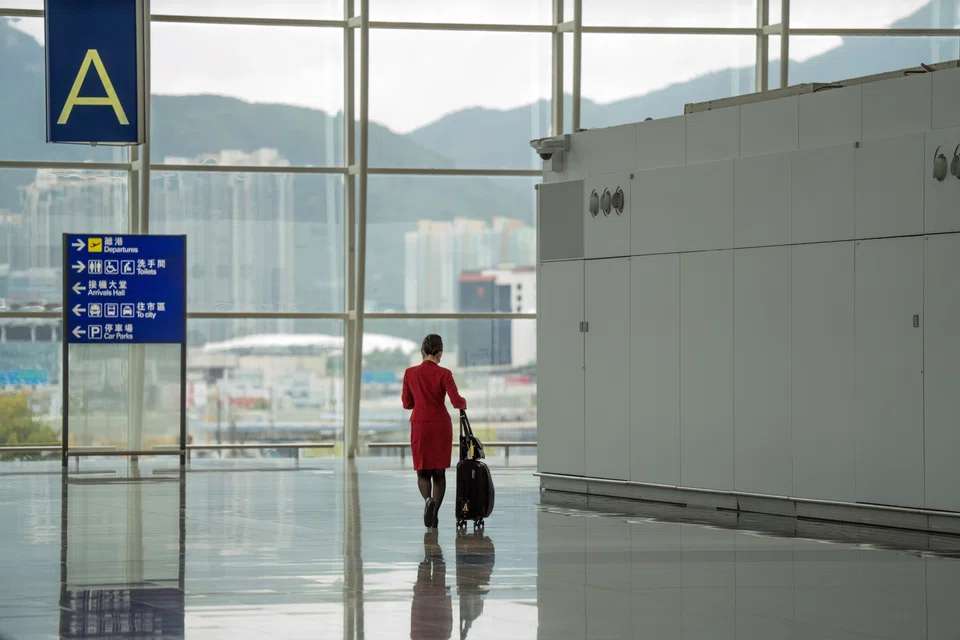
    • A flight attendant for Cathay Pacific Airways at Hong Kong International Airport.
    • A flight attendant for Cathay Pacific Airways at Hong Kong International Airport. PHOTO: BLOOMBERG
    Published Thu, Oct 6, 2022 · 05:50 AM

    Some businesses in Hong Kong say that the government’s recent relaxation of its Covid-19-related travel restrictions is actually hollowing out the city instead of attracting more visitors.

    The Hong Kong government dropped a controversial hotel quarantine rule last week. Instead, inbound travellers must avoid restaurants and bars for at least three days after arrival, an approach known as “0+3”. They also have to undergo numerous Covid-19 tests for seven days. 

    Companies told The Business Times that this mix of policies means that business and foreign travellers would still find it troublesome to visit the Chinese territory, with many of them calling for the authorities to drop the travel curbs completely in order for people to even consider going to Hong Kong, be it for work or leisure.

    “Now, a lot more people are going to leave Hong Kong than come in,” Maxence Traverse, the owner of Maka Hiki restaurant in Tai Hang. Tai Hang is a neighbourhood next to Hong Kong’s shopping mecca Causeway Bay. 

    “Who’s going to come to Hong Kong and not go to restaurants and bars for three days? We need to drop travel restrictions entirely,” he added.

    David Graham, executive director of the British Chamber of Commerce, said that while business travellers might return to Hong Kong now that the hotel quarantine policy has been removed, “some will still be deterred as a consequence of the self-monitoring requirements and the risk of being sent to government-run quarantine facilities if you test positive”.

    Asean Intelligence

    Get insights into businesses across South-east Asia

    Get the free report

    Annalisa Schiavon, an Italian expatriate who works in the city’s fashion industry, told BT she’s looking forward to travelling under the new rules, but she would discourage her family and friends from visiting.

    “I would not ask them to come. You have to get tested for so many days. It’s so much trouble, and if anything goes wrong, you get sent to quarantine,” she said.

    Instead, Schiavon is looking forward to travelling more frequently — something she did almost every month before the pandemic. 

    She is not alone. The website of the city’s flagship carrier, Cathay Pacific, glitched two weeks ago when those living in Hong Kong rushed to book flights out of the city when news of the easing first emerged, according to a report in the South China Morning Post.

    Hong Kong’s new rules for inbound travellers kicked in on Sep 26, after almost two years of strict curbs on inbound travel that, at one point in time, required travellers to pay to isolate themselves in hotel rooms for up to 21 days.

    The harsh requirements all but decimated tourism and dampened economic activity. Some 59,610 visitors entered Hong Kong in August, latest data from the Hong Kong Tourism Board showed, a far cry from the 3,590,571 that visited in Aug 2019 before the pandemic. 

    The government reported in August that the city’s GDP contracted by 1.3 per cent in the second quarter from a year earlier. It also cut its forecast for economic growth to about -0.5 per cent to 0.5 per cent in 2022.

    Reactions from Hong Kong’s tourism sector to the latest easing of travel restrictions were mixed. Some, like Sonia Cheng, the CEO of Rosewood Hotel Group, hailed the move. “The past 3 years have been immensely challenging for the hotel sector here,” Cheng wrote in a LinkedIn post, adding that hotels are finally approaching the “end of the tunnel”.

    Others were more cautious. The Ovolo group, which used its two properties as quarantine hotels when the rules were still in place, told Bloomberg that it saw 1,500 cancellations after the rules were relaxed. The Hong Kong Hotels Association declined BT’s request for comment.

    Aside from calls to drop travel restrictions entirely, businesses are also asking the city to reopen borders with mainland China to breathe life into Hong Kong’s economy.

    In 2019, mainland Chinese arrivals accounted for more than 78 per cent of the 55.9 million visitors to Hong Kong, according to the city’s Immigration Department. Since the pandemic, mainland Chinese have been unable to visit Hong Kong as Beijing pursued a strict zero-Covid policy.

    “At the surface, the ‘re-opening’ for Hong Kong is positive,” but the city’s discretionary retail sector is unlikely to benefit, said Hui Min Ng, an equities portfolio manager at Manulife Investment Management. “We believe that the landlords with discretionary malls will underperform the broader retail sector until there is greater clarity on the return of mainland tourists.”

    Graham added: “It is important that the Mainland boundary opens up so that Hong Kong can better perform its role as the gateway to Mainland China.”

    Restaurant owner Traverse agrees. He thinks that only with mainland China opening up can Hong Kong see more business travellers who are transiting through the city with an eye on opportunities and deals on the mainland.

    One group of inbound visitors to Hong Kong excited by the latest easing is the city’s diaspora, who still maintain ties to their families in the territory. 

    Lily Tsui, who was born in the city and moved to Canada over 30 years ago, boarded a flight on Tuesday (Oct 4) from Vancouver to Hong Kong to visit her father and her extended family. This is her first time seeing them in person since her last trip in January 2020, before the pandemic forced Hong Kong to shut its borders. 

    Tsui told BT that her experience of getting into the city was smooth, and she was glad that the relaxed restrictions made it easier for her to enter. But she also worried about whether this easing would cause a surge in new Covid-19 infections, posing a threat to unvaccinated seniors.

    “I’ve been wearing masks to err on the side of caution to avoid infecting my elderly dad,” she said. “But in a few weeks, I don’t know if we’ll see a spike in infection numbers and if we do, what’s the political tolerance for more restrictions?”

    For Schiavon, who has been living in Hong Kong for more than 20 years, she would prefer all Covid-19 restrictions, including the wearing of masks outdoors, be removed entirely

    “I’m getting tired,” she said. “If we don’t see a total relaxation by Chinese New Year, I’m considering relocating back to Europe.”


    Hong Kong’s complicated easing

    Hong Kong no longer requires tourists to quarantine in hotels but still wants them to test for Covid-19 daily. Here are the hoops visitors need to jump through to enter the city.

    Before departure

    • Only fully-vaccinated adult visitors or those medically exempted are allowed to board a flight for Hong Kong.
    • Submit a negative rapid antigen test result from a test within 24 hours before departure on Hong Kong’s Department of Health website.
    • Save the QR code after confirmation.
    • Present the QR code, proof of vaccination, and negative test result when checking in for your flight.

    Upon arrival

    • Take a PCR test upon arrival at the airport. You do not need to wait for your test results.
    • Undergo a “medical surveillance” period for a further three days, where you are barred from restaurants, bars, and gyms.
    • Thereafter, monitor your health over the subsequent four days.
    • Continue to take PCR tests on the second, fourth and sixth days after arrival.
    • Take antigen rapid tests every day for seven days after arrival.

    Decoding Asia newsletter: your guide to navigating Asia in a new global order. Sign up here to get Decoding Asia newsletter. Delivered to your inbox. Free.

    Share with us your feedback on BT's products and services