



China needs more than fiscal and monetary support to get its economy buzzing again
The country’s central bank and fiscal stimulus can only do so much without compromising its economic stability
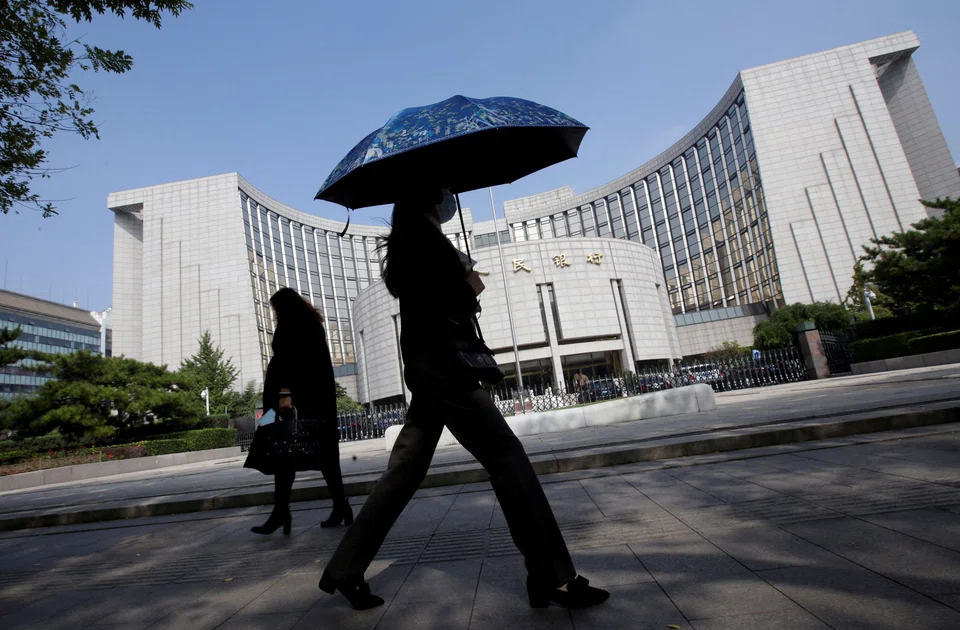
DESPITE China’s central government and central bank promising a slew of fiscal and monetary support measures to keep the economy humming in recent weeks, the growth outlook still looks dim.
A chorus of observers are saying that there seems to be just one policy that Beijing doesn’t seem to want to touch, and yet could make all the difference to its economic growth - and that is zero-Covid, or the pursuit to keep infections near zero.
Last Friday (Sep 16), China released a host of macroeconomic data for the month of August. Observers were surprised to see that retail sales, industrial production, and fixed-asset investment data improved at a better than expected rate. However, some noted that retail sales and industrial output rose only because they were much lower a year ago.
As for the better fixed-asset investment print, some economists said that may mean that Beijing’s relief packages have started to take effect. In August, the central government pledged to raise the quota that banks can lend to infrastructure projects by 300 billion yuan (S$60.4 billion), on top of another 300 billion yuan announced in June.
The central bank has been busy too, trying to inject more liquidity into China’s financial system. In recent months, the People’s Bank of China (PBOC) has been cutting rates and issuing bonds to encourage banks to lend more. That seemed to have worked in August when credit growth rebounded from a record low in July.
However, these better readings in August seemed to be more of an exception than the norm. Average new-home prices and property investment data disappointed.
The property market is seen as a significant driver of China’s economic growth. Other retail-focused data, such as movie-box revenue data and tourism receipts, worsened. Taken as a whole, August’s economic indicators showed a “slight loss of momentum overall,” economists from Capital Economics wrote in a note last Friday.
Investors concurred. That same day, the Chinese yuan weakened to below the psychologically-important level of 7 to the US dollar, the lowest since July 2020. The benchmark CSI 300 Index of stocks closed 2 per cent lower and was down by almost 4 per cent for the week.
Other recent macroeconomic numbers also pointed in the same direction. Consumer and producer inflation numbers for August slowed more than expected. The purchasing managers’ index for August showed that factory activity continued to cool for a second straight month. Its second-quarter GDP growth was a mere 0.4 per cent from a year ago.

Chinese policymakers have tried various means and ways to prop up demand and encourage companies to produce more, but the numbers seem to show that these measures have minimal effect. Whether August’s better-than-expected recovery in some indicators can widen into a broader uplift remains to be seen.
There is only so much that PBOC can ease before financial stability is shaken. Some economists said that the stimulus is only preventing the downturn from worsening and not breathing life into economic activity.
The ongoing Covid-19 restrictions remain the elephant in China’s downturn room. With fiscal and monetary responses not achieving the desired effects (yet, some may say), adequate attention must be paid to China’s strict zero-Covid mandate.
Sudden lockdowns make it hard for consumers to plan for purchases, if they even have the confidence to do so in the first place. They also make it hard for businesses to operate and make hiring plans. These feed into wage expectations and, in turn, dampen consumer spending even further.
Underscoring how significant this impact could be, a Goldman Sachs report earlier this month said that cities with districts that were seen as high or medium-risk of Covid-19 outbreaks accounted for about 35 per cent of China’s GDP. Elsewhere, external trade has also been disrupted, with further deceleration in both export and import numbers for August.
China’s economy has become weaker under the crumbling weight of harsh pandemic control measures. Even its National Bureau of Statistics acknowledges this grim reality.
A spokesperson said last Friday that the economy is in worse shape this year than in 2020, given the difficulty in controlling Covid-19 outbreaks and a slowdown in the global economy, according to Bloomberg. Major banks, including Goldman Sachs, J P Morgan and Nomura, have already dimmed their expectations of China’s full-year growth.
““We lower our 2022 projection for growth to 3 per cent, from 3.5 per cent. For 2023, the biggest uncertainty is the lifting of zero-Covid policies, without which China might still grow sluggishly,” Alicia Garcia-Herrero, chief economist for Asia Pacific at Natixis, wrote in a recent blog post.
“Zero-Covid remains the millstone that is slowing the economy,” Moody’s Analytics economist Heron Lim wrote in a note earlier this month.
In China’s search for answers to get its economy buzzing again, it needs to think about its way out from zero-Covid.
Decoding Asia newsletter: your guide to navigating Asia in a new global order. Sign up here to get Decoding Asia newsletter. Delivered to your inbox. Free.
Share with us your feedback on BT's products and services
TRENDING NOW

First Resources blames El Nino, outside fires for Kalimantan hotspots amid haze scrutiny

High Court rules against Julius Baer’s Singapore trust arm in US$50 million family trust dispute

Singapore key exports jump by higher-than-expected 68.4% in September, led by non-electronics

MSCI proposes downgrading Indonesia to standalone market status

