



China positions itself as a stable economic force amid global uncertainty at Beijing forum
More US corporate leaders travelled to Beijing for the conference this year
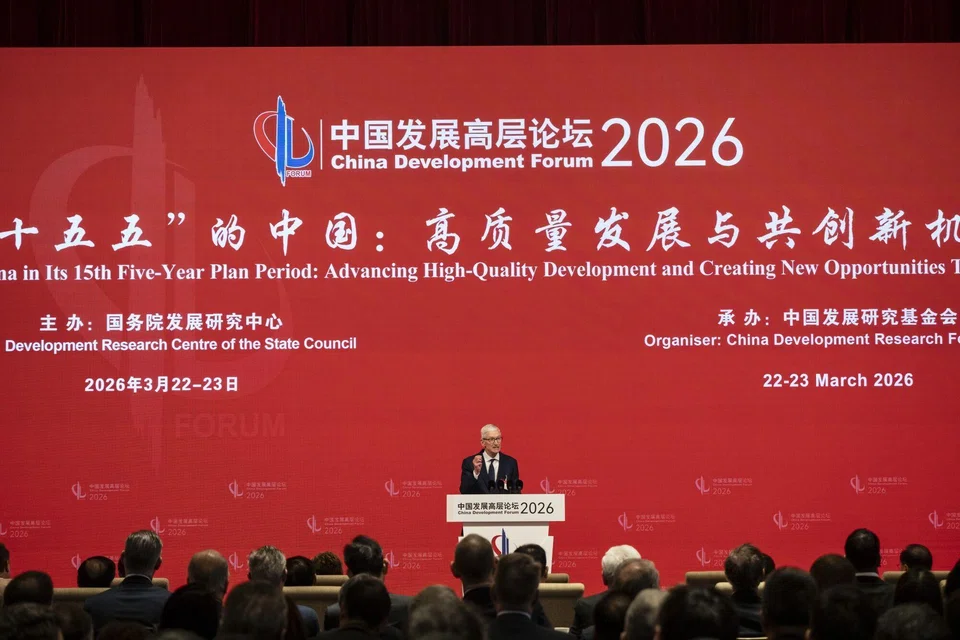
[BEIJING] Global corporate executives attending China’s flagship annual business conference this week were reassured by leaders of the world’s second-largest economy that it remains a predictable anchor at a time of geopolitical flux and global uncertainty.
The tone at this year’s China Development Forum (CDF), which ended on Monday, was noticeably more confident than in recent years, analysts said, marking a shift from previous post-pandemic forums where officials tended to emphasise support measures and recovery trajectories.
“Compared to previous CDFs, the China messaging was the most confident,” said Han Lin, China country director at US-based strategy consultancy, The Asia Group. “While identifying challenges in the international system and without naming the US directly, (Premier Li Qiang’s) opening speech focused on what China was doing right to encourage innovation, trade and other opportunities to collaborate.”
The timing of the forum sharpened that message.
Nearly a year into a bruising trade war and ahead of a postponed summit between President Xi Jinping and US President Donald Trump, Beijing is navigating strained ties with Washington and faces rising trade barriers elsewhere off the back of a record US$1.2 trillion trade surplus in 2025.
The US-Israeli war with Iran has caused a surge in energy prices that is rippling across the wider global economy and given Beijing another opportunity to promote itself as a bastion of calm that respects sovereignty and the international, rules-based order.
Reflection of shifting geopolitical landscape
Attendance patterns reflected shifting geopolitical boundaries. A higher share of US corporate leaders travelled to Beijing compared with previous years, among them the CEOs of Apple, McDonald’s, Eli Lilly, Coach parent Tapestry and Mastercard.
Their presence suggested that despite tensions, American multinationals remain keen to keep channels open with Beijing, as the two countries recalibrate trade and investment flows.

Stability, a recurring theme from last year’s CDF, resonated more strongly this year, said Albert Hu, professor of economics at the China Europe International Business School in Shanghai.
“Given all the erratic policies introduced by Donald Trump and the uncertainty his policies have introduced to the world economy, the message of China being a stabilising force probably finds a more willing audience this year than last year,” Hu said.
Absent, however, were Japanese executives — a stark contrast with last year, when their involvement included a widely publicised meeting between top global CEOs and Xi.
Their non-attendance this year comes amid a diplomatic rift between Beijing and Tokyo, underscoring how China’s promises of renewed openness still operate firmly within geopolitical red lines.
Eyes on potential meeting with Xi
A decision on whether Xi will reprise his recent practice of hosting a roundtable with select CEOs had not been confirmed by the close of the forum.
Han Lin believes the absence of an immediate announcement reflects sequencing rather than reluctance.
“I think Xi has every intention to meet CEOs, but only after a Trump visit,” he said. “Beijing wants trade terms set at the leadership level first, then multinationals get their signal on what comes next.”
Chinese policymakers also used this year’s forum to underline priorities that now define its medium-term strategy: technological self-reliance, industrial upgrading and “high-quality development.” All three pillars are central to the country’s latest five-year plan, released earlier this month and set as the theme of this year’s CDF.
Yet not all participants left convinced. Some attendees complained that the forum’s content had become increasingly rigid.
“The meetings are getting more and more bureaucratic. I cut short my trip and am going home now,” said a Chinese senior executive at an international hotel chain.
“CDF is losing its glamour. I hoped to sit in on some interesting sessions, but it turned out to be very bureaucratic and a total waste of my time.” REUTERS
Decoding Asia newsletter: your guide to navigating Asia in a new global order. Sign up here to get Decoding Asia newsletter. Delivered to your inbox. Free.
Share with us your feedback on BT's products and services
TRENDING NOW

DBS, OCBC, UOB rout lops billions off STI as inflation, rate concerns spook investors

Grab CEO’s wife Chloe Tong on life with Anthony Tan and finding her purpose

OCBC sheds S$8 billion in value as shares close nearly 6% down; analysts cautious on banks

Deal between tycoon friends sparks scrutiny of Philippine power sector

