China’s exports surge 25% as demand for high-tech, AI help prop up economic growth
Imports jump 28.2%, compared with a 27.5% year-on-year increase in July
 Add BT as a preferred source
Sharon Lee
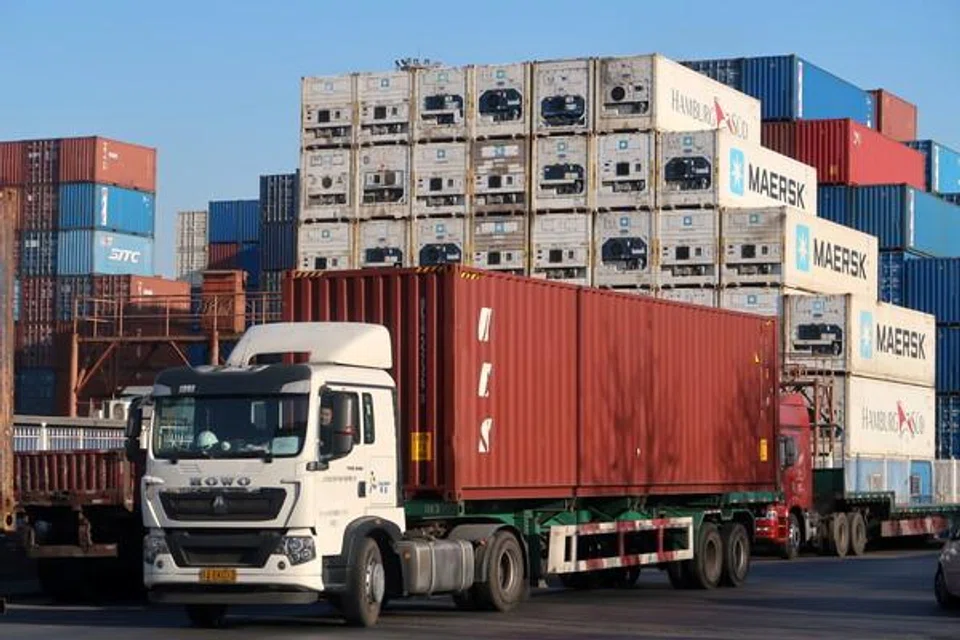
[BEIJING] China’s export growth quickened in August, buoyed by strong overseas appetite for high-tech and AI-related products, providing vital support for an economy weighed down by sluggish domestic demand.
The divergence between resilient exports and weak activity at home highlights Beijing’s continued dependence on foreign demand, with policymakers struggling to revive consumption and investment as they pursue a 4.5-5 per cent GDP growth target in 2026.
Exports from the world’s second-biggest economy surged 25 per cent year on year in August in US dollar terms, matching forecasts and accelerating from the 23.9 per cent growth in July, customs data showed on Tuesday (Sep 8).
Imports jumped 28.2 per cent, compared with a 27.5 per cent year-on-year increase in July and a forecast for a 30 per cent rise.
Lynn Song, ING’s Greater China chief economist, said that while external demand had significantly outpaced domestic consumption, “tariff risks and the durability of the tech investment cycle are the key factors to watch to see how long this strength will persist.”
In the first eight months, exports of high-tech products rose 42.9 per cent in US dollar value terms.
Semiconductor export values more than doubled even as volumes edged up just 4.1%, while car exports rose more than 50% in both value and volume.
Strong demand for AI products as well as electric vehicles, solar cells and lithium-ion batteries offset the impact from weather events, said Xing Zhaopeng, ANZ’s senior China strategist.
Xing noted that companies were still rushing to send goods to the US due to tariff uncertainties.



AI fervour, trade tensions
“The main areas of import growth still look tied to tech products, showing China continues to spend in the ongoing tech race,” ING’s Song said.
China’s push to dominate key technologies has turbocharged investor appetite for tech stocks, while surging AI-related demand is lifting a new generation of manufacturers. Chipmaker CXMT swung to a first-half profit in its maiden earnings report since listing, as soaring memory chip prices and strong demand for AI-driven computing lifted sales.
Industries relying on the domestic market, however, have been grappling with producer price inflation and soft demand.
Relying on outbound shipments to absorb industrial capacity also exposes China to risks of curbs from trading partners, as the US and the European Union have both demanded Beijing lower its trade surpluses.
China’s trade surplus rose to US$119.09 billion in August, from US$112.5 billion the previous month. The surplus in the first eight months reached US$805.51 billion, putting the annual number on track to top US$1 trillion for the second year.
The trade surplus with the US rose to US$29.18 billion from US$28 billion in July, with China’s exports to the US jumping 34.4 per cent year on year, outstripping the 17.8 per cent growth in imports.
A trade truce between Beijing and Washington, reached late in 2025 when the two countries’ presidents met, has held despite on-and-off frictions. The two governments are now exploring reciprocal tariff cuts on US$30 billion worth of goods from each side as they prepare for another summit later in September.
China’s exports of rare earths in August rose month on month in volume, but held well below the year-to-date monthly average. Crude oil imports, meanwhile, dropped 23.4 per cent year on year in volume terms.
The trade data barely moved markets, leaving the yuan flat and stocks slightly higher as traders awaited US inflation data for fresh signals on the US Federal Reserve’s rate path.
Dependence on external demand
After growth cooled to 4.3 per cent in the April-to-June period, economic data released in August showed industrial output and retail sales both slowed at the start of the third quarter, while fixed-asset investment recorded a sharper decline in the first seven months. The property market, once a major growth driver, is still in a years-long downturn.
Premier Li Qiang, the country’s No 2 leader, in August called for efforts to stabilise external demand while acknowledging insufficient domestic demand, hardships facing industries as well as rising uncertainties in the international environment.
The government has stepped up fiscal support for the economy, including deploying an 800 billion yuan (US$119.2 billion) financing tool to shore up infrastructure investment. But the strength in exports relieves Beijing of immediate large-scale actions to boost household income, improve job security and revive the property market.
“The latest trade data do not materially strengthen the case for an imminent interest rate cut,” said Zhou Hao, a Hong Kong-based analyst at Guotai Haitong Securities.
“While further policy support cannot be ruled out, the combination of resilient external demand, steady industrial momentum, and increasingly targeted fiscal measures implies that the timing and necessity of additional monetary easing will require further observation.” REUTERS
Decoding Asia newsletter: your guide to navigating Asia in a new global order. Sign up here to get Decoding Asia newsletter. Delivered to your inbox. Free.
Share with us your feedback on BT's products and services