
Chinese factory activity expands in September amid AI boom
But recovery remains uneven, as weak consumption and investment continue to weigh on outlook
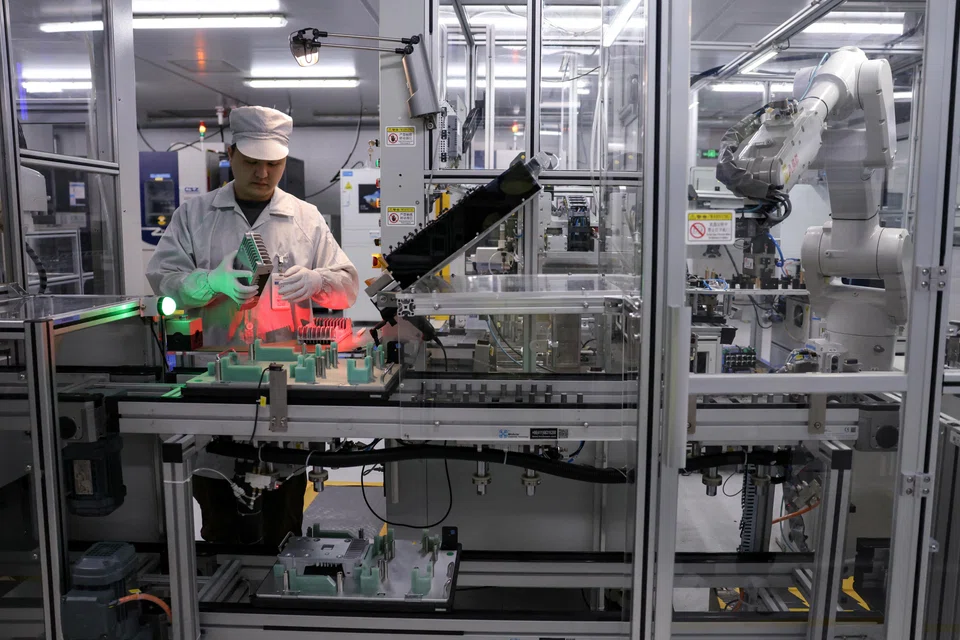
[BEIJING] China’s factory activity expanded in September, official and private surveys showed on Wednesday (Sep 30), as easing weather disruptions allowed factories to resume operations and a global artificial intelligence boom supported the industrial sector.
But the recovery remains uneven, as weak consumption and investment continue to weigh on the outlook. Analysts say that additional policy support may be needed as the property downturn drags on confidence among businesses and households.
The official manufacturing purchasing managers’ index (PMI) rose to 50.1 from 49.8 in August, ending two straight months of contraction, according to the National Bureau of Statistics (NBS). That matched the median forecast of 50.1 in a Reuters poll.
The 50-point mark separates expansion from contraction.
The sub-index for new orders was at 50.5, while the sub-index for production was at 51.7, the data showed.
“China’s fiscal push appears to be gaining traction, with September PMI data suggesting that the economy is shifting back into a higher gear,” said Hao Zhou, a Hong Kong-based economist at Guotai Haitong Securities. “But the most critical thing is to see whether property relief could help improve consumption via reducing the debt burden for households.”
The reading was broadly in line with a private survey by RatingDog, which showed manufacturing PMI rose to a five-month high of 52.1 in September from 51.5 in August.
The data underscores China’s continued reliance on exports to offset a prolonged property downturn and weak domestic demand, with the country’s goods trade surplus on track to exceed US$1 trillion for a second straight year.
A run of soft economic readings has heightened pressure on policymakers to roll out further support measures, as retail sales and investment remain weak.


China unveiled measures on Tuesday designed to steer cheaper credit into a range of sectors including infrastructure and technology, as well as to expand support for homebuyers.
The non-manufacturing PMI, which covers services and construction, came in at 50.2 in September, compared with August’s 49.0, according to the NBS.
“China’s K-shaped divergence this year has been quite striking,” said Lynn Song, chief Greater China economist at ING. “While we expect resources to continue to be funnelled into strategic priorities such as AI, tech self-reliance and industrial upgrading, efforts to address the lagging parts of the economy will be key to rebalancing and achieving healthier and more sustainable growth.”
Officials have shown greater urgency in supporting growth after recent data suggested a further loss of momentum in the third quarter. China’s economy grew 4.3 per cent in Q2, its slowest pace in more than three years. Beijing is targeting full-year economic growth of 4.5 to 5 per cent.
China’s leaders have pledged to shore up the slowing economy by accelerating fiscal spending and introducing new policies “in a timely manner”.
The country has relied heavily on exports and industrial production to support growth this year, but geopolitical uncertainty and growing trade frictions pose risks to the outlook, as Chinese goods ranging from high-end electronics to household products face greater scrutiny in overseas markets.
China and the US said on Monday that they would pursue tariff cuts on US$60 billion worth of goods imported from each other, from American corn to cosmetics and Chinese toys to household appliances.
However, there were some notable omissions on each side, including non-seed soybeans, the biggest US agricultural export to China. REUTERS
Decoding Asia newsletter: your guide to navigating Asia in a new global order. Sign up here to get Decoding Asia newsletter. Delivered to your inbox. Free.
Share with us your feedback on BT's products and services