Energy security fears could spur development of Asia’s upstream gas assets: McKinsey
New investments could unlock an additional 10 billion to 15 billion cubic feet of regional production daily

[SINGAPORE] Asia’s growing focus on energy security could catalyse fresh investments into the region’s upstream gas assets, even amid high costs, consulting firm McKinsey said in a report released on Thursday (Oct 22).
These new investments could unlock an additional 10 billion to 15 billion cubic feet per day of domestic gas production across South-east Asia, China and Central Asia.
“While importing is economically cheaper, governments might opt to incentivise domestic exploration, even above break-even cost, to reinforce energy security,” McKinsey reported.
Energy sources
The region’s fossil fuel basins “have passed their peak, with production expected to decline sharply without reinvestment”, so more than US$60 billion of annual investment might be needed to keep Asian gas production flat as its existing fields mature.
“Asia’s mature basins require continued investment simply to stop production decline, while some resources with historically marginal returns – including projects in China, Indonesia, and Thailand – may warrant reconsideration for investment,” McKinsey said.
But with traffic through the Strait of Hormuz choked off by US-Iran tensions in 2026, some national oil companies are stepping up exploration within Asia.
For instance, Malaysia’s Petroleum Sarawak has committed to the exploration and development of several projects in the East Malaysian state.
McKinsey acknowledged that cost is a hurdle, as many projects have break-even points slightly above the projected long-run oil price of US$70 to US$80 a barrel.
But it believes these projects could become economically viable with the support of resilience-linked incentives or government subsidies.

Separately, both biofuel and coal were pegged as growing energy sources for Asia. Biofuel is forecast to replace about US$90 billion to US$100 billion of fuel imports in 2040, with both Indonesia and Malaysia increasing biofuel blending mandates. (* See amendment note)
Biofuel usage could reduce Asia’s fuel import dependence in the long term, McKinsey said.
But Asian coal demand is rising as well, driven by strong appetite from India and South-east Asia, which more than make up for falling demand in China.
In Indonesia alone, coal demand could rise about 40 per cent by 2040. This is even as global demand for coal is expected to fall by about 5 per cent between 2025 and 2040, under McKinsey’s baseline scenario.
“New shape of demand”
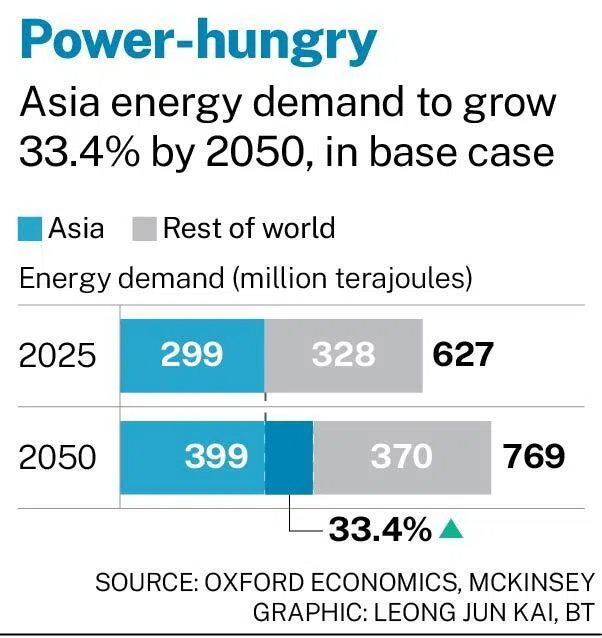
McKinsey expects Asia’s energy demand to soar by 33.4 per cent from 2025 to 2050, to almost 400 million terajoules.
Beyond securing energy supply, Asia will have to build its energy system around what the consultancy called “the new shape of demand”.
Citing the rise of artificial intelligence and data centres as the “clearest example”, it said that “the shape, location, and speed of demand growth are changing, requiring generation and infrastructure to be planned differently”.
Malaysia, for instance, has received more than 12 gigawatts of data centre power applications, or about 40 per cent of the country’s overall installed capacity.
But it will have to balance data centres’ energy demand with fiscal constraints, as fuel subsidies now account for about 8 to 10 per cent of Malaysia’s annual budget, up by more than 3.5 percentage points before the Strait of Hormuz closure.
Infrastructure planning will be another key consideration, as energy system redesign in Asia is expected to require US$1 trillion in annual investment over the next 15 years.
“A data centre can be built in one to three years, while major grid upgrades can take five years or more, increasing the importance of coordinating generation and grid capacity with new loads,” McKinsey noted.
For Asia to build energy resilience, stakeholders will have to ensure that energy projects are investable, as high financing costs, foreign exchange exposure and uncertain investment environments can hinder otherwise viable projects.
“Sovereign and credit guarantees, long-term power-purchase agreements, regulated returns and blended finance could help reduce those risks,” McKinsey said.
These projects must also be executable. McKinsey recommends that the government and the private sector coordinate policy permitting the development of land, grid and infrastructure so that committed capital can be deployed at the required pace.
* Amendment note: Due to a source error, the original version of this article said that biofuel is forecast to replace about US$90 billion to US$100 billion of fuel imports in 2026. McKinsey has since corrected the year to 2040.
Decoding Asia newsletter: your guide to navigating Asia in a new global order. Sign up here to get Decoding Asia newsletter. Delivered to your inbox. Free.
Copyright SPH Media. All rights reserved.