Evergrande creditors owed US$45 billion face more complex path after founder jailed for life
Liquidators have been pursuing jailed tycoon’s around US$7.7 billion in assets worldwide
CHINA Evergrande Group’s creditors have known for years they will only get pennies on the dollar back in one of the country’s biggest ever liquidations. Now, getting even just that has become more complex.
A mainland Chinese court sentenced Evergrande founder Hui Ka Yan to life in prison on Thursday (Aug 20) and ordered that his assets be confiscated. His companies were fined a combined 15.8 billion yuan (US$2.4 billion).
Evergrande’s liquidators, who said in 2025 that the builder’s debt load totalled some US$45 billion, have been pursuing Hui’s around US$7.7 billion in assets worldwide as they try to claw back funds.
For offshore creditors, one concern is that some of Hui’s assets could be drawn into Chinese mainland court’s enforcement proceedings.
“The new judgment has made the liquidation the most complicated we’ve ever seen,” said Foreky Wong, a Hong Kong-based insolvency specialist. “The ruling could make liquidators’ recovery route more challenging, especially towards Hui’s assets as the liquidators have not yet won their case against Hui.”
There is, however, one principle in Chinese law that could in theory help some creditors. Compensation for losses and debt repayments take priority over fines and asset confiscation in the country. But it is unclear how that will play out in practice in one of the world’s biggest-ever cross-border corporate debt cleanups.
“The penalty on Hui could add more uncertainties to how offshore creditors” can go about seeking to recoup some of their money, said Gary Ng, senior economist at Natixis. “Once the government gets all Hui’s assets, how it arranges the distribution will depend on its own considerations.” The developer’s liquidators in Hong Kong declined to comment.
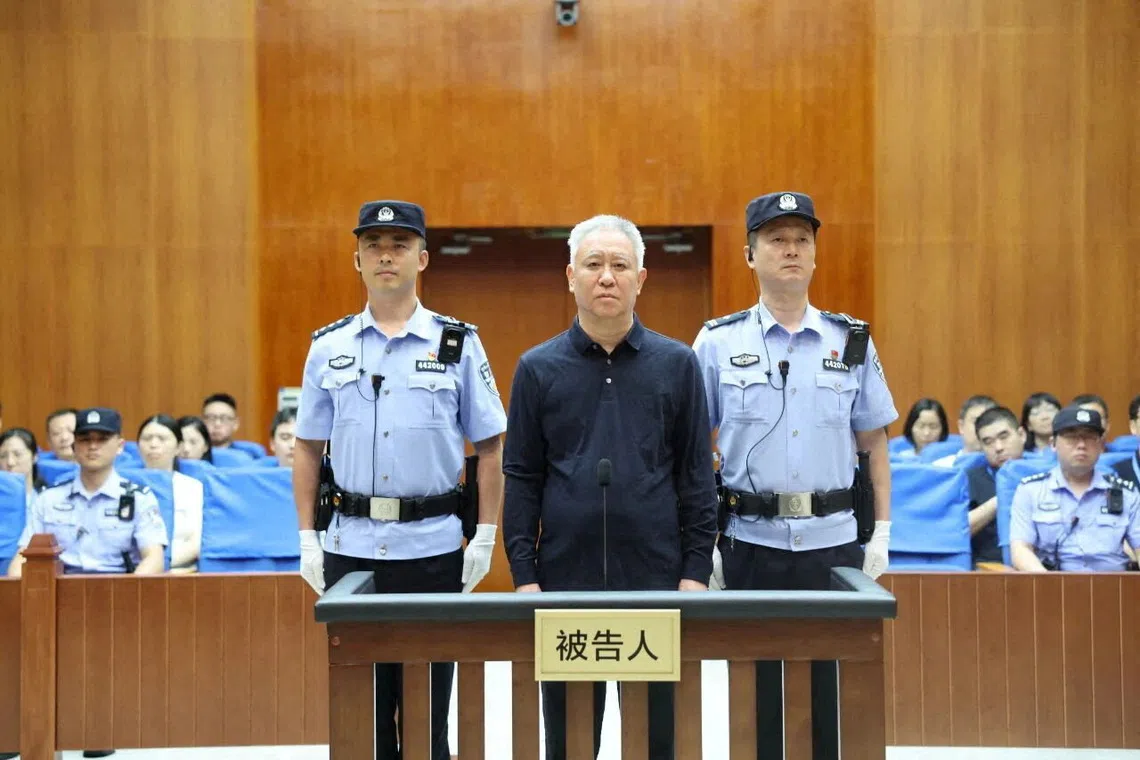
Evergrande, once China’s largest developer by sales, defaulted on its offshore bonds in late 2021. Following failed restructuring attempts, it received a liquidation order in Hong Kong in 2024, marking a significant escalation in the unravelling of the sector.
The liquidators are also jostling with authorities in Hong Kong.


On Aug 19, a court in the city began hearing arguments on a challenge brought by liquidators to a HK$1 billion (US$127.5 million) deal that set up a fund to compensate Evergrande’s minority shareholders.
Deloitte had estimated in 2023 that the recovery rate for Evergrande’s US dollar notes would be 3.4 per cent on average if the firm was liquidated.
Most of Evergrande’s offshore bonds were little changed after the mainland court’s ruling, valued at less than US$0.02 for every US$1 of face value, underscoring holders’ slim expectations for recovery.
Hui was taken away by Chinese police in 2023 and held under residential surveillance – a type of police action that falls short of formal detention or arrest. Apart from a company filing confirming Hui being put under police control, Chinese authorities had remained tight-lipped about his status since then.
In 2024, Chinese regulators accused Evergrande’s main onshore unit of inflating more than 560 billion yuan of revenue by recognising sales in advance, an alleged fraud that dwarfs that of Luckin Coffee and Enron. China then suspended the operations of PricewaterhouseCoopers, Evergrande’s long-time auditor, for six months and imposed fines.
Much of Hui’s known wealth was derived from his controlling stake in Evergrande and the cash dividends he has received from the company since its 2009 listing in Hong Kong. Hui had pocketed more than US$7 billion over the past decade, thanks to the firm’s generous payouts, according to Bloomberg calculations. BLOOMBERG
Decoding Asia newsletter: your guide to navigating Asia in a new global order. Sign up here to get Decoding Asia newsletter. Delivered to your inbox. Free.
Share with us your feedback on BT's products and services