


Futuristic Shenzhen shows Trump the difficulty of stopping China
The city’s progress serves as a powerful symbol of China’s technological rise — and the limits of Washington’s efforts to hold it back
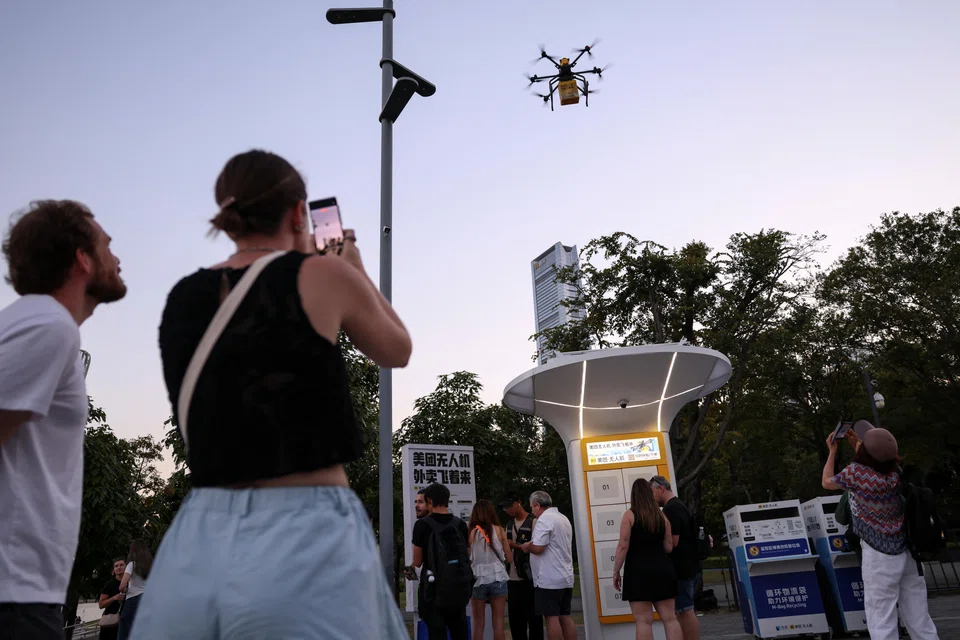
UNDER the towering skyscrapers home to some of China’s biggest tech giants, a small group of foreigners tilt up their smartphones to capture a drone descending from the Shenzhen sky with a fresh serving of bubble tea.
They’ve paid around US$90 a head to be dazzled by the southern Chinese city’s tech wonders on a tour led by Sean Zhang, who returned home in 2023 after studying in California. He’s now cashing in as tourists flock to Shenzhen to experience frontier technologies like flying robotaxis, wearable exoskeletons and buildings shaped like giant AirPods. Influencers on Western social media platforms regularly post videos with titles like “China built a city that feels like 2050!”
“Shenzhen usually leaves a very good impression,” says Zhang, 27, who has more than doubled the number of tours offered over the past year. “Many walk away saying: ‘This isn’t what I expected of China.’”
It’s that innovation President Xi Jinping wants to show the world — and Donald Trump — when he hosts the Asia Pacific Economic Cooperation summit this week in this city of some 18 million people.
At the turn of the century, Shenzhen was best known for its cheap knock-offs of Western goods. Today, the city’s progress serves as a powerful symbol of China’s technological rise — and the limits of Washington’s efforts to hold it back.
Dozens of companies in Shenzhen, including national tech champion Huawei and Tencent, are on US blacklists designed to restrict their access to American exports and markets. But that hasn’t stopped them going from strength to strength.

BYD last year dethroned US giant Tesla as the world’s top supplier of electric vehicles, while SZ DJI Technology now controls about 70 per cent of the global consumer drone market.
That boom has made Shenzhen a bright spot even as it epitomises the broader paradox in China’s economy: While exports are surging and its tech companies are becoming global leaders, many locals aren’t feeling any richer as wage growth slows and many firms struggle to eke out profits.
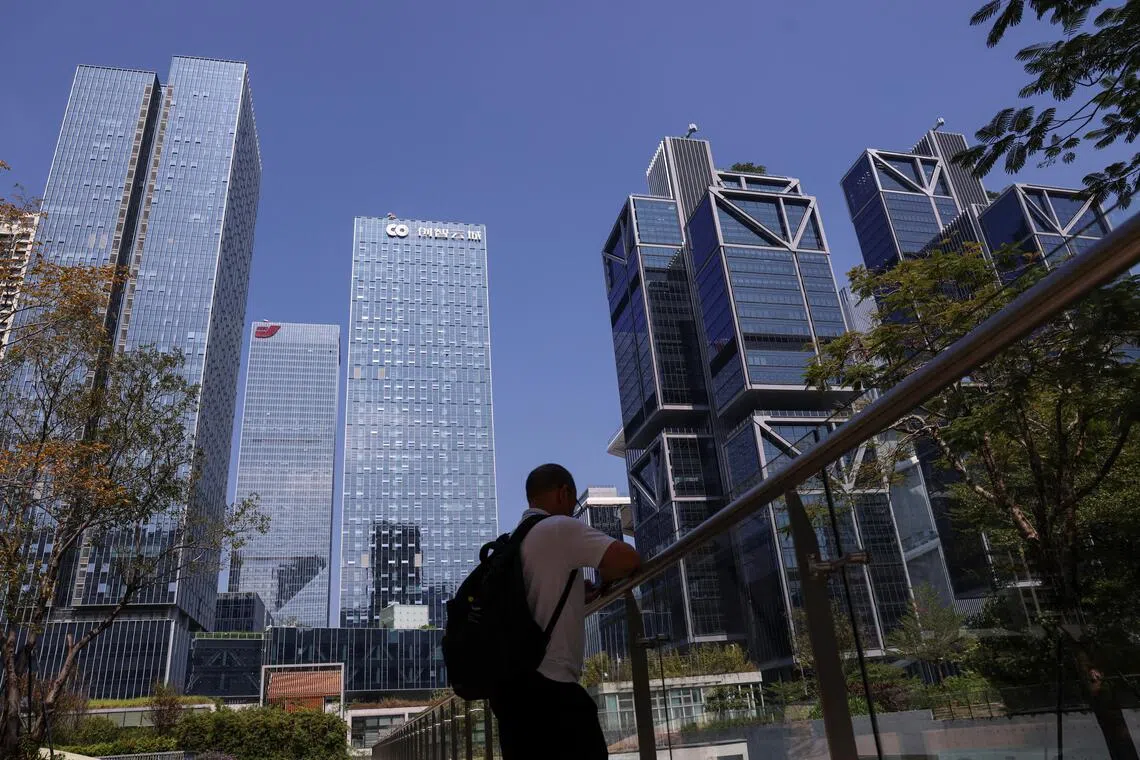
Shenzhen saw the highest population growth rate of any major Chinese city last year, and has one of the country’s youngest average urban populations at 32.5 years old. Airport signs declare: “Once Here Shenzhener Forever.”
SEE ALSO
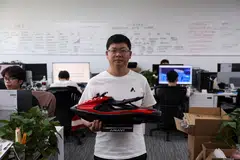
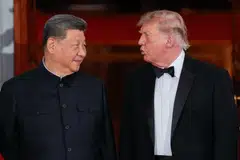
While China has a glut of unsold real estate — Goldman Sachs Group estimated in 2024 it would be worth US$13 trillion if fully built — the city is actually seeing a supply squeeze, making it potentially the first place to climb out of the nation’s five-year property slump.
“Shenzhen is no Potemkin showcase — its technological and industrial achievements are real,” said Han Lin, China country director at The Asia Group, a Washington-based advisory firm. “But China has already demonstrated it can build world-class productive capacity. The harder challenge is generating sufficient domestic demand to absorb that capacity.”
Shenzhen is among several megacities competing to be China’s version of Silicon Valley.
Beijing’s top colleges produce some of the brightest AI researchers working at leading labs like DeepSeek and Moonshot AI. Shanghai and neighbouring Hangzhou - home to Alibaba Group Holding - are better known for fast-to-market AI applications for global markets.
Shenzhen stands out for its supply chains that help AI integrate into everyday life. One company emblematic of that strength is Seeed Studio, which focuses on “physical AI” — sensors, cameras and robot arms connecting AI to real-world tasks. Its studio displays warehouse interfaces, a chicken-farm system, panda conservation sensors and an AI-and-inventor van touring rural areas.
Supply-chain anxiety spiked after Covid, pushing some clients to factories in Vietnam or Japan. But cost and complexity drew them back to China, according to Eric Pan, the company’s chief executive officer.
“Geopolitics of course is a big hammer to people’s confidence,” he said. “But I think after five years post-Covid, we have much stronger confidence and trust.”
Inside the souvenir shop at Huawei’s headquarters, some of founder Ren Zhengfei’s favorite phrases appear on the merchandise. “Victory is our belief and persistence is the only way out,” reads a box of fridge magnets, which are molded into the shape of Heidelberg Castle, a replica of which is featured at one of the company’s campuses.
It’s a mantra that Trump helped instill. During his first term, the Republican’s sanctions on Huawei were designed to kneecap a Chinese national champion and ensure US tech supremacy. Yet the detention of Huawei’s chief financial officer, Meng Wanzhou, only helped galvanise Beijing’s drive for technological self-reliance.
When Meng returned to Shenzhen in 2021, after nearly three years of house arrest in Canada due to US charges, the city’s skyscrapers lit up with messages welcoming her home.
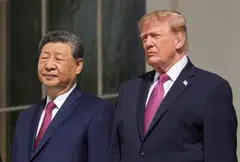
Five years on, Trump will become the first sitting US president to ever visit Shenzhen, where he’s set to hold his third summit with Xi this year to keep an uneasy relationship on track.
“Shenzhen is a window through which you can see a different China — one emerging as a major innovative country,” said Wu Xinbo, director of Fudan University’s Centre for American Studies. “Trump should visit Huawei to see whether he really killed it, eight years after the first punch was delivered.”
Huawei’s sprawling, tree-lined headquarters sits less than an hour’s drive from the Apec venue. On a November morning ahead of the summit, it was buzzing with foreigners exploring the compound. At the grand Darwin Hall, a giant graphic declared: “Huawei business growth back on track.”
A chart showed the company’s revenue last year rising close to its pre-sanctions peak, up from a trough when it marked its first-ever full-year decline in 2021. Another data point stood out: Of roughly 213,000 total employees, more than 53 per cent are now engaged in research and development.
Huawei only began developing its own domestic chip manufacturing and assembly lines in 2022, helped by an estimated US$30 billion in government funding.
While it remains behind Nvidia, China is increasingly relying on Huawei to become self-sufficient in chip production and catch the US in the AI race — a push only reinforced by Jensen Huang’s ouster last week, and the likelihood that the US will further tighten export controls.
When Xi emerges at Apec this week, he’ll be holding court in a city where his father burnished his reformist credentials and helped ignite the Chinese economic miracle. It’s a powerful stage as Xi prepares to receive a fourth term at next year’s Communist Party leadership reshuffle, the biggest event on China’s domestic political calendar.
Shenzhen’s evolution accelerated during Xi’s reign thanks in part to his Made-in-China project to transform the nation into a self-reliant global superpower. One testament to that shift is Huaqiangbei, described as the world’s largest electronics marketplace.
Ryan, a 25-year-old Shenzhen native who studied in Europe, remembers visiting the area as a child with his father.
Now looking more like Tokyo’s Akihabara Electric Town, it’s transformed from a drab secondhand-electronics hub into a neon-lit mall with Chinese-branded drones, robotic dogs and droves of foreign visitors. Many come from Hong Kong, attracted by the city’s wide spaces and cheap prices — a reversal from a few years ago, when mainlanders flocked to the former British colony.
Ryan, who asked to be identified by an English name to speak freely on sensitive matters, remains skeptical of China’s technology boom, even while acknowledging the country has achieved real breakthroughs.
He said he can’t look past low wages, the tech industry’s punishing culture of “996” — working 9 am to 9 pm six days a week — and the Communist Party’s pervasive use of AI-enabled surveillance. He’s looking for opportunities abroad.
Shenzhen’s success is unevenly distributed. Despite having the world’s fourth-highest count of self-made billionaires under 40, trailing only San Francisco, Shanghai and New York, the average monthly income is around 7,000 yuan (US$1,050).
Pedestrians need to dodge speedy delivery scooters while walking on Shenzhen’s sidewalks, showing the rise of a gig economy that now accounts for nearly half the national labour pool and leaves workers without benefits like sick pay or healthcare.
Ryan expects AI to widen the inequality further, creating more highly paid AI aristocrats while displacing white-collar workers.
Li, a 44-year-old parcel delivery worker in Shenzhen who asked to be identified by his surname, told Bloomberg News earlier this year that his income has declined to around 9,000 yuan a month now from 15,000 yuan a few years ago.
“I only graduated from high school,” he said, “but even college graduates nowadays struggle to get a job.”
Shenzhen produces nearly 8 million service robots, or 43 per cent of last year’s national output. Kevin Zhou, author of a Chinese biography of OpenAI’s Sam Altman, said Shenzhen must focus on capturing the opportunity in embodied AI and avoid simply assembling the hardware while others control the underlying technology and capture the profits.
“As models get cheaper and more open, value will shift to whoever can put them into robots and devices at scale,” he said. “And no city is better placed for that than Shenzhen.”
A new generation of entrepreneurs is looking to navigate the more fractured geopolitical landscape and become world leaders in their fields.
Among them is Will Wang, a former Apple engineer who founded AI smart-glasses maker Even Realities in 2023. The startup reached a US$1 billion valuation after raising US$150 million in a funding round led by Meituan, with participation from Tencent.
His ambition is to build a premium global brand, starting with developed markets before expanding into China. “You absolutely have to be the defining force of your category,” he said at his minimalist office in Shenzhen along an avenue of gleaming glass towers where hardware startups, robotics teams and AI developers operate side-by-side.
Wang has explored manufacturing overseas, storing user data in Europe and establishing a separate entity to oversee data governance. As the company grows bigger, it will be harder to keep out of politics, but Wang believes he can address any government concerns.
“You just kind of have to play the game,” he said.
Livra, a 30-year-old who moved to Shenzhen from central China a decade ago, has a startup supplying batteries for drones and robotics across the US, Middle East and Europe.
While she praises Shenzhen’s ecosystem of factories, she’s also found it difficult to convert that capability into sales, as many robotics customers are still in early development and haven’t moved into mass production. She’s also found that Shenzhen’s reputation for churning out fast prototypes has its limits.
“When it comes to high tech stuff, it’s slow,” Livra said. “Everything has to be customised and tested over and over again. It can take a long time.”
On the Shenzhen technology tour with Zhang, the bubble tea delivery softly touched down, drawing coos of excitement. In reality, the technology remains a novelty, he explained. Companies are still struggling to move it beyond a spectacle for tourists.
A driverless taxi experience also showed the real-world snags. Locals avoid taking them when in a hurry, as the vehicles are slow and stop too often for pedestrians. Zhang pointed to the steady emergence of new shopping malls around town as evidence that standing still isn’t an option in Shenzhen.
“It’s like that in tech, too,” he said. “If you’re not at the forefront, then you’ll be left behind.” BLOOMBERG
Decoding Asia newsletter: your guide to navigating Asia in a new global order. Sign up here to get Decoding Asia newsletter. Delivered to your inbox. Free.
Share with us your feedback on BT's products and services
TRENDING NOW
Ex-Nvidia CEO Jensen Huang carried a secret for more than a year. It led to his downfall

Higher rates, weaker spending: Is the Philippines entering stagflation?
As Indonesia picks new vice-president to succeed Gibran, investors see risks and opportunities
Singapore to inherit South China Sea code talks with key issues unresolved

