Haze clouds Indonesia’s growth, but economists see breathing room for Malaysia and Singapore
Indonesia bears the fires’ direct damage while its neighbours’ growth engines are insulated

[SINGAPORE] Despite the widespread disruption from an unusually intense episode of transboundary haze, economists are leaving their 2026 growth forecasts for Indonesia, Malaysia and Singapore unchanged – but warn of a downside risk to Indonesia’s economy.
In contrast, growth in Malaysia and Singapore is driven by manufacturing, electronics and finance – sectors largely insulated from this year’s regional haze.
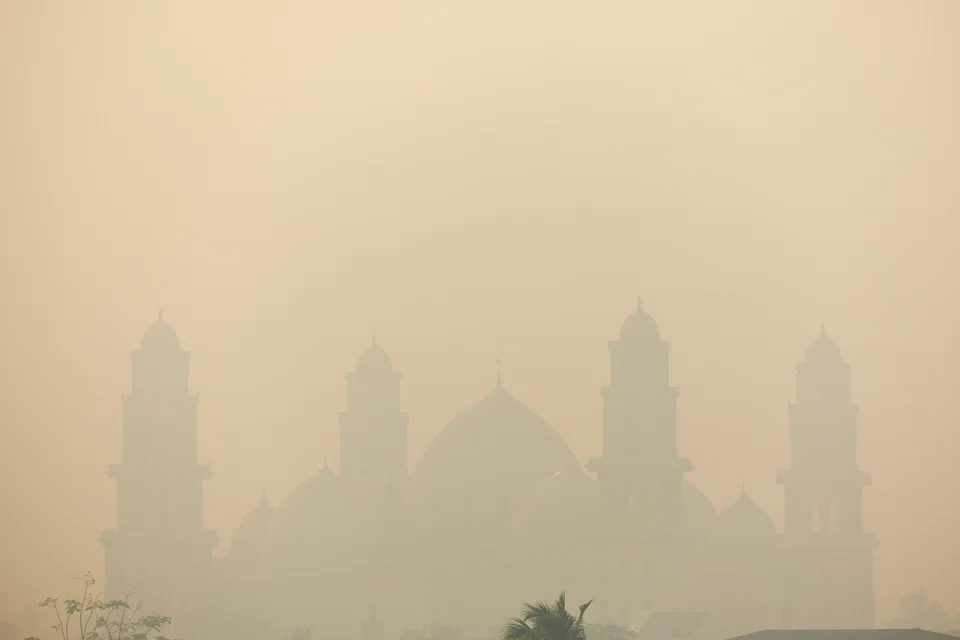
Toxic smoke from fires in Sumatra and Kalimantan in Indonesia has blanketed wide swathes of South-east Asia for weeks, with Singapore’s Pollutant Standards Index sitting in the unhealthy range since Sep 4, Malaysia closing schools in Kuala Lumpur and several states, and the air quality reaching hazardous levels in parts of Indonesia’s Central Kalimantan.
The amount of land burnt has not yet reached the level seen during the last episode of severe haze in 2015, even though the regional impact of the fires has been greater than in recent years, Moody’s economists Denise Cheok and Jeemin Bang noted.
Indonesia: Biggest downside risks
Indonesia has been tipped as the most exposed of the three countries facing the haze, with risks concentrated in agriculture, plantations and transport in the worst-hit regions.
The palm oil industry is particularly vulnerable, as drought is also affecting crop yields and river transport, said Tay Qi Hang, senior analyst at the Economist Intelligence Unit (EIU).
He estimates that the disruption could shave 0.2 to 0.3 percentage point off Indonesia’s full-year growth if the haze persists.
Flagging risks to fourth-quarter performance in particular, Lavanya Venkateswaran, senior Asean economist at OCBC, noted that agriculture accounts for 11 to 12 per cent of Indonesian gross domestic product, and plantation crops, 3 to 3.5 per cent.
Logistics disruptions would weigh on the most affected regions, and risks would become more meaningful if production disruptions began to affect palm oil export supply, she said.
SEE ALSO




Still, Maybank is maintaining its forecast for full-year growth of 5.3 per cent. Economist Brian Lee told The Business Times that the impact of lower plantation output, transport disruption and weaker labour productivity is likely to be felt mostly by fire-hit regions and sectors, “rather than large enough on its own to derail national growth”.
Meanwhile, UOB is keeping its 5.2 per cent forecast, pending Q3 data due on Nov 5.
Asean economist Enrico Tanuwidjaja said that the capital region of Java, which is outside from the main fire-hit provinces in Sumatra and Kalimantan, will remain “the key centre of domestic household consumption” for Indonesia.
“Together with the expectation of steady support from expansionary fiscal policies and liquidity support from the central bank, domestic demand is likely to remain upheld,” he told BT.
Yet, recurring haze, if left unaddressed, could impact the extent of foreign investment flowing into the region, he added.
Malaysia: Effects manageable
The haze is expected to weigh modestly on Malaysia’s Q4 growth, although it should not derail growth for the full year, economists told BT.
Tay is keeping EIU’s full-year forecast for growth of 5.6 per cent and inflation of 1.9 per cent, though he noted prolonged disruption could put some upward pressure on food prices.
As for the total cost of the haze episode, Ray Choy, chief economist at ratings firm Marc Ratings, said a prolonged episode could cost the Malaysian economy up to RM1 billion (US$245.1 million) a month, based on past haze episodes where quarterly growth slowed by 0.2 to 0.5 percentage point.
Maybank chief economist Suhaimi Ilias estimated that the economic impact of the haze came up to today’s equivalent of RM1.5 billion in 1997, and RM2 billion in 2013 – small against an overall Malaysian economy of more than RM2 trillion.
Indeed, Julia Goh, senior economist at UOB Malaysia, said the overall macroeconomic effect “should remain manageable unless conditions become more severe or prolonged”.
While tourism, aviation, agriculture and outdoor construction are the most exposed industries, Lee Heng Guie, executive director of the Socio-Economic Research Centre think tank, said that the “small dent on domestic demand” from the haze would be offset by strong electronic exports.
“The broader economy appears relatively insulated because manufacturing and most service activities can continue operating normally,” OCBC’s Lavanya said.
She added that there has not yet been any meaningful impact from the haze on inflation, as consumer prices “have remained remarkably well-behaved despite broader regional food and transport price pressures”, including in the food inflation basket.
“This gives Bank Negara Malaysia room to remain patient and assess incoming data rather than responding pre-emptively to the haze,” she told BT.
Singapore: No GDP downgrade expected
In Singapore, economists do not expect the haze to prompt a downgrade of the Ministry of Energy, Trade and Industry’s (METI) 4.5 to 5.5 per cent growth forecast.
ANZ head of research Khoon Goh said the forecast is more likely to be upgraded towards the top of the range. Food and beverage and tourism-related activity will be hit hardest, he said, but retail, accommodation and food services account for only 2.8 per cent of GDP.
The dollar cost of the haze “will definitely exceed 2015’s but may not (do so) as a percentage of GDP”, he said. “It depends on how long it lasts.”
Suan Teck Kin, head of research at UOB, said the episode should have “only a limited impact on Singapore’s headline GDP growth, even if poor air quality persists into November”.
UOB raised its in-house forecast for full-year growth to 5.7 per cent last week on artificial intelligence-related demand, from 5 per cent before. Suan said that METI could lift the official forecast to around 6 per cent in November.
Even though Moody’s Cheok and Bang expect some impact to tourism, some of the loss will be offset by major events such as the Formula 1 Singapore Grand Prix in early October, as most foreign visitors did not cancel their tickets.
“The contribution of tourism receipts and other haze-affected sectors to GDP has likely declined since 2015,” they added.
“The difference in costs to the economy, compared to 2015, would depend on whether the reduction in productivity in sectors such as construction and outdoor events outweighs their relative decline in contribution to GDP.”
Additional reporting by Tan Ai Leng in Kuala Lumpur
Decoding Asia newsletter: your guide to navigating Asia in a new global order. Sign up here to get Decoding Asia newsletter. Delivered to your inbox. Free.
Copyright SPH Media. All rights reserved.