As India and China surge ahead with nuclear energy, all eyes on Asean’s next move
The war in the Middle East beefs up the case for nuclear energy to underpin energy security

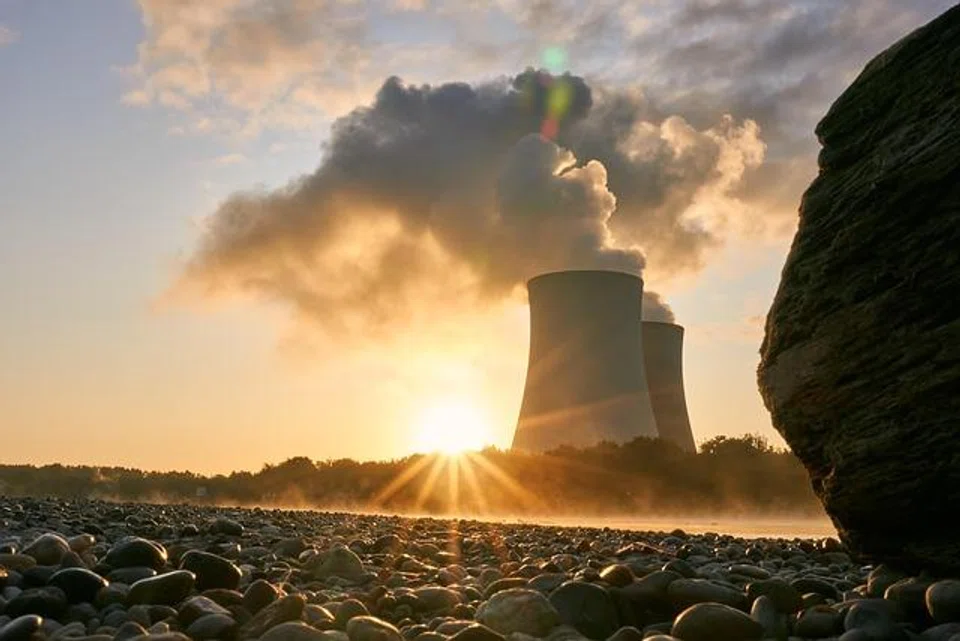
[SINGAPORE] This is shaping up to be a banner year for nuclear energy in Asia, as India and China ramp up additions and energy security fears from the Middle East war further fuel South-east Asia’s exploration of the power source.
Earlier this month, Singapore announced that it would participate in a review by the International Atomic Energy Agency (IAEA) on its ability to make an informed decision on nuclear energy.
Vietnam, meanwhile, is advancing plans for its first nuclear power plant, and recently signed deals with Russia. These moves come as Asia’s nuclear energy giants, China and India, double down.
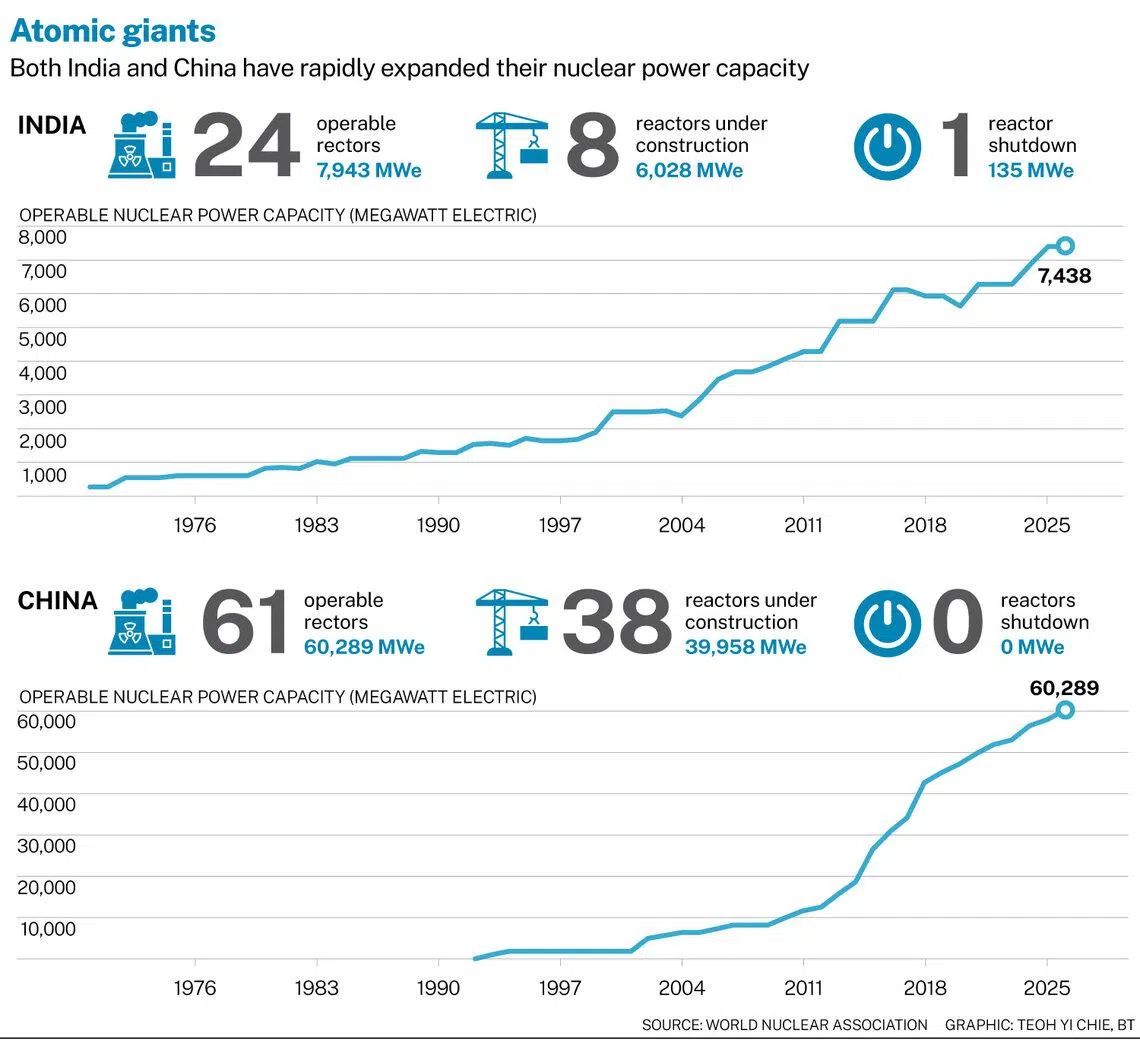
China could raise its existing nuclear capacity from 66 gigawatts (GW) to 132 GW by 2032, said Robert Liew of energy intelligence firm Wood Mackenzie. The country currently has 61 nuclear power reactors that are operable and 38 under construction, according to the World Nuclear Association (WNA).
Likewise, India’s nuclear fleet could more than double from 9 GW to 20 GW by 2031, said Liew, who is Wood Mackenzie’s director for renewables research in the Asia-Pacific ex-China. The subcontinent has 24 operable reactors with another eight being built, WNA data shows.
Research outfit BMI noted in a Mar 24 report that India and China “benefit from vertically integrated state-owned utilities, streamlined approvals and government-backed financing that mitigate traditional barriers” to nuclear energy.
'%3e%3cpath%20d='M12.1475%2025.5262C13.7713%2025.4295%2014.94%2023.913%2014.94%2021.8832C14.94%2019.5359%2013.474%2018.093%2011.5917%2018.093C11.3745%2018.093%2010.9582%2018.093%2010.8393%2018.1413V25.2086L11.8891%2025.5745C11.8891%2025.5745%2012.207%2025.5262%2012.1475%2025.5262ZM11.4934%2017.6281C13.2567%2017.6281%2014.3843%2016.4292%2014.3843%2014.4501C14.3843%2012.372%2013.275%2011.2973%2011.4339%2011.2973H10.8393V17.6305H11.4934V17.6281ZM6.66078%2025.6482L7.39265%2025.5492C8.02617%2025.4502%208.26403%2025.3053%208.26403%2025.1097V11.6149C8.26403%2011.4193%208.1451%2011.3709%207.23484%2011.249L6.68137%2011.173L6.6219%2010.7588H11.9508C15.7153%2010.7588%2017.0624%2012.0797%2017.0624%2014.1578C17.0624%2015.9666%2015.7748%2017.1909%2013.4969%2017.6305V17.7041C16.111%2017.948%2017.6571%2019.5382%2017.6571%2021.7636C17.6571%2024.3318%2015.8937%2026.0417%2012.1109%2026.0417H6.60132L6.66078%2025.6482Z'%20fill='%232B2B2B'/%3e%3cpath%20d='M20.6287%2025.6505L21.5596%2025.5515C22.1725%2025.4779%2022.4104%2025.3076%2022.4104%2025.112V11.249H21.9346C20.073%2011.3479%2018.982%2013.0095%2018.408%2014.6227L18.1907%2015.5018H17.6555L18.1701%2010.7588H29.3837L29.6421%2015.4787H29.1664L28.9491%2014.6227C28.3728%2012.8645%2027.3047%2011.2743%2025.5002%2011.249H24.9856V25.1856C24.9856%2025.3812%2025.1251%2025.4548%2025.9965%2025.5515L26.7695%2025.6505L26.829%2026.0417H20.5693L20.6287%2025.6505Z'%20fill='%232B2B2B'/%3e%3c/g%3e%3cdefs%3e%3cclipPath%20id='clip0_5242_21648'%3e%3crect%20width='24'%20height='16.8'%20fill='white'%20transform='translate(6%2010)'/%3e%3c/clipPath%3e%3c/defs%3e%3c/svg%3e)
Technological progress is another big tailwind behind both countries’ explosive growth in nuclear power.
In April, India’s prototype fast breeder reactor – a type of advanced nuclear reactor – hit a major milestone of “first criticality”, meaning that it achieved the start of a controlled chain reaction.
This is significant because India has traditionally used another type of nuclear reactor, known as the pressurised heavy water reactor, which runs on uranium and produces plutonium as waste.
In contrast, fast breeder reactors are able to consume both uranium and the waste plutonium, allowing greater energy extraction.
Once the reactor is fully operational, India will become the second country after Russia to have a commercial fast breeder reactor.
More notably, this technology could be adapted to use thorium as a fuel. Thorium is a radioactive metal which India has in abundance domestically.
China has also made inroads into harnessing thorium for nuclear power. Last year, it achieved a global first with the addition of thorium to a molten salt reactor, another type of nuclear reactor.
Like India, China has massive reserves of thorium, noted Dr Victor Nian, founding co-chairman of the Centre for Strategic Energy and Resources (CSER), a think tank.
Both countries are still relying on uranium imports for nuclear power fuel now. This supply chain exposure opens them up to energy-security issues with nuclear power.
The breakthroughs in thorium fuel thus hold the promise of greater energy independence for Asia’s nuclear power giants, said Dr Nian.
Thorium-based nuclear power has other advantages: It produces shorter-lived, less radioactive waste and is harder to weaponise.
When used as a fuel in China’s molten salt reactor, it has the added advantage of avoiding water-based cooling risks.
Another tech breakthrough is with small modular reactors (SMRs), a new class of nuclear reactors that are more compact and can be assembled in a modular fashion.
Besides Russia, China is the only country to have a working SMR. In December, Beijing announced that it would begin commercial operation of a domestically-built SMR, the Linglong One, in the first half of 2026.
The country is pushing the innovation boundaries with nuclear plant designs and applications in other industries. Said Dr Nian: “It is also developing a floating nuclear power plant and a modern salt reactor-powered vessel – that is, a nuclear-powered merchant vessel.”
Targets and market reform
China recently set an ambitious target to hit 110 GW of nuclear power capacity by 2030, an increase of over 75 per cent from end-2025.
India aims to hit the 100 GW mark by 2047, coinciding with its 100th year of independence.
Linda Zeng, a senior power and renewables analyst at BMI, said: “China’s policy direction has always been pro-nuclear, and (it) will continue its large-scale build-out.”
India is likewise accelerating nuclear power “as a strategic hedge for energy security”, she added.
Last December, it conducted a sweeping reform of the nuclear sector with the passing of the Sustainable Harnessing and Advancement of Nuclear Energy for Transforming India, or Shanti Bill. The legislation encourages private-sector participation in India’s nuclear power industry and the entry of foreign suppliers.
Abhi Bhuchar, Oliver Wyman’s head of energy and natural resources in the Asia-Pacific, noted India’s “broad political and natural appetite to be more self-reliant and not aligned with any particular geopolitical force”.
“Nuclear lends itself much more to that.”
“Back in the conversation”
Nuclear energy hit a global setback in 2011 after the Fukushima disaster. Several governments, including those of Japan, Germany and Belgium, backtracked on the technology.
But these three markets are now reconsidering their stance. BMI noted that as at March, Japan had restarted 12 nuclear power reactors, and is targeting a nuclear share of 20 to 22 per cent by 2030, up from 8 per cent in 2025.
Such moves “signal a pragmatic shift towards reassessment of nuclear’s role in balancing energy security”, it added.
Bhuchar said that nuclear power “is very much back in the conversation” and interest levels in Asia were already rising before the Iran war broke out.
“We’re all talking under this dark cloud of the Iran conflict, but the wind was changing even before this… there’s regulatory curiosity; the technology is mature,” he added.
Asean’s gradual steps
Unlike China and India, South-east Asia has wavered on nuclear energy over the decades. That said, interest is building up, with Vietnam being emblematic of the recent sentiment shift.
The country had been eyeing nuclear energy since the 1980s; in 2009, it proposed building two reactors in the Ninh Thuan province, more than 300 km east of Ho Chi Minh City on the country’s south central coast.
Vietnam backtracked on the project in 2016, in the face of high costs and safety concerns. But it revived the project in 2024 and in April 2026 inked a deal with Russia on nuclear power cooperation. State-owned Rosatom is expected to be involved in the construction of the Ninh Thuan 1 reactor.
Vietnam’s decision to revive the nuclear plant project is driven by its growing energy needs, on the back of ambitions to be “the next manufacturing hub of South-east Asia”, said CSER’s Dr Nian.
But it is not the only country to take the winding path on nuclear energy
The Philippines built a US$2.3 billion nuclear power plant in the coastal province of Bataan in 1984, with the decision influenced by the 1973 oil shock. The plant, however, never went into operation amid political turmoil, cost overruns and allegations of corruption. It remains unused today.
The Philippines is nevertheless exploring nuclearenergy in earnest, as are many other South-east Asian economies. Singapore, for instance, is taking part in the “Phase 1 Mission” of the Integrated Nuclear Infrastructure Review, a voluntary assessment by the IAEA for countries mulling nuclear energy.
As Prime Minister Lawrence Wong noted: “We must be confident not just in the technology itself, but in the entire supporting ecosystem around it: regulation, security, emergency response and waste management.”
The big coal question
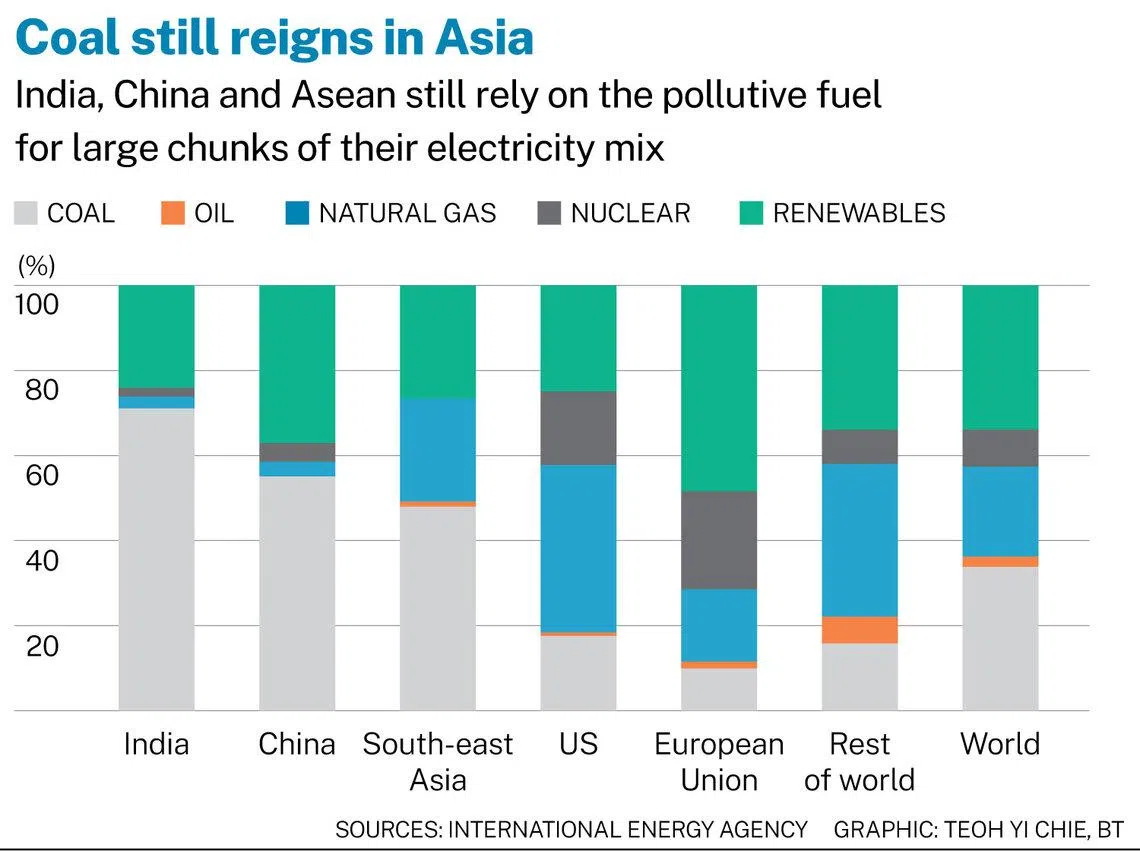
While interest in nuclear energy has surged, there is a hard-to-ignore reality: Coal is still king across Asia.
India relied on the pollutive fossil fuel for 71 per cent of its electricity generation mix last year; China tapped coal for 55 per cent of its mix, data from the International Energy Agency (IEA) indicated.
The figure in South-east Asia stood at 48 per cent.
And despite the recent breakthroughs, nuclear power made up just 4.5 per cent of China’s electricity mix, and 2.5 per cent for India.
As the war in Iran upends global energy markets, some observers fear that this could detract from the exploration of nuclear power and other low-carbon sources, and give a fillip to coal usage.
Coal can be appealing, given its abundance in South-east Asia and its qualities as a stable or “baseload” power source, in that it is unlike solar or wind power, for which energy output fluctuates according to weather conditions.
In the short term, countries are turning to coal as a “strategic reserve”, said Dr Nian, though he believes that there is a long-term momentum for nuclear power, driven by the need for both energy security and decarbonisation.
“The war is only going to amplify the sentiment that nuclear energy is a necessity; it’s not an option,” he said.
Bhuchar of Oliver Wyman expressed hope that individual jurisdictions will see clean power as a means to “control their destiny”, rather than to continue burning coal.
“And it is hoped that sustainability does not become a long-term victim of the war,” he added.
Decoding Asia newsletter: your guide to navigating Asia in a new global order. Sign up here to get Decoding Asia newsletter. Delivered to your inbox. Free.
Copyright SPH Media. All rights reserved.