Nuclear power: Singapore to undertake IAEA review on decision-making ability
Safety will always be the ‘overriding’ priority in Singapore’s consideration of nuclear power, says PM Wong

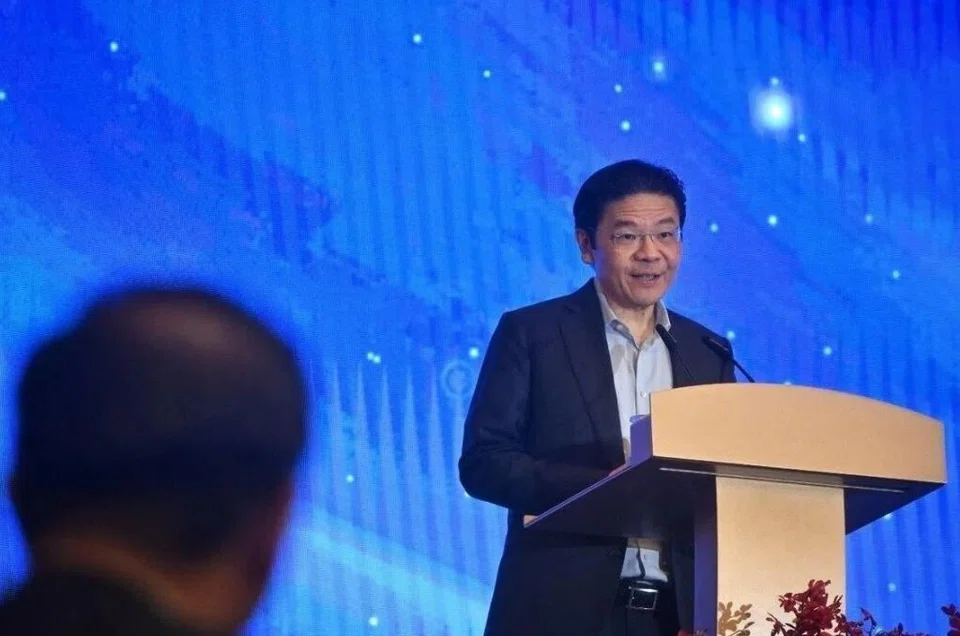
[SINGAPORE] Singapore will undertake a review in 2027 on its ability to make an informed decision on nuclear power, Prime Minister Lawrence Wong announced on Tuesday (May 19).
The Republic will take part in the “Phase 1 Mission” of the Integrated Nuclear Infrastructure Review (INIR), as it deepens its exploration of the clean energy source.
Conducted by international experts, the INIR is a voluntary assessment by the International Atomic Energy Agency (IAEA) for countries mulling nuclear power to ensure responsible development.
“This is not a decision to deploy nuclear power in Singapore,” said PM Wong in a speech at the Energy Market Authority’s (EMA) 25th anniversary dinner held at the Shangri-La Singapore hotel.
If a country decides to go ahead with nuclear power, there is still a second phase of the INIR on readiness to invite bids, and a third phase on safe commissioning and operation of the first plant.
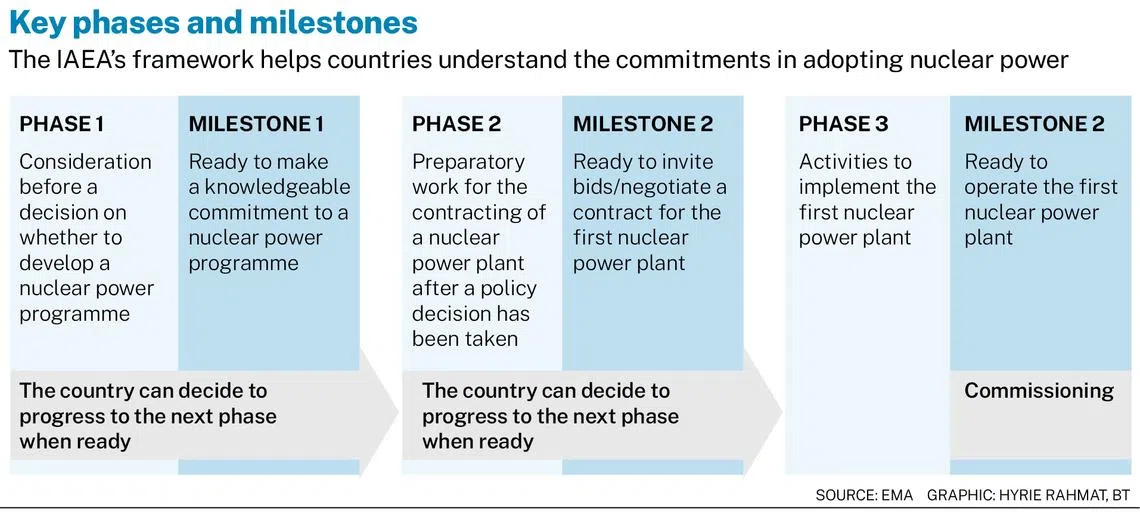
The preparation and infrastructure development for nuclear power can take over 15 years, and is a long-term commitment.
“For Singapore, the considerations are even more demanding because of our unique circumstances. Safety will always be our overriding priority. As a small and densely populated city-state, we have no margin for error,” PM Wong said.
“We must be confident not just in the technology itself, but in the entire supporting ecosystem around it: regulation, security, emergency response and waste management.”
This is why Singapore is starting the hard work of building capabilities now and proceeding step by step, added the PM, who was EMA’s chief executive from 2009 to 2011, before his entry into politics.
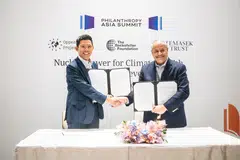
Singapore and its neighbours have shown renewed interest in nuclear power, especially with the rise of a new class of reactors, small modular reactors (SMRs).
South-east Asian countries that have completed the INIR Phase 1 mission are Malaysia, Indonesia, Vietnam, the Philippines and Thailand.
Vietnam recently advanced plans to build a nuclear power plant with Russia’s Rosatom, while the other countries have stepped up their exploration.
The Middle East energy crisis has also made the case for domestic nuclear power stronger, as countries seek to reduce their reliance on fossil fuel imports.
Next steps
Singapore is now preparing a self-evaluation report on 19 areas outlined in the IAEA’s “milestones approach” framework, which reflects international best practices on nuclear power deployment.
The 19 areas include radioactive waste management, emergency planning, human resources development, environmental protection and financing.
Singapore expects to undertake the main INIR mission in 2027. This involves a week-long plenary interview conducted by IAEA experts, right after which the agency will publish its key findings.
The mission report is expected to be finalised in 2027 or 2028, with IAEA detailing its observations, recommendations and suggestions.
Singapore will keep the public informed throughout the process and openly share the IAEA’s findings, including any risks and challenges highlighted, said PM Wong.
“Along the way, be it through the IAEA review or our own further studies, there may well be findings that lead us to conclude that nuclear is not the right path for Singapore. If so, we will accept the conclusion,” he said.
Even then, the effort will not be wasted, with such knowledge being valuable as nuclear power enters South-east Asia’s energy mix.
In 2022, a report commissioned by EMA found that nuclear power could supply 10 per cent of the country’s energy needs by 2050.
Singapore has since inked multiple international agreements to study nuclear power and unveiled plans to train nuclear safety experts.
Nuclear power is less exposed to fluctuations in global fuel prices, allowing stable electricity generation costs.
Its high energy density is another plus: Five uranium pellets – each smaller than a thumb – can generate the same amount of energy as an Olympic-sized swimming pool of natural gas, PM Wong noted.
EMA mulls update for energy imports
Separately, he said that EMA is looking into how the electricity market framework can be updated to facilitate energy imports into Singapore.
The challenge with regional electricity imports is in balancing cost-competitiveness with the certainty of long-term revenue streams. The latter is a requirement for developers to secure financing.
“EMA is studying how the market framework can be updated to address these issues, and enable import projects which are commercially viable,” PM Wong said.
“If importers bring in low-carbon electricity, we ought to recognise the value of its green attributes. But the premium over fossil fuel-generated power must still be competitive relative to other decarbonisation pathways, such as carbon credits.”
Singapore currently relies on natural gas imports to generate 95 per cent of its electricity. Natural gas will continue to anchor the energy mix, which is why Singapore is investing in a second liquefied natural gas terminal, he said.
But it is actively diversifying its energy mix. Beyond nuclear power and regional energy imports, the Republic has also been increasing solar power deployment and exploring alternatives such as geothermal and hydrogen power.
There is “no silver bullet”, as every energy pathway comes with trade-offs and constraints, “but our responsibility is to plan ahead and build resilience early”, PM Wong said.
Congratulating EMA on its progress since 2001, he said that the next 25 years “will be even more challenging than the last”.
Decoding Asia newsletter: your guide to navigating Asia in a new global order. Sign up here to get Decoding Asia newsletter. Delivered to your inbox. Free.
Copyright SPH Media. All rights reserved.