
Indian refiners lock in tankers as freight volatility raises crude import costs
Higher shipping rates and geopolitical disruptions are reshaping India’s oil transportation strategies
[BENGALURU] India’s biggest refiners, including Reliance Industries, Bharat Petroleum Corp and Indian Oil Corp (IOC), are moving to secure tankers through long-term charters or outright purchases as volatile freight rates and shipping disruptions ratchet up the cost of importing crude.
The stakes are high for India, which imported 88.7 per cent of its crude oil requirements in 2025 to 2026, up marginally from the previous financial year, according to Petroleum Planning & Analysis Cell data.
This makes the cost and availability of shipping crucial to bringing that overseas crude home.
Reliance Industries has increased its fleet of time-chartered supertankers from about seven or eight vessels to around 12, and Bharat Petroleum is looking to extend its existing tanker charters by three years, Bloomberg reported on Nov 20, citing sources.
IOC is also looking to acquire vessels of its own, with its board having approved the purchase of a few ships and tenders already issued, said Anuj Jain, the company’s director of finance, during its second-quarter earnings call.
Indian refiners are gradually moving away from booking ships voyage by voyage and are coordinating shipping more closely with crude purchases, noted Deepak Chelladurai, founder of oil and freight market intelligence firm Arkline Research.

He explained that this was because long-term time charters allowed refiners to secure vessels at predetermined daily-hire rates, providing greater control over cargo movements, loading schedules and delivery planning.
Sumit Ritolia, who leads refining and modelling at ship-tracking firm Kpler, said: “Locking in tonnage is now partly a supply-security decision, not just a cost one.”
The economics of getting crude home
The price at which a refiner buys crude is only one part of the cost of securing a cargo. What ultimately matters is the total landed cost, which includes freight, insurance, transit time, financing and other logistical expenses, said Chelladurai.

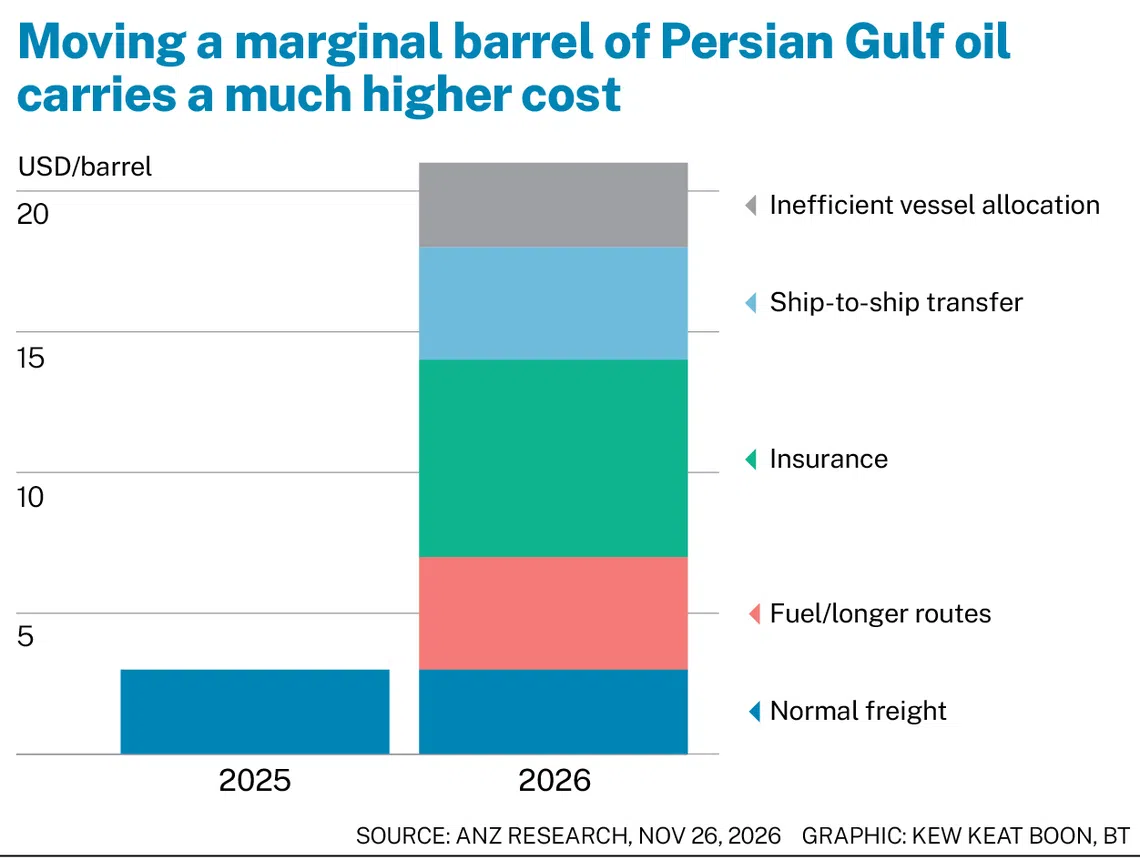
The cost of shipping crude from the Persian Gulf has risen from around US$3 per barrel before the US-Iran conflict to around US$20 per barrel in 2026, according to a note from ANZ Research.
The impact is particularly evident in discounted Russian crude.
Higher freight and insurance costs are increasingly eroding these discounts, noted Ritolia, adding that even when Russian barrels are offered at attractive prices, the savings can narrow once transportation costs are factored in.
Securing capacity to manage freight costs
Securing tanker capacity in advance through long-term contracts can offer refiners greater visibility over transportation costs and reduce the risk of being caught short of vessels during periods of disruption, analysts said.
The potential savings from securing capacity in advance were highlighted during IOC’s Q2 earnings call, when Jain said that its existing crude tanker time-charter arrangements were costing about US$2 to US$2.50 per barrel compared with prevailing spot-market costs of around US$8 to US$10 per barrel at the time.
Chelladurai said that while the difference shows the potential advantage of locking in transportation capacity ahead of a freight-market spike, such a gap should not be viewed as permanent.
Time charters also provide refiners with greater flexibility and cost predictability at a time when Middle Eastern freight costs remain elevated and companies are diversifying crude sourcing towards Africa, Brazil and other regions, noted Ritolia.
Chelladurai sees time charters as a middle ground, allowing refiners to secure capacity without taking on the full costs of owning a fleet.
Shipping as a strategic advantage
More than 85 per cent of India’s crude imports come from just six countries, leaving India reliant on a relatively small group of suppliers and vulnerable to disruptions, said Hemant Mallya, fellow, Council on Energy, Environment and Water (CEEW).
Expanding purchases from the Atlantic Basin, including the Americas and West Africa, could help reduce this dependence.
However, longer voyages, vessel availability and whether refineries can process the grades on offer will determine how viable these alternatives are, he added.
Chelladurai pointed out that having suitable tankers available could make it easier for refiners to pursue attractive crude-buying opportunities in distant markets, manage transportation and capture commercial gains.
The competitive advantage, however, may not necessarily come from owning the largest tanker fleet. Rather, it lies in how effectively refiners coordinate crude procurement, vessel availability, freight costs and refinery requirements, he argued.
This is also reflected in IOC’s plans to expand its shipping capabilities.
Alongside its plans to acquire vessels, the company is considering building ships domestically under the government’s Make in India initiative, said Jain during the earnings call.
The trade-off between security and flexibility
Freight rates have started to ease in November, although they remain above pre-war levels, said Ritolia. If rates fall further, the cost advantage of long-term charters could narrow, making spot-market bookings more attractive, especially for refiners whose crude-sourcing requirements change frequently, he noted.
Chelladurai also cautioned that long-term charters can become costly when vessels are underutilised, as refiners must continue paying hire charges even when the vessels are not in use.
Rather than relying exclusively on one arrangement, he favours a combination of owned vessels, time-chartered capacity and spot-market bookings.
Ritolia also expects refiners to adopt a hybrid approach rather than make a wholesale shift towards vessel ownership.
But while a mix of shipping arrangements can help refiners manage transportation risks, strengthening India’s crude supply chain requires a broader set of measures.
CEEW’s recommendations for strengthening India’s crude supply chain include putting strategic stock-holding on a statutory footing, securing more supplies through term contracts and stakes in upstream projects, and upgrading refineries to process a wider range of crude grades.
The think tank also recommends diversifying transport fuels to reduce import dependence, Mallya said.
Decoding Asia newsletter: your guide to navigating Asia in a new global order. Sign up here to get Decoding Asia newsletter. Delivered to your inbox. Free.
Copyright SPH Media. All rights reserved.