



Mercedes-Benz, Porsche choose Singapore for high-profile global debuts
Such unveilings – rare outside the US, Europe and China – attest to the Republic’s growing status as a regional platform


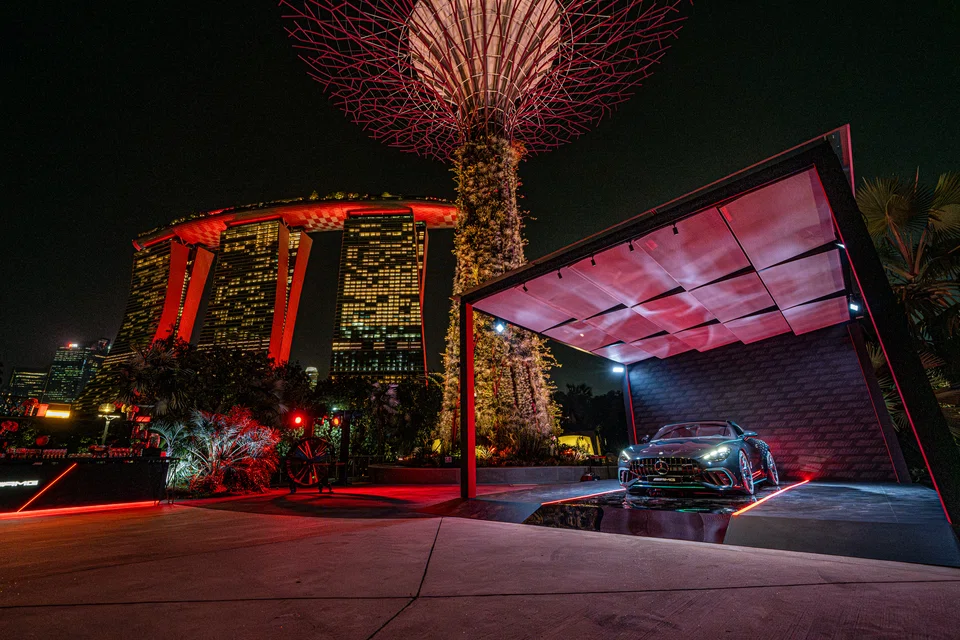
A LIMITED-EDITION Mercedes-Benz sports car made its global debut – not at Pebble Beach or Goodwood – but at Singapore’s Gardens by the Bay on Thursday (Sep 19).
The German luxury carmaker launched the Mercedes-AMG GT 63 Pro Motorsport Collectors Edition. Aimed at car enthusiasts with deep pockets, it is priced on application but may cost at least S$1.5 million without a Certificate of Entitlement (COE), according to industry estimates.
The fast Benz is the third model to see a global debut in Singapore this year – or indeed, ever. Before 2024, there were no global-level car launches in the Republic.
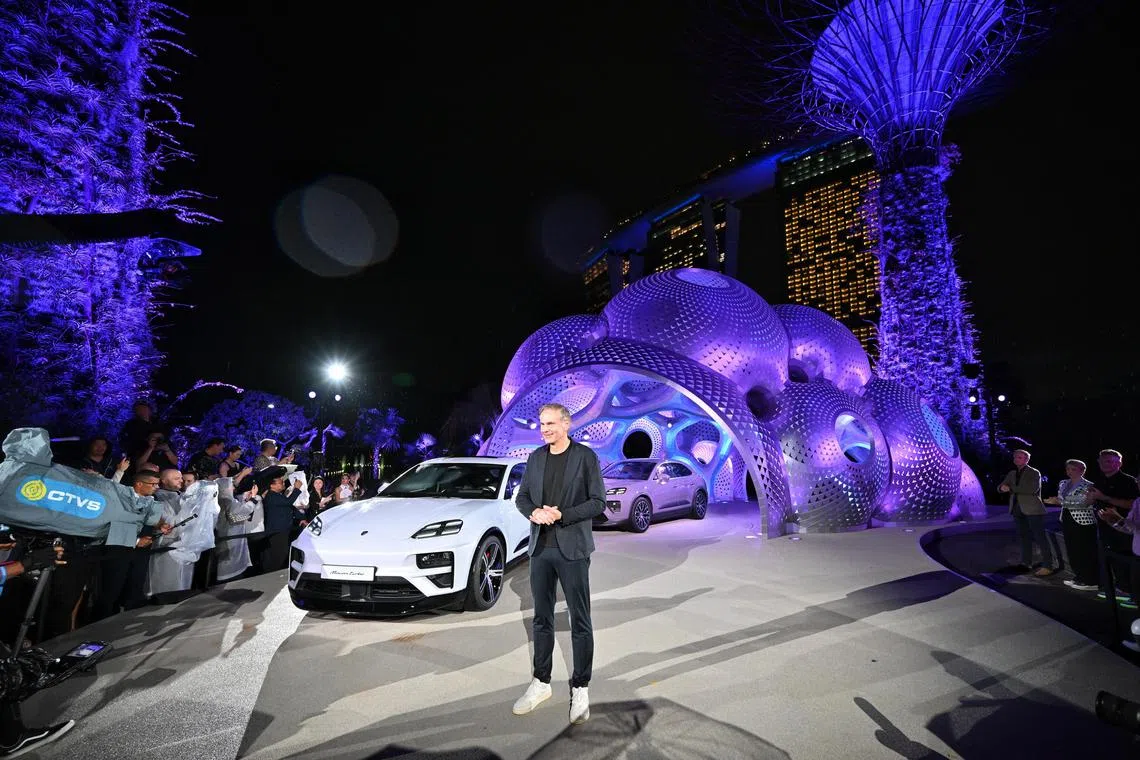
In January, Porsche was the first car manufacturer to hold an international unveiling here, launching the Macan sport-utility vehicle. The second global launch in Singapore was also by Porsche – a limited-edition version of its Taycan electric vehicle (EV) in September.
Industry observers expect more such launches, attesting to Singapore’s rise as a major platform for showcase events – as well as the industry’s shift away from China as a luxury market.
Fast love
The top factors in selecting a global launch venue are the model’s expected sales volume, the brand dynamics, target demographics, and projected media value return, said a manager with experience working for German car brands in marketing and public relations roles.
In the past, German carmakers focused on the largest markets for launches, which typically meant Europe, the US and China.
In response to queries from The Business Times, Mercedes-Benz and Porsche said potential sales numbers were not a priority when choosing Singapore, as the Republic has a small market. Rather, other factors tipped things in its favour.
“Singapore’s reputation as a premier business and cultural hub aligns perfectly with the luxury and prestige associated with Mercedes-Benz,” said a spokesperson for the company.
SEE ALSO




A Porsche spokesperson said Singapore’s history, multicultural background and image as a modern, technologically advanced city made it “the perfect backdrop” for the launch of the Macan, which was being offered as a fully electric model for the first time.
The presence of high-net-worth individuals (HNWIs) in Singapore also influenced the decision to premiere expensive limited-edition sports cars here.
Porsche’s second debut in Singapore, the Taycan Turbo S Celestial Jade, is a one-off car from its custom car programme Sonderwunsch. Currently touring South-east Asia, it will be auctioned in 2025 and is expected to cost around three times as much as a regular Taycan Turbo S, which retails for about S$900,000 without a COE.
The Mercedes-AMG GT 63 Pro Motorsport Collectors Edition is inspired by the brand’s Formula One team and is limited to 200 units globally, with two available in Singapore.
Porsche said Singapore’s large presence of HNWIs was “certainly” a consideration, while Mercedes-Benz said that this “naturally aligns” with the brand, although both emphasised it was not the only reason.
Reaching beyond
Singapore is also attractive as a high-visibility and easily accessible locale.
“High-visibility events like the Singapore Grand Prix offer exceptional platforms to enhance our brand’s visibility and give us an opportunity to engage with automotive enthusiasts that come to Singapore from all over the world in a unique setting,” said the Mercedes-Benz spokesperson. Thursday’s launch was timed ahead of this weekend’s Formula One race.
Singapore has strong local and international media presence, which would ensure that the debut garners global attention, the spokesperson added.
For Porsche, logistics was also an important consideration, due to the scale of its events.
The Macan is Porsche’s best-selling model worldwide, accounting for a third of its total sales. As the carmaker invited more than 100 international media representatives to the event, openness to global media access and supporting services such as hotels and transport were crucial, said its spokesperson.
After the launch, Porsche followed up with an even larger event in March – its annual global dealer conference at Marina Bay Sands. The two-week event saw 1,800 attendees from 100 countries as well as an appearance by brand ambassador, pop star Dua Lipa.
The industry estimates the cost of the two events to total around S$10 million to S$15 million.
“On the supply side, what (Singapore) offers is very good soft and hard infrastructure,” said Edward Lee, chief economist and head of FX Asean and South Asia Global Research, Standard Chartered. “Easy to get in, easy to set up your shows, getting permits and all is probably very smooth as well.
“You want to be situated at a place where you can market, where you can reach your crowd... I think Singapore stands in a very good space (here).”
Stage for the region
As China’s car market cools on foreign brands, brands are also looking at Singapore as a platform for the region.
Singapore serves as a “strategic gateway to the Asia-Pacific region, allowing us to connect with a broader audience of automotive enthusiasts and potential customers”, said Mercedes-Benz.
Porsche’s decision to hold two global launches in Singapore was also influenced by earlier moves it had made in South-east Asia.
These include the assembly of cars in Malaysia, which started in 2022, as well as two upcoming projects – the Porsche Experience Centre Singapore and the Porsche Design Tower luxury residential development in Bangkok.
In China, meanwhile, both Mercedes-Benz and Porsche have seen EV sales plunge recently. BMW also reported lower-than-expected profit margins in the second quarter.
Eric Robertsen, global head of research and chief strategist for Standard Chartered, told BT that luxury brands of the world have “recognised that China is probably not going to be the kind of golden ticket for them going forward”.
Luxury brands, including European automotive companies, are therefore looking at alternative markets – and the concentration of wealth is now spread across Asean and South Asia, not just in Singapore and Hong Kong, as was the case a decade or so ago.
“Singapore is an obvious platform for the rest of the region, and I think that works in the country’s favour,” he said.
Decoding Asia newsletter: your guide to navigating Asia in a new global order. Sign up here to get Decoding Asia newsletter. Delivered to your inbox. Free.
Copyright SPH Media. All rights reserved.






