


In new era of supersonic travel, a Singapore-London flight could take just five hours
[LONDON] Imagine boarding a flight in Singapore and arriving in London in a little over five hours, instead of the 12 to 13 hours it takes currently to complete the journey of well over 10,000 km.
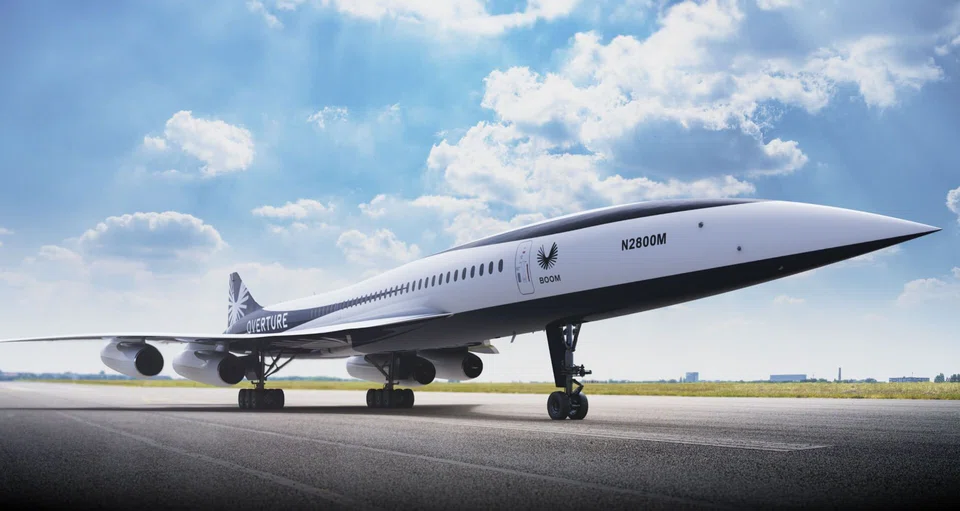
It may seem incredulous to many, but for US airplane manufacturer Boom Supersonic, it is a reality that’s perhaps not too far away. The Colorado-based company insists its latest supersonic airliner, called Overture, can reach a speed of Mach 1.7 – that’s 1.7 times the speed of sound, or 1,800 kmh.
At the Paris Air Show in June, Boom revealed that there are as many as 130 such planes on order from the likes of American Airlines, United Airlines and Japan Airlines, with the aim to deliver them by 2029.
The Overture can fit up to 80 passengers and can cruise at an altitude of 60,000 feet. In comparison, a Boeing 737 jet can reach heights of around 41,000 feet.
And unlike the sleek but extremely noisy Concorde plane that was the first to break the sound barrier in the 1960s, Boom said the Overture will meet noise levels that already apply to subsonic planes. It will also run solely on sustainable aviation fuel.
A ticket on the Overture will be largely similar to business-class and first-class levels on current commercial carriers, company executives disclosed at the Paris Air Show.
Lofty ambitions
To put Boom’s ambitions in perspective, the Concorde – which made its last flight two decades ago in November 2003 – flew at twice the speed of sound and completed a flight from New York to London in just under three hours.
The fastest plane in history is Lockheed’s SR-71 Blackbird, which once travelled at Mach 3.3, or over 4,000 kmh.
Today, there are some manufacturers that have lofty ambitions to produce commercial jets that can fly at Mach 4 and even Mach 5. Assuming their tests meet stringent global aviation requirements, it could result in a flight from Singapore to London taking just two hours. For a journey from London to New York, it would be even shorter, at only 60 minutes.
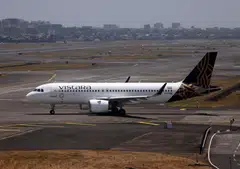
Among the other frontrunners in this supersonic race is Destinus, a Swiss aerospace firm that has raised 50 million euros (S$73.1 million) from the EU and private investors.
The company hopes to get its hydrogen-fuelled Destinus-3 supersonic jet in the air for tests as early as 2024, with the aim of flying at five times the speed of sound at around 108,000 feet. The target is to operate a first commercial flight by 2030.
“We are working on the hydrogen economy becoming a reality, which I think will happen,” said Destinus founder Mikhail Kokorich in a recent TV interview. “There is going to be a tsunami of hydrogen technology.”
Then there’s Hermeus, a US startup that counts Sam Altman – the chief executive of ChatGPT creator OpenAI – among its main backers.
The other companies making waves include Richard Branson’s Virgin Atlantic, Venus Aerospace in the US, and British aerospace manufacturer Reaction Engines.
Boom Supersonic, Hermeus and Reaction are among those that plan to use conventional aviation fuels, or sustainable versions of those fuels made from renewable sources. According to the companies’ disclosures, their engines will burn oxygen from the atmosphere.
One of the more ambitious companies out there is Venus Aerospace. It is working on a plane called the Stargazer, which it claims will be able to reach an astonishing top speed of Mach 9. That would mean a trip from Singapore to London would barely take an hour to complete.
Venus Aerospace previously said it secured funding from Airbus Ventures, the independent venture capital arm of the European plane maker. Dakin Sloss, the founder of venture capital firm Prime Movers Lab, is another major investor.
Decoding Asia newsletter: your guide to navigating Asia in a new global order. Sign up here to get Decoding Asia newsletter. Delivered to your inbox. Free.
Share with us your feedback on BT's products and services






