US will find ‘another way’ if talks with Iran to end war fail: Rubio
Trump on May 24 said he had told his representatives not to rush into any deal
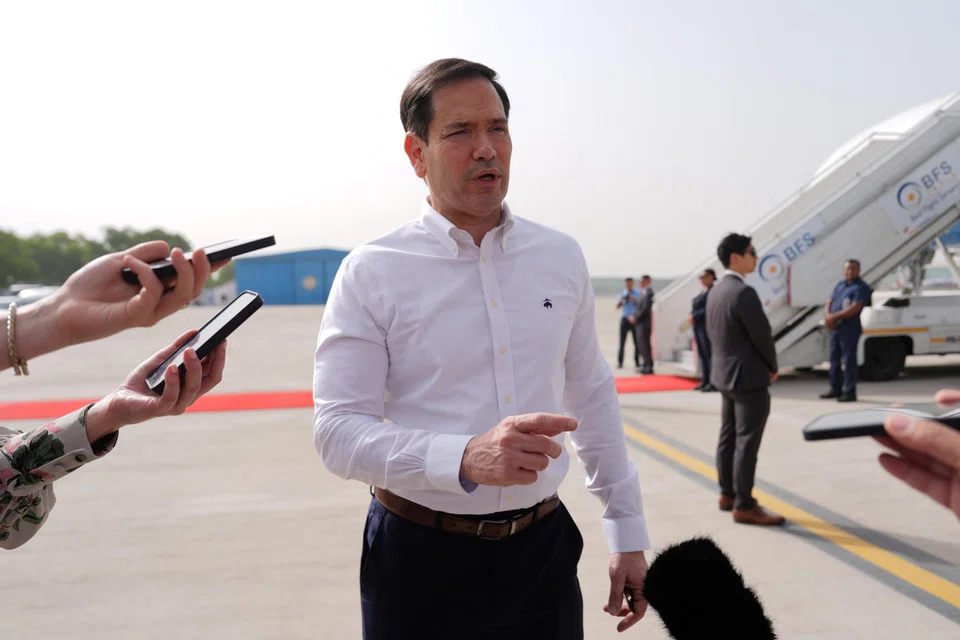
[WASHINGTON/ISLAMABAD] The US will either have a good agreement with Iran or deal with the country “another way,” US Secretary of State Marco Rubio said on Monday (May 25), as Washington played down hopes for an imminent breakthrough in the three-month-old war.
Rubio told reporters in New Delhi that the US would give diplomacy every chance to succeed before exploring “alternatives”, after President Donald Trump said on Sunday he had told his representatives not to rush into any Iran deal.
There was a “pretty solid thing on the table in terms of their ability to open up the strait, get the strait open, enter into a very real, significant, time-limited negotiation on the nuclear matter, and hopefully we can pull it off,” Rubio said.
On May 24, Trump wrote on Truth Social that the US blockade on Iranian ships in the Strait of Hormuz would “remain in full force and effect until an agreement is reached, certified, and signed”.
“Both sides must take their time and get it right,” he added.
There was no immediate response from Iran’s government. But Tasnim news agency, which is linked to Iran’s Revolutionary Guards, said the US was still obstructing parts of a potential deal, including Teheran’s demand for the release of frozen funds.
During military conflict, Iran’s tactic was “an eye for an eye,” and in diplomatic conflict it is “action for action”, Ebrahim Rezaei, the spokesperson of the Iranian parliament, said on Monday.
Iran would not yield to pressure or threats, and if the United States wanted an agreement it should negotiate, but if it wanted $6-gasoline it could continue bluffing, he added on X.
Oil prices fell 6 per cent to two-week lows as optimism grew that the US and Iran were moving closer to a peace deal.
SEE ALSO




Trump raised expectations of an imminent deal on May 23 when he said Washington and Teheran had “largely negotiated” a memorandum of understanding on a peace agreement that would reopen the Strait of Hormuz.
Before the conflict, the critical waterway had carried a fifth of global shipments of oil and liquefied natural gas.
The two sides remain at odds on several difficult issues, such as Iran’s nuclear ambitions, Israel’s war in Lebanon with the Iranian-backed Hizbollah militia and Teheran’s demands for the lifting of sanctions and the release of tens of billions of dollars of Iranian oil revenues frozen in foreign banks.
Sticking points
A senior Trump administration official outlined what he said were the latest contours of issues being negotiated.
Speaking on the condition of anonymity, the official said Iran had agreed “in principle” to open the Strait of Hormuz, in exchange for the US lifting its naval blockade, and to dispose of Teheran’s highly enriched uranium.
The US understood Iran’s Supreme Leader Ayatollah Mojtaba Khamenei had endorsed the broad template of the deal, he added.
There was no immediate confirmation from Iran or elaboration on what an “in principle” agreement meant.
The US official said Washington envisioned first reopening the strait and lifting the US naval blockade. Negotiating the details of the nuclear measures would take more time, he said.
The official pushed back on suggestions that Iran has not accepted disposing of its stockpiled enriched uranium. “It’s a question about how,” the official said.

A second senior administration official said on Sunday that the proposed framework would give negotiators 60 days to reach a final deal.
Iranian sources had told Reuters that in future stages, “feasible formulas” could be found to resolve the dispute over its highly enriched uranium stockpile, including diluting the material under the supervision of the UN nuclear watchdog.
Iran has long denied US and Israeli accusations that it is pursuing nuclear weapons and says it has a right to enrich uranium for civilian purposes, although the purity it has achieved far exceeds that needed for power generation.
Deal draws out US critics
Trump, whose approval ratings have been hit by the war’s impact on US energy prices and who has faced congressional efforts to curb his war powers, has repeatedly played up the prospect of an agreement to end the conflict that the US and Israel started on Feb 28. A tenuous ceasefire has been in place since early April.
The president hit back at critics of his handling of the negotiations and his willingness to compromise with Iran.
“If I make a deal with Iran, it will be a good and proper one ... So don’t listen to the losers, who are critical about something they know nothing about,” Trump posted on May 24.
Any deal reinforcing the current fragile ceasefire would bring relief to markets but not immediately quell a global energy crisis, which has driven up costs of fuel, fertiliser and food.
The US-Israeli bombing of Iran killed thousands of people in Iran before it was suspended in early April.
Israel has also killed thousands more and driven hundreds of thousands from their homes in Lebanon, which it invaded in pursuit of Hizbollah. Iranian strikes on Israel and neighbouring Gulf states have killed dozens. REUTERS
Decoding Asia newsletter: your guide to navigating Asia in a new global order. Sign up here to get Decoding Asia newsletter. Delivered to your inbox. Free.
Share with us your feedback on BT's products and services