



Trade, Taiwan, Iran war, AI: What to expect at the Sep 24 Trump-Xi summit in Washington
Markets watching for signs of an extension of a tariff truce announced after the October 2025 Trump-Xi summit
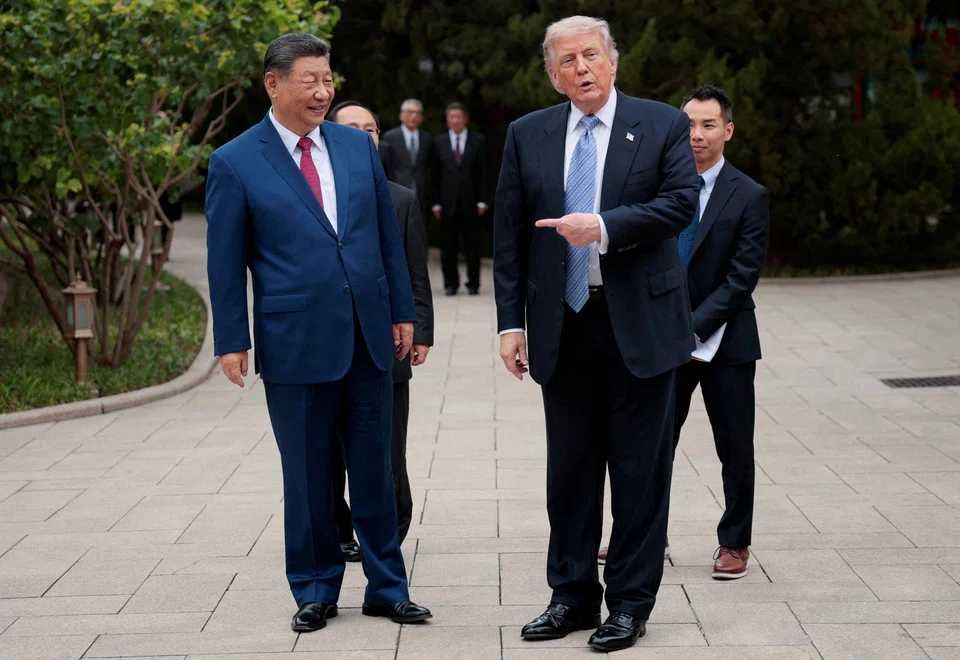
[WASHINGTON/BEIJING] US President Donald Trump will welcome Chinese leader Xi Jinping next week for their second meeting in 2026, as the two leaders seek stability in a relationship under pressure over issues ranging from trade to Taiwan and Iran to global worries about artificial intelligence.
Xi arrives for his first White House visit in a decade at the helm of an economy on track to post a US$1 trillion trade surplus for a second straight year. Trump, mired in the Iran war and with low approval ratings, is looking for trade wins he can tout to Americans unhappy with rising prices.
Here are some of the key issues for the Sep 24 summit, which follows Trump’s May visit to Beijing:
Trade truce or back to trade war?
Markets will watch for signs of an extension of a tariff truce announced after a Trump-Xi summit in South Korea in October 2025 and set to expire on Nov 10. That deal paused a trade war in which the world’s two largest economies threatened global supply chains with tit-for-tat tariffs that topped 100 per cent.
US Trade Representative Jamieson Greer said in September the countries will make “some announcements on agriculture and non-tariff barriers” and traders will be watching for progress on an agreed mutual tariff reduction covering US$30 billion in goods – a step China could most easily take by cutting duties on US agricultural imports.
US officials say they have continued to press China to address its lack of compliance with 2025’s agreement, while Beijing has pressed for further tariff relief.
Jets, farm produce and tech
Trump will be looking to announce trade wins ahead of November midterm congressional elections, including by locking in high-profile purchases of Boeing aircraft and agricultural products.
Sources told Reuters in September that Xi is preparing a large business delegation to accompany him similar to 2015, when China signed a US$38 billion agreement for 300 Boeing aircraft. China said after the May summit that it would buy 200 more Boeing jets and the company said this was only an “initial tranche” of a potentially far bigger deal.
China has been in prolonged talks with Boeing for a transaction that industry sources say could include 500 737 MAX jets, plus dozens of wide-body planes, a deal stalled for years as Trump has threatened to cut off China’s access to critical spare engine parts.

Beijing has been pressing the US to further delay a rule that would bar thousands of Chinese firms from receiving advanced US technology, while Washington wants Beijing to ease shipments of rare earths and critical minerals used in high-tech applications from automobile to aerospace manufacturing, as well as defence.
Iran war
The two presidents are expected to discuss the Iran war, which Trump has struggled to end after launching it with Israel in February.
China maintains close ties to Teheran and is by far the world’s biggest buyer of Iranian oil exports. Washington sees Xi as uniquely able to exert pressure on Teheran, but he has shown little inclination to do so. In August, Reuters reported that Beijing is selling billions of dollars’ worth of goods to Iran through a sanctions-evasion scheme. China’s foreign ministry says it is not aware of such a scheme.
Despite US frustration, US Treasury Secretary Scott Bessent stopped short of imposing penalties on Chinese banks when he in August unveiled an “economic onslaught” against Iran and warned countries to cut business ties with Teheran.
Bessent has said he would meet Chinese Vice-Premier He Lifeng this weekend and that Trump and Xi would continue discussions on China’s financial ties to Teheran during the summit.
On Sunday (Sep 13), Trump brushed aside a report that Iran acquired satellite images of a base in Jordan from Chinese entities before an attack that killed three US troops there in July.
Taiwan
China has long been hoping to extract concessions from Trump over Taiwan, a democratically governed island Beijing claims as its own, and the world’s leading producer of cutting-edge chips. Taiwan strongly objects to China’s sovereignty claims and says only the island’s people can decide their future.
US law requires the administration to provide Taiwan with the means to defend itself, but questions have been hanging over a large pending arms package worth up to US$14 billion since Trump’s Beijing visit.
People familiar with Chinese efforts told Reuters Beijing hopes to persuade Trump to state publicly that the US opposes Taiwan’s independence instead of saying only that it does not support independence, which has been Washington’s formulation for decades.
Any US shift on Taiwan would be highly controversial, raising questions about Washington’s resolve to defend the island, alarming allies across Asia and provoking opposition in Congress.
Artificial intelligence
Analysts see artificial intelligence as a potential area for cooperation, given its implications for national security, economic competitiveness and military capabilities, and shared US and Chinese concerns about misuse. However, experts say intense competition in the field between the countries is likely to limit the scope for anything beyond symbolic agreements.
On Wednesday, Axios cited a statement from Bessent as saying that the United States was open to discussing shared risks with China in AI talks this weekend.
US lawmakers have urged new rules to govern AI systems, while Dario Amodei, chief executive of U.S. artificial-intelligence firm Anthropic, warned in September that Chinese dominance in AI could pose security risks to the US.
Chinese state media dismissed Amodei’s warning as coming from a “Cold War playbook” while Trump has brushed aside calls to slow AI development, saying that “very negative forces” were raising exaggerated concerns.
Fentanyl flows
Curbing the flow of fentanyl precursor chemicals from China remains a concern of the Trump administration, given the ravages the drug has caused among Americans.
Washington has repeatedly accused Beijing of failing to stem the flow of precursors, and Trump imposed fentanyl-related tariffs on China in early 2025 that the US Supreme Court struck down in February.
FBI Director Kash Patel told Reuters in August that he had forged a new law enforcement partnership with China in hopes of curbing the trade. REUTERS
Decoding Asia newsletter: your guide to navigating Asia in a new global order. Sign up here to get Decoding Asia newsletter. Delivered to your inbox. Free.
Share with us your feedback on BT's products and services
TRENDING NOW

DBS, OCBC, UOB rout lops billions off STI as inflation, rate concerns spook investors

Grab CEO’s wife Chloe Tong on life with Anthony Tan and finding her purpose

OCBC sheds S$8 billion in value as shares close nearly 6% down; analysts cautious on banks

Deal between tycoon friends sparks scrutiny of Philippine power sector

