



UK PM Rishi Sunak faces tough economy going into election year
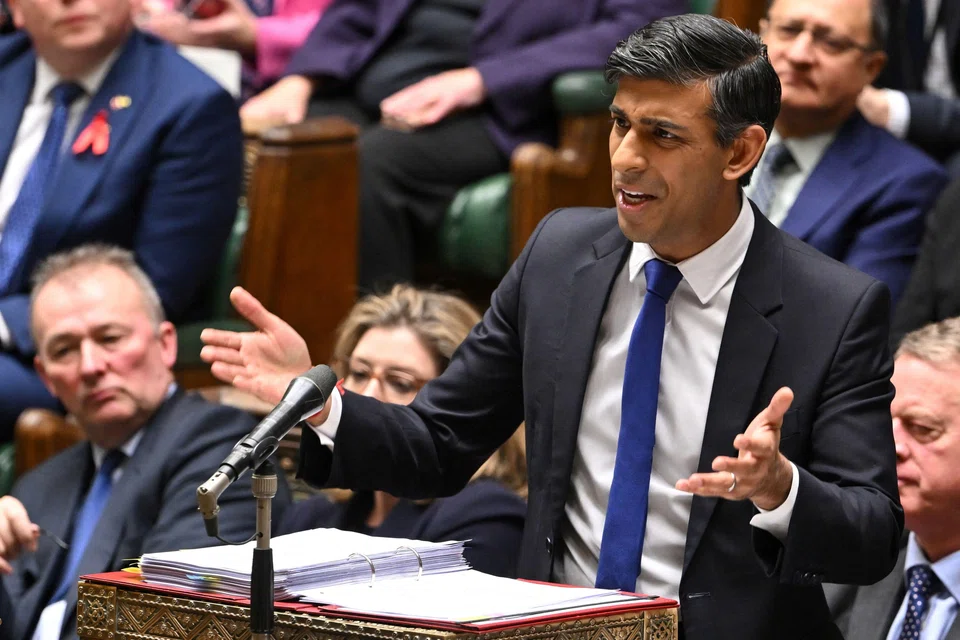
[LONDON] THE UK is heading into an election year at a time of economic and political uncertainty, which bodes poorly for Prime Minister Rishi Sunak and his Conservative party.
Banks and economic consultants have not paid much attention yet to the implications of a transfer of power. They believe the general election will be in late 2024.
That may be enough time to turn the tide of sentiment, which is in favour of Labour. Despite tax giveaways in Chancellor Jeremy Hunt’s Autumn Statement, an average of polls shows Sunak’s Tory government is still 19 points behind Labour.
More depressing for the Conservatives: the negative poll gap has fluctuated around 20 per cent for more than a year. Conservative members of parliament also fear the resurgence of the Liberal Democrats, as 11 per cent of poll respondents favour the party.
According to the polls, a left-liberal alliance of Labour and the Liberal Democrats would control 56 per cent of the vote. If Labour wins and carries out its promises of more spending, the Bank of England (BOE) may have to raise interest rates above the current 5.25 per cent – potentially pushing the country into a recession.
To counter a potential opposition landslide, Sunak will do his utmost to boost the sagging economy. The expectation is that there will be further tax cuts and other incentives in the April 2024 budget.
Yet, government debt is now 97 per cent of gross domestic product. The UK is also in a current account deficit. Both these factors limit Sunak’s options.
The Conservatives could also hope the BOE eases up on monetary policy and begins cutting interest rates well ahead of the election.
Weak economic growth would be one reason to begin easing. The UK’s GDP grew an estimated 0.6 per cent in the third quarter, and 2023 growth is expected to come in around that level. Inflation is expected to fall.


Such a situation would bring with it other pains, though: there is a risk that the pound sterling could plunge 10 per cent or more if there is a recession. The FTSE 100 index, the national stock benchmark, could trade within a 5 to 10 per cent range – or even sink.
ING’s base case scenario is for the UK to narrowly avoid a recession next year; and for inflation to decline to around 4 per cent by mid-year, from the current 4.6 per cent.
Chris Turner, head of UK economic research at ING, said the BOE will be able to cut rates in autumn – ahead of the likely election – under those circumstances.
At the same time, Turner offered two other possible scenarios. The optimistic one is for a resilient jobs market to boost household confidence, even as 2023’s high interest rates finally cause inflation to dip to 3 per cent. Lower inflation will help raise real wages and salaries. In those circumstances, sterling and the stock market would be buoyant.
Under his pessimistic scenario, the UK enters a recession in the second half of 2024. Households and companies struggle under the weight of persistently high interest rates, but inflation remains stubbornly high due to salary increases and costly energy.
The BOE would, at first, keep money tight and rates high to counter persistent inflation. As the economy deteriorates, however, it would be forced to slash rates. Following an initial decline, the FTSE 100 would revive under a combination of interest rate and sterling declines.
BOE governor Andrew Bailey is worried that the pessimistic scenario could materialise. Recently, he said that he is “in no doubt” that the potential growth rate of the economy is the lowest he has experienced in his working life.
The recently released BOE financial stability report summed up Bailey’s fears: household income growth has been greater than expected, but “finances remain stretched” because of higher cost of living, higher interest rates and higher mortgage repayments.
Earnings growth has helped British companies service their debts, “but the full impact of higher financing costs has not yet passed through to all corporate borrowers”. Smaller or highly geared companies are likely to remain under pressure. Corporate insolvency rates are beginning to rise.
“The UK banking system is well-capitalised... but the overall risk environment remains challenging,” the report added. Loans to commercial real estate and highly leveraged companies may lead to losses.
Net lending is “subdued”, and tightening in credit hinders the macroeconomic outlook.
Sunak, who is now under fire for his handling of the UK’s reaction to the Covid-19 pandemic, may face an even tougher test next year.
Decoding Asia newsletter: your guide to navigating Asia in a new global order. Sign up here to get Decoding Asia newsletter. Delivered to your inbox. Free.
Share with us your feedback on BT's products and services






