World’s most important bromance revived as Trump heads to China
The two men have met at least six times over the past decade
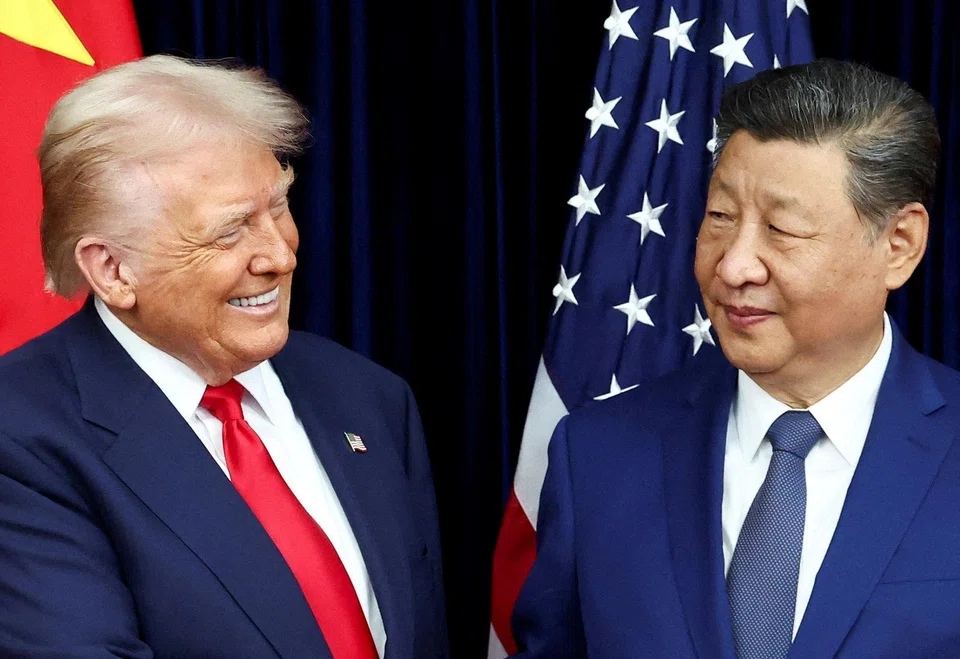
[HONG KONG] When Donald Trump’s plane touches down in Beijing, he will become the first sitting US president to visit China in nearly a decade. His two-day summit with Xi Jinping extends a personal relationship that’s weathered a tariff war, pandemic and historic energy crisis.
The two men, septuagenarians with June birthdays just one day apart, have met at least six times over the past decade. Those meetings have mostly unfolded on the sidelines of major multilateral summits, although both men have visited each other’s nations and been treated to grand displays of respect.
That pageantry has belied deeper fault lines. Even as both leaders leaned into personal diplomacy, tensions over trade, Taiwan and technology intensified – setting the stage for a rising rivalry that’s reverberated across international markets and geopolitics.
Despite the barbs traded between the governments of Trump and Xi, their personal rapport remains intact – a contrast with Joe Biden, who never visited China as president, becoming the first leader since Jimmy Carter to leave office without doing so.
Here’s a roundup of the relationship:
The first summits
The bromance began with a lavish Florida summit in April 2017, when Trump welcomed Xi to his Mar-a-Lago resort. Over chocolate cake, Trump informed Xi that 59 US cruise missiles had just been launched at a Syrian airbase, a detail he later said the Chinese leader asked the interpreter to repeat.
“I did not want him to go home … and then they say: ‘You know the guy you just had dinner with just attacked [Syria]’,” Trump explained.
Trump’s granddaughter Arabella Kushner serenaded Xi and his wife, Peng Liyuan, in Mandarin with the traditional folk song “Mo Li Hua”, a moment touted by Chinese state media. Xi, in turn, gifted Trump an ornate calligraphy display and a custom dinnerware set imprinted with the pink Mar-a-Lago estate, some of the most expensive gifts the US leader received from a foreign counterpart that year.
“There are a thousand reasons to make China-US relations a success, but not a single reason to break it,” Xi told Trump. The US leader later said: “I got to know him very well.”

About seven months later, Trump travelled to Beijing for what Chinese officials branded a “state visit-plus”, an unprecedented designation. Xi and his wife hosted the US president and first lady for a private tour of the Forbidden City, the imperial palace that served as China’s political centre for nearly 500 years, along with tea and a traditional opera performance. Trump became the first US president to dine inside the complex, as the two sides unveiled more than US$250 billion in commercial deals.
During Trump’s first administration, however, pressure built to confront China over what officials saw as unfair economic practices, a hefty trade imbalance and national security threats.
“I don’t blame China,” Trump said during his state visit to Beijing in November 2017, referring to the US trade deficit. Instead, he blamed previous US administrations, adding: “I give China great credit.”
Within months, the bonhomie collided with policy.
Heated friendship
Even as Trump continued to speak warmly about Xi, the relationship took a sharper turn within six months of their Beijing summit, as the US launched its most aggressive economic offensive on China in decades. That included plans to hike tariffs on US$200 billion in imports, tighten export controls and restrict companies such as Huawei.
Still, the personal rapport seemed to offer some reprieve. At a stripped-down Group of 20 working dinner in Buenos Aires in December 2018, the two struck a 90-day truce in escalating tariffs.
A similar dynamic played out six months later in Osaka. “We have become friends,” Trump said, “I think we are going to do something that’s going to be very positive.” Xi continued to stress the need to maintain cordial ties, saying “cooperation and dialogue are better than friction and confrontation”.
Even as officials traded jabs, Trump kept his rhetorical warmth towards Xi, telling reporters at Davos in January 2020 – the month the US-China “Phase One” deal was signed – that the relationship had probably never been better.
The pandemic shattered that veneer. Trump began calling Covid-19 the “China virus”, blaming Xi for the global crisis, and left office with the bilateral relationship teetering on the brink of crisis.
The two would not meet face-to-face again for six years.
The rematch
Trump’s return to the White House in January 2025 reopened a personal channel immediately, as Trump invited Xi to attend his inauguration. China instead sent Vice-President Han Zheng, a high-level diplomatic move that signalled a desire for stable relations.
Within weeks, Trump launched his most aggressive economic salvo yet, with so-called Liberation Day tariffs, along with fentanyl-related duties. That drove levies on Chinese goods to 145 per cent. Beijing retaliated by hiking tariffs on all US goods to 125 per cent and calling the administration’s actions a “joke”.
Yet when the two finally met in October 2025 on the sidelines of the Asia-Pacific Economic Cooperation conference in Busan, an air of conviviality reasserted itself. Over roughly 100 minutes at a South Korean airbase, Trump described Xi as a great leader and a tough negotiator. Xi told Trump that, as captains of the “giant ship of China-US relations”, they should keep a steady course.
The meeting yielded a one-year truce: Washington halved the fentanyl-related tariffs and shelved a threatened 100 per cent increase. Beijing paused its expanded rare-earth export controls and committed to soybean purchases. Trump rated the meeting a “12” out of 10.
Game of telephone
Phone calls have been keeping the truce alive more recently.
Trump has again hailed Xi as a great leader and described their “extremely good” rapport. But the relationship is playing out against a more complex backdrop. The world’s biggest economies are entrenched in structural decoupling, with both sides racing to build parallel supply chains in chips, rare earths and AI.
Trump has said that he’s looking forward to seeing Xi at their two-day summit slated for May 14 to 15 in Beijing, where the two will seek to navigate tensions over trade and Taiwan, even as the US war in Iran scrambles global energy markets and his diplomatic calendar – delaying the trip from April to May.
Expectations for a breakthrough are low, though up to three more meetings are tentatively planned this year, including a possible state visit by Xi to Washington.
For now, the bromance abides – fragile, transactional and bound less by what’s going right than what could possibly go wrong. BLOOMBERG
Decoding Asia newsletter: your guide to navigating Asia in a new global order. Sign up here to get Decoding Asia newsletter. Delivered to your inbox. Free.
Share with us your feedback on BT's products and services