

Higher technology co-funding for some types of farms, new lease system for sea farms
 Add BT as a preferred source
DeeperDive is a beta AI feature. Refer to full articles for the facts.
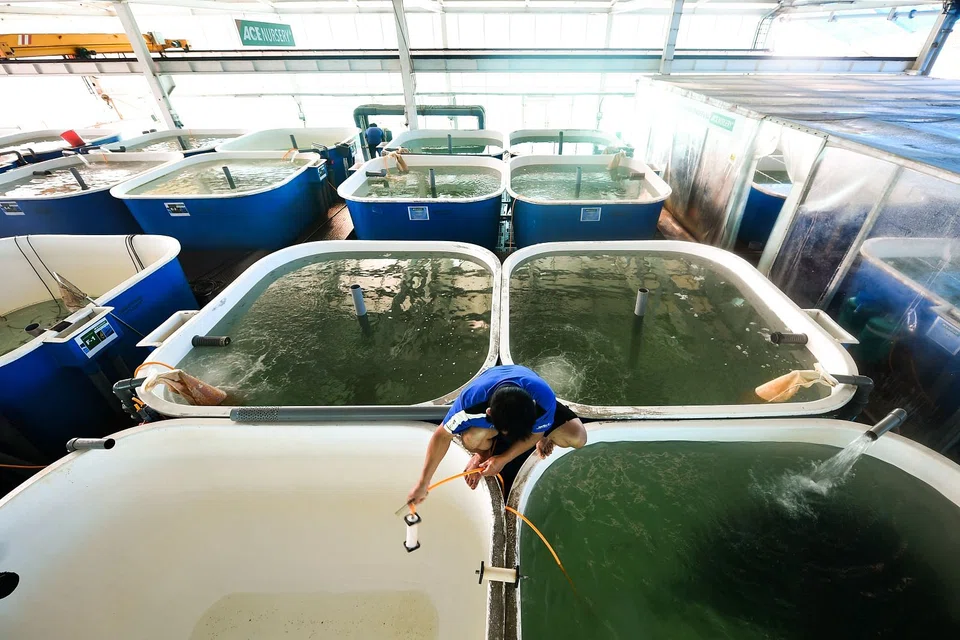
SOME types of farms will be able to get higher co-funding for technology, as part of efforts to strengthen Singapore's food supply resilience, said Minister of State for Sustainability and the Environment Desmond Tan at his ministry's Committee of Supply debate on Monday (Mar 7).
New sea spaces will also be launched for local aquaculture - though sea-based farms will have to start paying for leases under a new system.
The S$60 million Agri-Food Cluster Transformation (ACT) Fund, established in 2021 and available till end-2025, will offer a higher co-funding rate for fruited vegetables, mushrooms, and shrimp.
The fund provides support in three areas: technology upscaling, for commercial-scale and advanced farming technology; innovation and test-bedding, for prototyping or developing innovative farming technology; and capability upgrading, for procuring approved equipment and systems.
Currently, the co-funding rate is 70 per cent for leafy vegetables, food fish and hen eggs, and 50 per cent for other types of farms, up to different respective caps.
For applications from Apr 1, farms producing fruited vegetables, mushrooms, or shrimp will also receive the higher rate of 70 per cent for technology upscaling, as well as innovation and test-bedding. There is no change to the co-funding rate under capability upgrading.
Navigate Asia in
a new global order
Get the insights delivered to your inbox.
The aim is to build research and development (R&D) capability and incentivise investment into technology and farming systems, in line with the "30 by 30" goal of having the local agri-food sector produce enough to meet 30 per cent of Singapore's nutritional needs by 2030, said the Singapore Food Agency (SFA).
Separately, from end-2022, new land and sea tenders with 20+10-year leases will be launched "to provide greater certainty for our farmers, so they will invest more into their farms", said Tan.
The longer leases will apply to new land parcels in Sungei Tengah and Lim Chu Kang after the Lim Chu Kang masterplan is developed.
From end-2022, the SFA will progressively launch new sea space tenders in the Southern Waters and East Johor Strait.
Sea-based farms do not currently pay for the use of sea spaces, and instead apply for a licence and are allocated a site if successful. But they will soon have to pay, under the new lease-based system.
As part of the transition to leases, temporary occupation licences (TOL) will be introduced for existing sea farms from Jan 1, 2023.
An annual TOL rate of S$3,600 per half hectare in the Straits of Johor and S$6,000 per half hectare in the Southern Waters will apply from 2023, with valuation taking into account factors such as locational attributes.
Farms were meant to pay 20 per cent of the TOL in the first year, but this will be waived to mitigate the cost impact on farmers, said SFA. To ease the farms towards the lease-based system, the payment will be phased over 4 years, reaching the full amount in 2026.
Separately, most sea-based farmers will see a substantial reduction in their annual licence fees to S$145 per licence, down from S$850 per half hectare, from Jan 1, 2023.
Only new farm applications and farms with major changes to their farming activities, such as a change in the food type that they want to produce, will be subject to a separate one-off assessment fee, said Tan.
READ MORE:
- SFA, SLA open tender for fish farming plots on Pulau Ketam
- The Fish Farmer looks to reduce food waste, make aquaculture industry more sustainable
- Revamping aquaculture farming with innovation and technology
Decoding Asia newsletter: your guide to navigating Asia in a new global order. Sign up here to get Decoding Asia newsletter. Delivered to your inbox. Free.
Copyright SPH Media. All rights reserved.
TRENDING NOW

From 1MDB to ‘corporate mafia’: Is Malaysia facing a new governance test?

Higher costs, lower returns: Why are Singaporeans still betting on real estate?
South-east Asian markets account for 8.8% of global capital inflows from 2021 to 2024: report
Richard Eu on how core values, customers keep Singapore’s TCM chain Eu Yan Sang relevant

