Hizbollah launches missiles at Israel, prompting airstrikes on Lebanon
 Add BT as a preferred source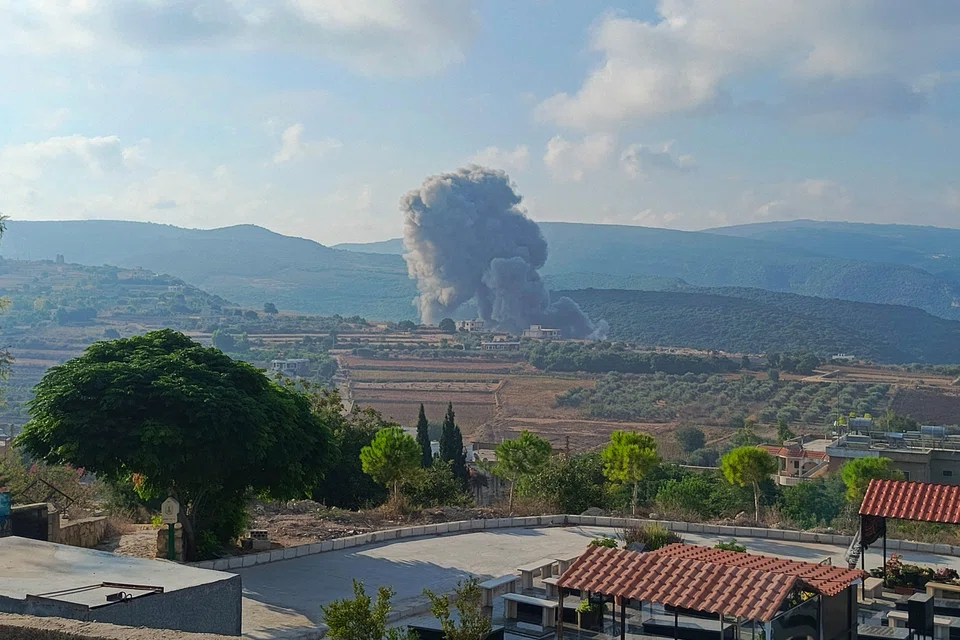
DeeperDive is a beta AI feature. Refer to full articles for the facts.
HIZBOLLAH launched hundreds of rockets and drones at Israel early on Sunday (Aug 25), as Israel’s military said it struck Lebanon with around 100 jets to thwart a bigger attack, in one of the biggest clashes in more than 10 months of border warfare.
Missiles were visible curling up through the dawn sky, dark vapour trails behind them, as an air raid siren sounded in Israel and a distant blast lit the horizon, while smoke rose over houses in Khiam in southern Lebanon.
The extent of damage was not immediately clear and Hizbollah indicated it was not planning further strikes yet, while Israel’s Foreign Minister said the country did not seek a full-scale war.
Any major escalation in the fighting, which began in parallel with the war in Gaza, risks morphing into a regional conflagration drawing in Hizbollah’s backer Iran and Israel’s main ally the United States.
Sunday’s strikes came as negotiators were meeting in Cairo in a last-ditch effort to conclude a halt to the fighting in Gaza.
The Iran-backed Lebanese group said it had fired 320 Katyusha rockets towards Israel and hit 11 military targets in what it called the first phase of its retaliation for Israel’s assassination of Fuad Shukr, a senior commander, last month.
Navigate Asia in
a new global order
Get the insights delivered to your inbox.
Israel’s military said it had foiled a much larger attack with pre-emptive airstrikes after assessing that Hizbollah was preparing to launch the barrage, using 100 jets to strike more than 40 Hizbollah launch sites in southern Lebanon.
Israeli Prime Minister Benjamin Netanyahu said on Sunday that all drones launched against a strategic target in central Israel were intercepted, and that the leaders of Hizbollah and Iran should know that the response was “another step towards changing the situation in the north and returning our residents safely to their homes” and that “this is not the end of the story”.
Hizbollah dismissed Israel’s statement that the group’s attack had been foiled with pre-emptive strikes, saying it had been able to launch its drones as planned and that the rest of its response to Shukr’s killing would take “some time”.

Flights briefly suspended
Israel’s Cabinet met at 7 am (0400 GMT). Defence Minister Yoav Gallant declared a state of emergency and Foreign Minister Israel Katz said Israel would respond to developments on the ground but did not seek a full-scale war.
Flights to and from Ben Gurion airport in Tel Aviv were suspended for around 90 minutes.
“We are determined to do everything possible to defend our country, to return the residents of the north safely to their homes and to continue to uphold a simple rule: Whoever harms us – we harm him,” Netanyahu said.
Lebanon’s caretaker prime minister Najib Mikati met Cabinet ministers at a session of the national emergency committee.
The United Nations peacekeeping force in Lebanon and the UN’s special coordinator’s office in the country called on all sides to cease fire, calling the developments overnight “worrying”.
Expectations of an escalation had risen since a missile strike in the Israeli-occupied Golan Heights last month killed 12 youngsters and the Israeli military assassinated Shukr in Beirut in response.
Warning sirens
In northern Israel, warning sirens sounded and multiple explosions were heard around several areas as Israel’s Iron Dome aerial defence system shot down rockets coming from southern Lebanon. Israel’s Magen David Adom ambulance service said it was on high alert all over the country.
The Israeli military issued civil defence instructions from central Israel to the north, limiting gatherings but authorising people to go to work as long as they were able to reach air raid shelters quickly. There were no casualties immediately reported in Israel, according to the ambulance service.
Israeli media said the barrage hitting northern areas had damaged some houses and a chicken coop.
A security source in Lebanon said at least 40 Israeli strikes had hit various towns in the country’s south in one of the densest bombardments since hostilities began in October.
One of the strikes on the town of Khiam killed one fighter from the Hizbollah-allied Shi’ite group Amal, two security sources told Reuters. Amal later announced his death.
A resident of the southern Lebanese town of Zibqeen, some 7 km from the border, told Reuters it was the first time he had awakened “to the sound of planes and the loud explosions of rockets – even before the dawn prayer. It felt like the apocalypse.”
Israel’s Army Radio, citing defence officials, said the military assessed that the Hizbollah barrage on northern Israel was “improvised” after the pre-emptive strike by Israeli jets on the Hizbollah launch sites.
Regional conflict risk
US President Joe Biden was following events closely, the White House said.
“At his direction, senior US officials have been communicating continuously with their Israeli counterparts. We will keep supporting Israel’s right to defend itself, and we will keep working for regional stability,” said National Security Council spokesperson Sean Savett.
Hizbollah fired missiles at Israel immediately after the Oct 7 attacks by Hamas gunmen on Israel. Hizbollah and Israel have been exchanging fire constantly ever since, while avoiding a major escalation as war rages in Gaza to the south.
That precarious balance appeared to shift after the strike in the Golan Heights, for which Hizbollah denied responsibility, and the subsequent assassination of Shukr, one of Hizbollah’s most senior military commanders.
Shukr’s death in an air strike was quickly followed by the assassination of Hamas political leader Ismail Haniyeh in Teheran, which led to vows of reprisal against Israel by Iran.
Decoding Asia newsletter: your guide to navigating Asia in a new global order. Sign up here to get Decoding Asia newsletter. Delivered to your inbox. Free.
Share with us your feedback on BT's products and services