

Hong Kong sets first five-year plan tech goals, expands baby bonus
City aims to make total domestic expenditure on innovation activities account for 3% of GDP after 2030
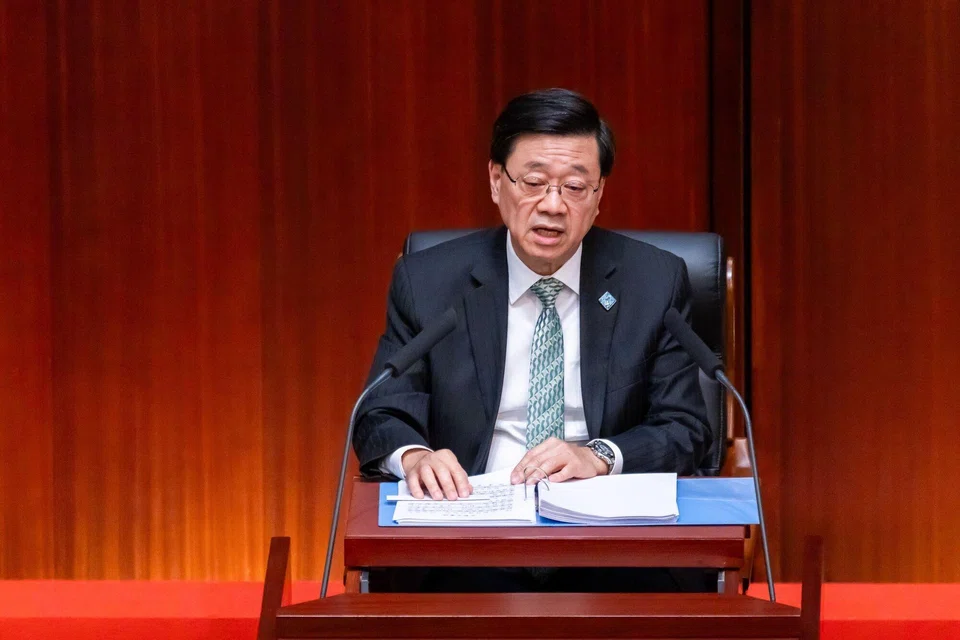
[HONG KONG] Hong Kong chief executive John Lee set out plans to almost double the city’s spending on innovation in coming years and offered greater financial support for new parents, as his government seeks to build new growth engines growth and arrest a decline in births.
The innovation target was announced on Wednesday (Sep 16) as Lee unveiled Hong Kong’s first five-year development plan.
The city will strive to make total domestic expenditure on innovation activities account for 3 per cent of gross domestic product after 2030, up from 1.63 per cent in 2024.
“We will closely align with our country’s strategic technology areas,” Lee said in a speech, naming life and health technology, artificial intelligence and robotics, and microelectronics among focus areas.
China’s research and development expenditure accounted for 2.8 per cent of GDP in 2025.
Lee followed the five-year plan with his annual policy address, which set out measures for putting the longer-term blueprint into effect and offered more immediate support to households.
The government will extend the one-time newborn baby bonus of HK$20,000 (US$2,550) for three years through October 2029 and raise the payment for second and subsequent children to HK$30,000.
Homebuyers who buy an apartment within one year before or two years after the birth of a child will also receive a HK$20,000 reduction in stamp duty. The existing newborn bonus was first announced in the 2023 policy speech for an initial three-year period.
Lee emphasised national security in the policy address, calling it a “never-ending process” that must not be overlooked in the pursuit of development.
The government will continue to strengthen the legal system and enforcement mechanisms for safeguarding national security.
To promote patriotic education, the city will establish a museum to showcase China’s achievements in areas such as technology, sports and culture.
The emphasis continues a central theme of the Hong Kong government since Beijing imposed a National Security Law in 2020 that has silenced dissent and led to the imprisonment of dozens of critics, including former media mogul Jimmy Lai.
Lee, a former security chief, said that the enforcement of security laws has provided the stability and predictability needed for economic growth, describing the former British colony as a “safe harbour” for development.
The new five-year plan calls for AI to become a core industry for Hong Kong and be applied more widely across finance, trade, logistics, professional services and healthcare.
The government will expand computing infrastructure through a Sandy Ridge data facility due to start operating by 2029 and review legislation to support wider AI use.
A key part of Lee’s technology drive is the Northern Metropolis project bordering the mainland city of Shenzhen. That development is intended to provide land, infrastructure and talent for tech and emerging industries.
He set a binding goal of increasing “spade-ready sites” – plots that can be readily used for development – to 900 hectares by 2031 from 120 in 2026.
The Hang Seng Property Index advanced as Lee highlighted cross-border initiatives and progress on the future tech hub. Developers with ample liquidity stood out, with Longfor Group, Hang Lung Properties and Sun Hung Kai Properties among the biggest gainers.
The longer-term plan also seeks to enhance Hong Kong’s traditional roles as a centre for finance and trade.
The government plans to expand offshore yuan products, promote the currency’s use in settling public expenditure and develop a commodity-trading ecosystem with gold as an entry point.
Hong Kong will seek to attract more global companies and talent, targeting annual growth of 4 to 5 per cent in the number of businesses with parent companies located outside the city.
Three university towns planned for the Northern Metropolis will combine education, research and industry, with student housing and other services designed to attract international talent.
Lee did not set a hard target for GDP growth, saying only that the economy should expand at a pace “within a reasonable range” through 2030.
The innovation goal aligns Hong Kong with China’s 15th Five-Year Plan, which puts technological self-reliance at the centre of the country’s strategy.
Beijing is seeking breakthroughs in fields including advanced chips, quantum computing and robotics as competition with the US intensifies and American export controls expose China’s dependence on foreign technology.
AI is a particular focus. China’s national plan calls for AI to be deployed across the economy, including in manufacturing and other industries, as Beijing seeks to raise productivity and compete with the US for leadership in the technology. BLOOMBERG
Decoding Asia newsletter: your guide to navigating Asia in a new global order. Sign up here to get Decoding Asia newsletter. Delivered to your inbox. Free.
Share with us your feedback on BT's products and services
TRENDING NOW

DBS, OCBC, UOB rout lops billions off STI as inflation, rate concerns spook investors

Grab CEO’s wife Chloe Tong on life with Anthony Tan and finding her purpose

OCBC sheds S$8 billion in value as shares close nearly 6% down; analysts cautious on banks

Deal between tycoon friends sparks scrutiny of Philippine power sector

