

China’s latest Five-Year Plan opens co-creation opportunities for Singapore companies
The latest economic blueprint focuses on emerging industries, technological self-reliance and boosting consumption

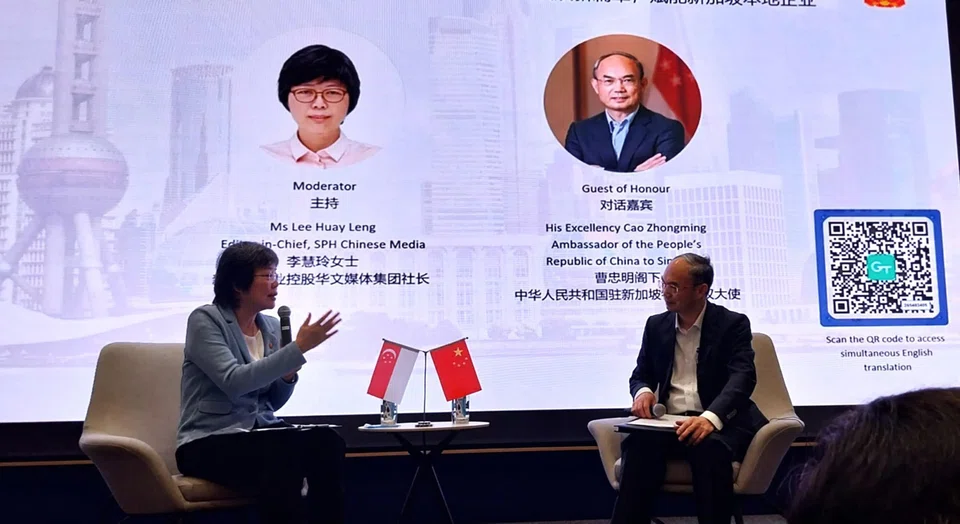
[SINGAPORE] China’s biggest annual political event, the Two Sessions, recently wrapped up with lawmakers approving the 15th Five-Year Plan – essentially the country’s economic and development blueprint for the next five years.
The key priorities in the latest edition include developing technological self-reliance, focusing on emerging and future industries such as aerospace and quantum technology, as well as boosting domestic consumption.
Cao Zhongming, the country’s ambassador to Singapore, on Monday (Mar 23) said the 15th Five-Year Plan is particularly important for China as it will connect its past and future.
He was speaking in Mandarin at an event titled “China’s next chapter and impact on your business”, organised by the Singapore Manufacturing Federation (SMF) and attended by about 200 business executives.
In a fireside chat moderated by Lee Huay Leng, editor-in-chief of the Chinese Media Group at SPH Media, Cao said he hopes Singapore and China can keep working together closely.
He added that Singapore companies are well-received in China, citing the success of Bee Cheng Hiang, which has around 300 stores there.
SMF president Lennon Tan, who gave the welcome address, noted that the latest Five-Year Plan is both a warning and a rare opportunity for Singapore firms.
He said the warning is that local companies need to accelerate their own digital transformation, but the opportunities are in exploring future areas with Chinese partners, such as artificial intelligence (AI), smart manufacturing and green technologies.
There is broad scope for cooperation between companies from both economies, he noted, with the two countries’ leaders emphasising the development of the AI sector.
He added that for Singapore businesses, the opportunities may not be just manufacturing in China, but also co-creating with China – whether through digital or supply platforms, supply chain solutions, or partnerships with Chinese companies to explore third markets.
Cao said that Beijing signposting its Five-Year Plans help to bring more certainty and predictability to a global environment currently facing tariffs and conflict.
The 15th Five-Year Plan builds on the success of the 14th blueprint, which led to China maintaining its manufacturing strength, the ambassador noted.
Chinese gross domestic product reached a record 140 trillion yuan (S$26.1 trillion) at the end of 2025, the final year of the 14th Five Year-Plan. Meanwhile, GDP per capita rose to US$13,400, placing China among the top upper-middle-income countries.
Critics have often pointed to China’s uneven income distribution and weak social safety net as factors holding back domestic consumption. Household consumption accounts for about 40 per cent of China’s GDP – below the above-50 per cent levels of Organisation for Economic Co-operation and Development economies.
Cao said that China will continue to support small and medium enterprises in digital transformation, as well as focus on technological self-reliance. It will also propose measures to improve incomes and its social security system, he added.
Decoding Asia newsletter: your guide to navigating Asia in a new global order. Sign up here to get Decoding Asia newsletter. Delivered to your inbox. Free.
Copyright SPH Media. All rights reserved.






