

Indonesia’s long-term draw intact despite market, currency jitters, says new SBF chairman
The business chamber and Indonesia’s Kadin sign 2-year agreement to help companies trade more easily across borders

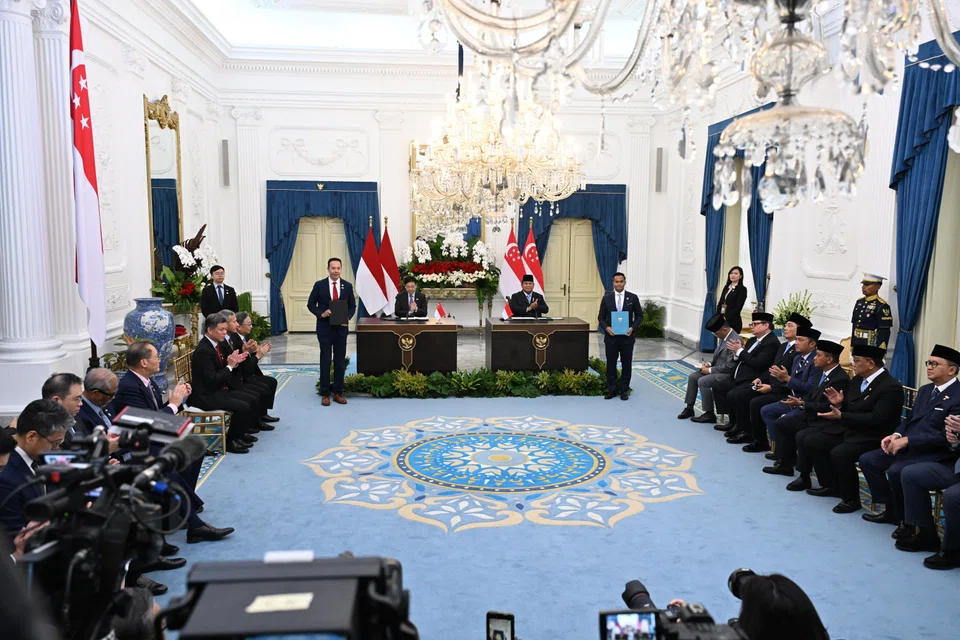
[JAKARTA] Singapore companies should not let short-term market volatility in Indonesia obscure the longer-term opportunities in South-east Asia’s largest economy, said the Singapore Business Federation’s (SBF) new chairman Mark Lee, as the apex business chamber deepens ties with its Indonesian counterpart.
Speaking to The Business Times during his first overseas trip since taking over as SBF chairman in June, the 53-year-old said companies should take a long-term view of Indonesia, pointing to the country’s scale, urbanisation, export potential and growing middle class as reasons it remains attractive.
Lee, who is also chief executive officer of Sing Lun Industrial and a Nominated Member of Parliament, was elected for a two-year term as SBF chairman, after previously serving as vice-chairman.
“Volatility is not isolated in Indonesia; I think volatility has been happening to all of us in the business community over the last 18 months,” he said. “As a businessman – (speaking) beyond just the chair of SBF – I think in any volatility, there’s always opportunities.”
His comments come as Indonesia faces investor concerns over its currency, equity market and policy direction under President Prabowo Subianto, who took office in October 2024 for a five-year term.
Middle class expansion
But Lee said the longer-term fundamentals of South-east Asia’s largest economy remain difficult to overstate.
“The fundamentals behind the opportunities, and the mega trends, (they) cannot be ignored,” he said. “You’ve got a 280-million-plus population in Indonesia, and you’ve got rapid urbanisation.”
He added that Prabowo has been “very ambitious” in developing urban centres across the country, creating opportunities for Singapore firms in areas such as construction, infrastructure and housing.
As Indonesia’s middle class expands, demand for education, healthcare, lifestyle and consumer brands will also continue to rise, presenting further opportunities for companies from the city-state, Lee said.

“These are some things that are exciting, and it won’t go away, good times or bad times,” he said. “People will go shopping, (they) will get a house – I think it’s about framing where you see the opportunity.”
Indonesia is also one of the closest large markets available to Singapore firms, he noted.
For manufacturers, the country’s ambitions to move further upstream also present opportunities, particularly given Singapore’s resource constraints. Indonesia, by contrast, has land, resources, power, solar potential and industrial parks, Lee said.
Export-oriented companies could also benefit from the current currency environment, he added. A weaker rupiah may lower local-currency operating costs for firms producing in Indonesia, while export revenues are often collected in US dollars.
“If you take a longer-term approach, I would say that you ride it out, because you can never time a market,” he said.
Asked whether Singapore firms remained keen to expand in Indonesia despite the current uncertainty, SBF chief executive officer Kok Ping Soon said businesses here continue to be interested in Indonesia and the wider Asean region, even if market volatility may slow some plans.
Citing SBF’s latest internationalisation survey released in April, Kok noted that among Singapore firms planning to expand, 65 per cent intend to do so in Asean, with Indonesia, Malaysia and Thailand among the leading destinations.
This is also reflected in findings from BT’s inaugural regional survey, The Business Times Insights: Asean Intelligence 2026, which polled more than 500 C-suite executives and business leaders across six South-east Asian markets, including Indonesia, earlier this year.
The survey found that South-east Asian business leaders see Asean and their own domestic markets as the biggest opportunities, cited by 63 per cent and 62 per cent of respondents, respectively.
Affordable digital infrastructure, strong growth potential and more manageable operating costs compared with Singapore remain among the reasons firms are attracted to Indonesia, Kok said.
Still, companies need the right partners and a strong understanding of local conditions before entering the market, he stressed. This is especially important given that Indonesia should not be treated as a single, uniform market.
“In reality, it’s not – it’s very heterogeneous, it’s a huge archipelago,” Kok said. “It really has different centres and different cultural affinities, depending on the goods that you have.”
Singapore companies should therefore do their homework, understand the regulations and tap support from SBF, Enterprise Singapore, trade associations and banks, he added.
Facilitating cross-border trade
To that end, SBF and the Indonesian Chamber of Commerce and Industry, or Kadin, signed a two-year memorandum of understanding on Monday (Jul 6) to help small and medium-sized enterprises in Indonesia trade more easily across borders.
The agreement, signed by Lee and Kadin chairman Anindya Novyan Bakrie, was announced as one of the deliverables of this year’s Singapore-Indonesia Leaders’ Retreat between Singapore Prime Minister Lawrence Wong and Prabowo in Jakarta.
Under the agreement, SBF and Kadin will work together in three areas: digital enablement, policy engagement and capability building.
This includes using digital tools to help small businesses understand cross-border trade requirements, organising roundtables and discussions on trade facilitation issues, and conducting workshops and advisory sessions to improve their readiness to trade across borders.
A key initiative under the partnership is the Trade AI Advisor (TAIA), a generative artificial intelligence-powered platform developed by SBF.
The tool, which is currently being trialled, provides Singapore-based companies with guidance on cross-border trade requirements, market entry considerations and regulatory procedures.
Both SBF and Kadin plan to extend TAIA to cover Indonesia’s network of free trade agreements and offer a Bahasa Indonesia version.
For Indonesia-based companies, the platform will provide step-by-step guidance on tariff eligibility, rules of origin, export procedures and market access opportunities.
The initiative is undertaken in partnership with Temasek Foundation, which is supporting the localisation and deployment of TAIA, as well as policy engagement and capability building efforts under the deal.
The Singapore version of TAIA is expected to be officially launched in September. There is no firm timeline yet for the Bahasa Indonesia version.
Lee said the agreement reflects SBF’s broader aim of helping businesses do more with one another across Asean.
“At the end of the day, it’s about making sure that we can all do more business together: not just Singapore to Asean, but also Asean to Singapore,” he said.
Decoding Asia newsletter: your guide to navigating Asia in a new global order. Sign up here to get Decoding Asia newsletter. Delivered to your inbox. Free.
Copyright SPH Media. All rights reserved.
TRENDING NOW

Once staunchly pro-China, Malaysian Chinese businesses are now distancing themselves from Beijing

Looking beyond looming CEO succession, should UOB potentially pursue a transformative merger?

Could stablecoins be the future of money?

Grab CEO’s wife Chloe Tong on life with Anthony Tan and finding her purpose

