

McLaren Automotive aims to widen audience with planned SUV
CCO Henrik Wilhelmsmeyer expects a shift in buyers to include younger, female customers

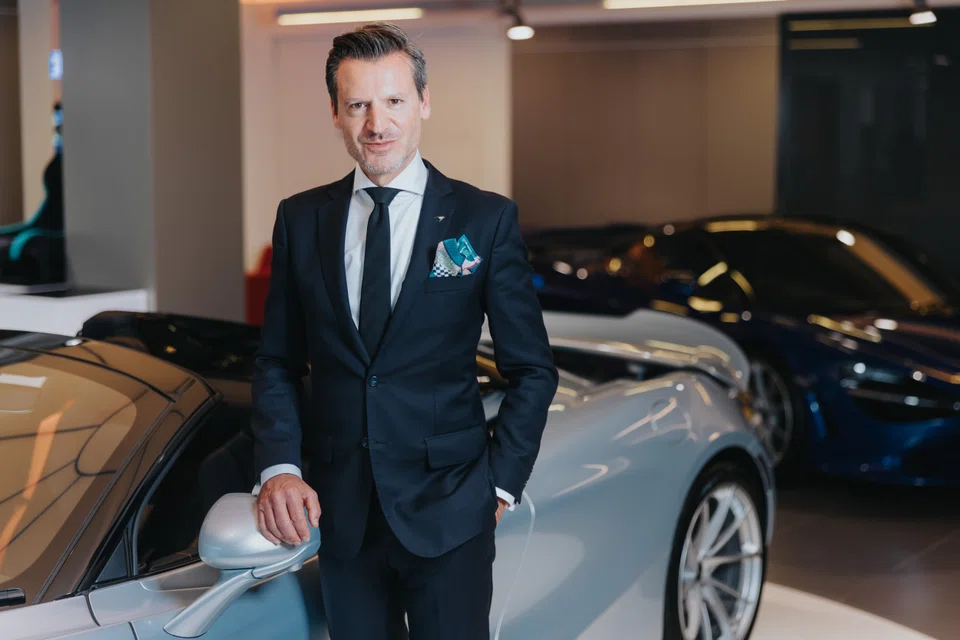
[SINGAPORE] The next wave of customers for British ultra-luxury carmaker McLaren Automotive could well come from the likes of the latest K-pop stars: younger, Asian and female.
That is because the carmaker is now embarking on a new 10-year plan, which includes expanding its model range to include a SUV for the first time, marking a major departure from its history.
Henrik Wilhelmsmeyer, McLaren Automotive’s chief commercial officer, said: “I think we will see very different customers going forward. Today there are a lot of customers with a household of more than two people, who would love to enjoy a McLaren without leaving others behind.”
Sport cars to sport utility
Wilhelmsmeyer confirmed that an SUV is in the works, but provided no specific details. Media reports say the car could be launched as soon as 2028.
In an interview with The Business Times, he said: “We see globally that (the SUV segment is) one of the fastest-growing segments still, and that holds true in Asia as well as Europe and the US.”
While high-performance cars will remain an important part of the business, Wilhelmsmeyer admits that supercars only have relevance to a “certain audience”.

“A supercar, by definition, is built for one purpose. An SUV certainly supports different use cases, and that makes it more relevant to more people,” he added.
McLaren Automotive was founded in 2010 as part of McLaren Group, which includes the Formula 1 team McLaren Racing. Since then, the Woking-based manufacturer has focused on high-performance, two-door, two-seat supercars.
Globally, traditional buyers of supercars are older men, typically above 50. As it has with other luxury carmakers, an SUV will help boost McLaren’s appeal to younger buyers and women.
SEE ALSO






“A fast-growing age band for us is between 20 (and) 30 years old, and we see more clients coming from the tech industry… whereas maybe the previous generation has taken an entire generation to create that wealth, we see this now happening way earlier, and customers are approaching us at a much younger age than ever before.”
Wilhelmsmeyer said another aim is to draw more female buyers to the brand. While he did not link the new SUV to those buyers directly, historically SUVs have had more appeal to women, even in the ultra-luxury segment.
In the Asia-Pacific, outside of China, Japan is a key market with an established supercar-buying audience and large automotive collector market, but South Korea is also fast rising as one of its “most dynamic markets that has a comparatively younger, new audience that is just discovering the brand”.
Less with more
For low volume ultra-luxury carmakers such as McLaren, production is about balancing output, profitability and exclusivity, since flooding the market with too many cars will reduce residual values, alienating existing customers.
In recent years, McLaren has relooked its strategy, reducing output by building only according to demand in order to preserve resale values and prevent sales cannibalisation.
It has also focused on higher margin per car by offering more customisation options through its bespoke division, McLaren Special Operations (MSO).
In 2025, McLaren produced around 2,000 cars, down from 3,300 in 2024. In 2025, rivals Aston Martin manufactured 5,448, Bentley had 10,131 while Ferrari produced 13,640.
All these brands have introduced SUVs in recent years.
Like its competitors, a new SUV will likely mean McLaren must increase its annual production numbers, although Wilhelmsmeyer said there are no new volume targets set as yet and its production strategy remains the same for now.
“Now, the production volume is not predefined. Our clear strategic direction is that we want to be a demand-led business. This means we only want to build cars for a customer. We don’t want to build cars on stock,” he said.
In September, McLaren announced a fresh £500 million (US$655.5 million) funding from its new owner, L’imad, the sovereign fund of Abu Dhabi. The money will be used to build a second factory alongside its existing one in the UK to facilitate the model portfolio expansion.
Formerly, McLaren was majority owned by Bahrain Mumtalakat, the sovereign fund of Bahrain. CYVN, an Abu Dhabi-based transport investment firm, acquired Mumtalakat’s stake in the business in 2024, and was itself folded into L’imad in early 2026.
L’imad’s planned investments in the automaker amount to £1.5 billion over the next five years.
Part of the investments will also be used to expand MSO.
“MSO strategically is our focus for us. It is more relevant to grow the value per car that we sell than the absolute number of cars… the more you personalise and individualise a car, the longer it takes to build, and the less you can do of them,” said Wilhelmsmeyer.
Decoding Asia newsletter: your guide to navigating Asia in a new global order. Sign up here to get Decoding Asia newsletter. Delivered to your inbox. Free.
Copyright SPH Media. All rights reserved.
TRENDING NOW

JPMorgan, BlackRock among those making bid to manage CPF savings

GIC in talks to lease bulk of 88,000 sq ft CapitaSky space to be vacated by Allianz

BN-PN’s Melaka election landslide puts spotlight on jobs, investments and political divides

Why Singapore, Johor and Riau Islands should build a cross-border ecosystem for AI

