

Middle East conflict unlikely to trigger global economic shock, says JPMorgan as it keeps US$60 oil view
Market behaviour so far suggests investors are pricing in a ‘relatively short event or regional conflict’

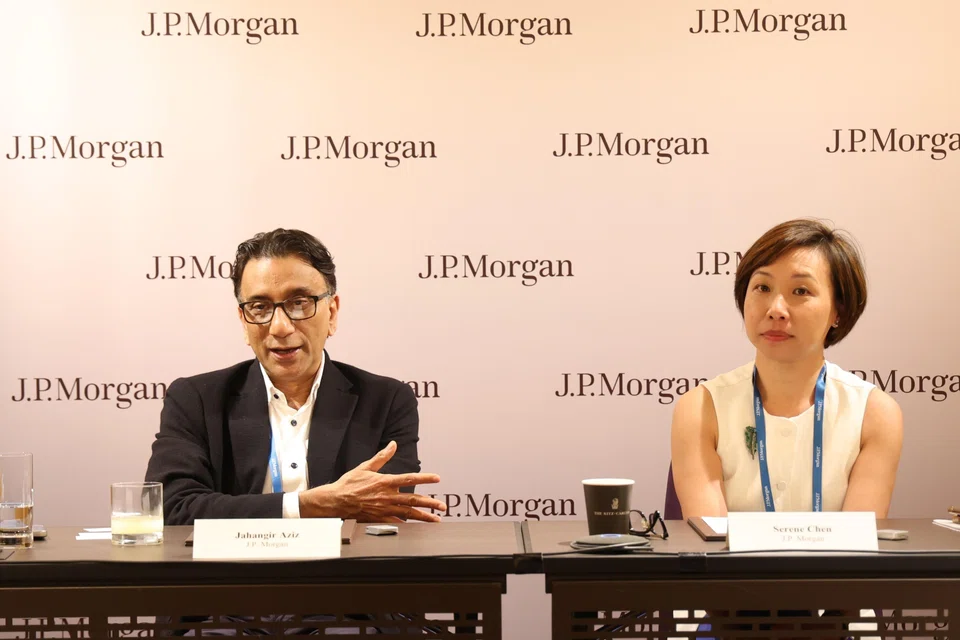
[SINGAPORE] The ongoing conflict in the Middle East involving the US, Israel and Iran is unlikely to trigger a “systemic shock to the global economy”, given the oil market’s structural oversupply, said Jahangir Aziz, global co-head of economic research at JPMorgan Chase, on Tuesday (Mar 3).
Unless oil infrastructure is affected or the Strait of Hormuz faces a sustained disruption, the impact should be regional, Aziz said, as oil remains the main transmission channel between the region and the global economy.
The bank has not altered its pre-conflict oil price forecast, he noted. Its base case still sees Brent crude stabilising at around US$60 a barrel in the second half of the year, supported by projected surpluses in global production.
However, that outlook is subject to “a lot of uncertainty” over how the conflict unfolds and how long it lasts, he warned.
“Clearly, the impact will be in the (Middle East) region,” he said. “But for the global economy, you need to see a sustained increase in oil prices.”
As at 3.15 pm on Tuesday, Brent crude was up 2.9 per cent at US$78.40 a barrel; West Texas Intermediate was up 2.8 per cent at US$73.20.
Regional tensions
Aziz’s remarks came as major airports across parts of the Middle East remained closed after Iran launched attacks on Saudi Arabia, the United Arab Emirates and other US-allied Gulf states.
The retaliatory strikes followed US and Israeli attacks on thousands of targets in Iran over the weekend, which killed its supreme leader Ayatollah Ali Khamenei, as the conflict entered its fourth day.
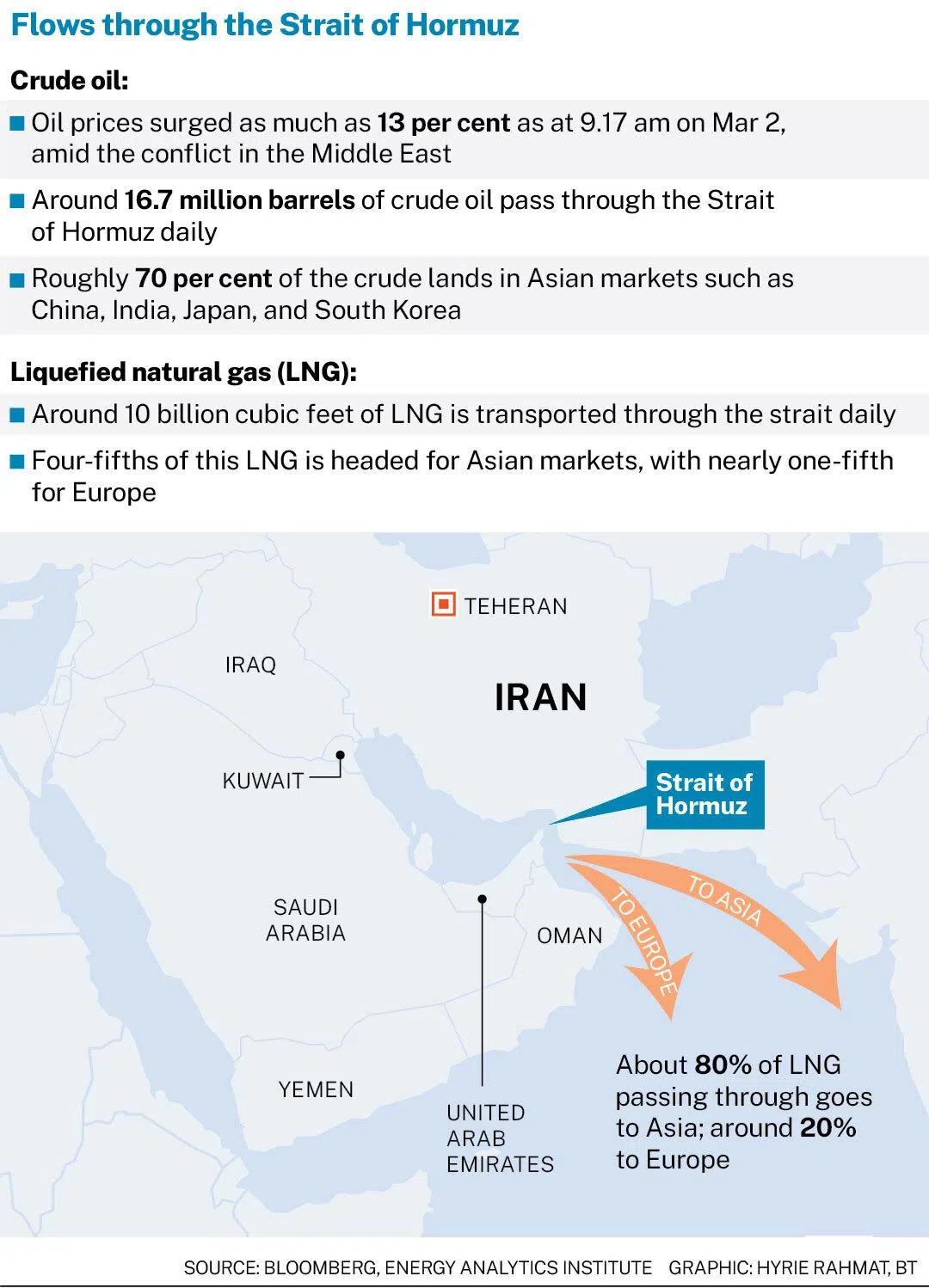
Concerns over potential disruption to shipping through the Strait of Hormuz – the narrow passage between Iran and Oman that accounts for about 20 per cent of daily global crude supply – have added to upward pressure on oil prices.
Even so, market behaviour so far suggests investors are pricing in a “relatively short event or regional conflict”, said Serene Chen, head of credit, currency and emerging market sales for Asia-Pacific at JPMorgan.
Aziz and Chen were speaking to reporters on the first day of the two-day JPMorgan Asia-Pacific Macro Conference at the Ritz-Carlton, Millenia Singapore.
The bank continues to field enquiries on equity investments, particularly in tech-driven, artificial intelligence-exposed economies. Chen said some clients are also assessing “buy-the-dip” opportunities if markets correct.
In JPMorgan’s foreign-exchange trading business, Monday was a “very heavy day”, with volumes several times above normal as clients bought US dollars in a flight to safety, though activity has since largely normalised.
The base case could change if the conflict is prolonged, but it was “still very early days”, Chen added. “We don’t see a fundamental shift yet.”
Decoding Asia newsletter: your guide to navigating Asia in a new global order. Sign up here to get Decoding Asia newsletter. Delivered to your inbox. Free.
Copyright SPH Media. All rights reserved.






