

Oil fears keep S-E Asia’s central banks on their toes as they mull over easing plans
Economists see rate hikes or delayed cuts as policy space wanes and stagflation looms

[SINGAPORE] South-east Asia’s economies came into the new year strong as trade and investments brushed off tariff fears in 2025, but the renewed threat of inflation from an oil shock could prompt its economies to delay their easing cycles – or even begin tightening.
Oil prices have surged more than 30 per cent since the onset of the US-Iran-Israel conflict, breaking above US$100 per barrel on Monday (Mar 9) as the closure of the Strait of Hormuz threatened global oil supply.
Across the region, inflation had largely been benign coming into 2026, leaving South-east Asia’s economies with ample policy space to boost growth through further rate cuts.
“We see most central banks in the region at or near the end of the monetary policy easing cycle,” said OCBC chief economist Selena Ling and senior Asean economist Lavanya Venkateswaran in a report.
This comes as oil-driven inflation concerns place increased pressure on the US Federal Reserve to delay rate cuts. Prior to the conflict, a weakening labour market and slowing growth in the US had most watchers expecting the Fed’s easing cycle to begin in June.
The International Energy Agency said on Wednesday that it would release 400 million barrels of emergency oil reserves in an effort to soften elevated energy prices. But it remains unclear how effective the move will be to stem the bleeding, as details on the pace of release remain uncertain.
“Ultimately the disruption from the Strait of Hormuz is so large that it dwarfs the oil reserve release,” said Michael Wan, senior currency analyst at MUFG.
“To put the 400 million barrels in context, it makes up around just four days of total daily global demand for oil.”
Meanwhile, the fate of the key waterway through which the majority of Asia’s supply flows remains mired in uncertainty.
Iran’s United Nations envoy said on Thursday that while the country would not impose a blockade of the strait, it would exercise its right to self-defence in the area.
Holding rates steady
Geopolitical risks have already garnered the attention of South-east Asia’s policymakers, with Malaysia’s central bank adopting a cautious stance.
Bank Negara Malaysia held its policy rates steady on Mar 5. It said that the country’s domestic inflation would largely be shielded even as global commodity prices spike, reflecting continued economic expansion and the absence of excessive demand pressure.
Ling and Venkateswaran noted: “We see Bank Negara Malaysia and State Bank of Vietnam on a prolonged hold through 2026.”
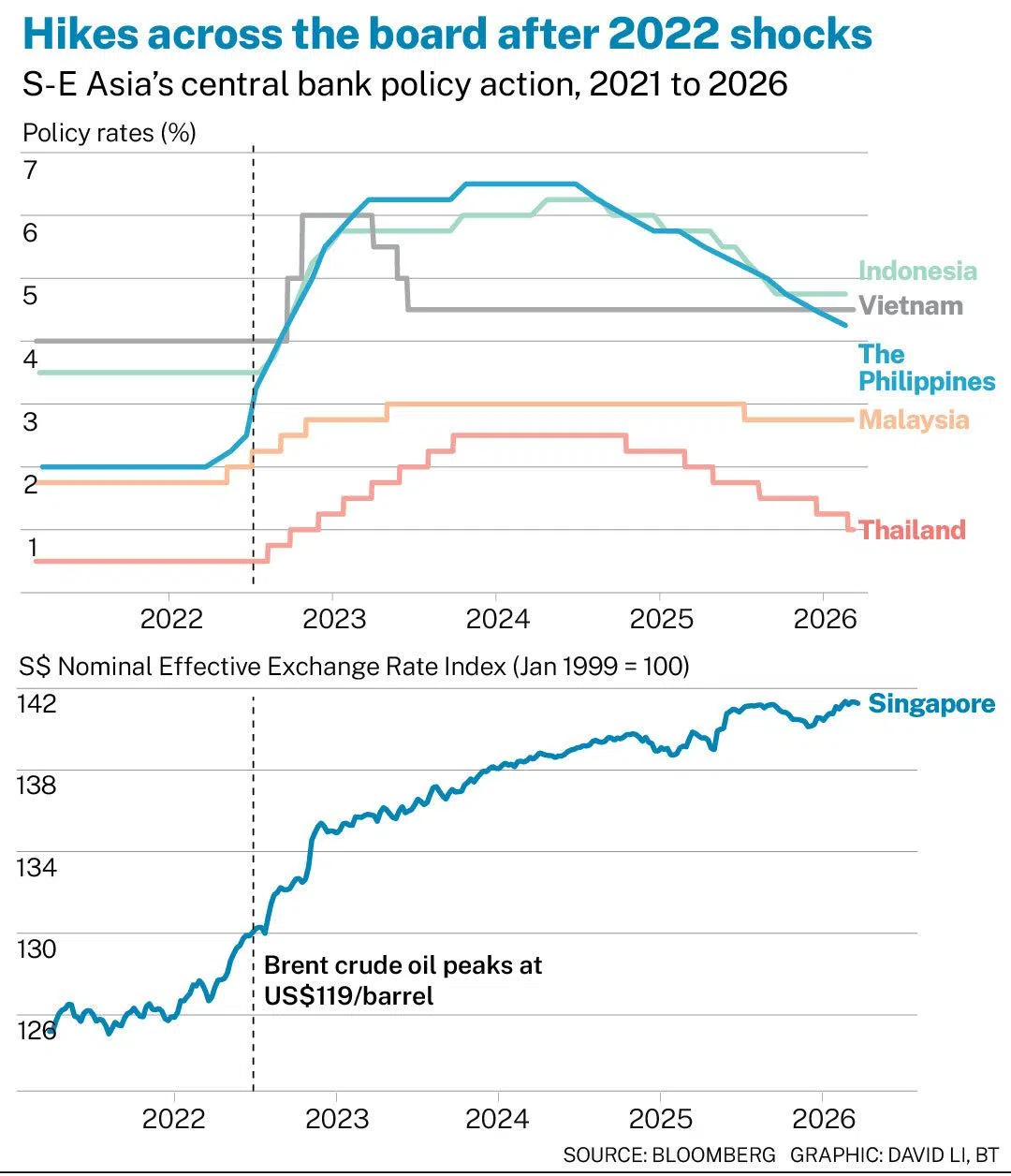
Both economies appear to have reached the end of their easing cycles, with Vietnam’s last cut in June 2023 and Malaysia’s most recent cut in July 2025.
Stagflation and currency weakness threaten
But the region’s other economies, including Indonesia and Thailand, could be forced to reassess the room left for additional cuts if higher oil prices persist, OCBC’s economists said.
In Indonesia, a storm of market pressures has put its central bank in a tight spot, and planned cuts to support economic growth may be delayed as the conflict unfolds.
MUFG senior currency analyst Lloyd Chan said that maintaining the rupiah below the 17,000 per US dollar mark remains a policy priority, following renewed weakness amid rising oil prices and global volatility.
This makes it difficult for Bank Indonesia to reduce rates as differentials with the US narrow, while foreign investor caution threatens to weigh further on the rupiah, noted Deepali Bhargava, regional head of research for Asia-Pacific at ING, in a report on Wednesday.
Meanwhile, higher fiscal deficits could impose further currency headwinds.
There is “limited room to manage sustained shocks without broader fiscal strain”, said Bhargava, as oil prices rise well beyond the country’s 2026 Budget assumptions of US$70 per barrel.
But a weak domestic growth trajectory signals that Bank Indonesia’s easing cycle is not yet complete, she added. “Once the currency stabilises, further rate reduction remains likely to support growth.”
Most economists recently polled by Reuters projected that Bank Indonesia would hold its policy rates steady at 4.75 per cent in its upcoming meeting on Tuesday.
Thailand, which is South-east Asia’s largest net energy importer, remains among the region’s most vulnerable to elevated consumer prices from higher energy cost.
“The escalating geopolitical backdrop in Iran has introduced a layer of complexity that now stands as the primary risk,” said Pipat Luengnaruemitchai, chief economist at Kiatnakin Phatra Securities.
While he noted that the current spike could be temporary, Pipat added that the conflict could disrupt the country’s hopes of growth recovery as tourism, manufacturing and government spending brighten. Under a severe scenario, he projected that a sustained oil spike to US$120 per barrel could drag on growth and trigger stagflation.
Kaushal Ladha, head of Thailand research at Macquarie Capital, said that the kingdom’s central bank could have its hands tied in either direction of monetary policy.
“Raising rates will be too difficult and politically not palatable as economic growth is already so poor,” he told The Business Times. “But at 1 per cent, there is very little space to further cut.”
However, the country remains at a benign starting point with its prices, reporting a deflationary print in February of 0.8 per cent.
Brandon Ong, country risk analyst at BMI, said that he expects the Bank of Thailand to cut its benchmark rate further to 0.75 per cent, though elevated oil prices for a sustained period could shift the Bank of Thailand away from further easing.
Tightening moves
Singapore is among the regional economies that could lean towards tightening.
Ling and foreign exchange strategist Christopher Wong of OCBC noted in a report on Wednesday that the Monetary Authority of Singapore (MAS) had tightened monetary policy on five occasions in 2021 and 2022, as elevated commodity prices and supply-chain disruptions increased inflation globally.
They said that sustained pressures from imported inflation could prompt a tightening of the central bank’s policy stance, including a potential steepening of the Singapore dollar nominal effective exchange rate policy slope.
Nevertheless, they said: “MAS is likely to monitor developments rather than react immediately.”
Likewise, the Philippines has signalled that a rate hike may be on the cards.
Bangko Sentral ng Pilipinas (BSP) governor Eli Remolona had said in February that the central bank was open to further cuts to support growth, as inflation remained subdued at 2 per cent in January.
But the BSP’s move to lower its policy rate by 25 basis points on Feb 19 could now be reversed if an oil-induced inflationary spike sustains.
Remolona told Bloomberg in an interview last Friday that rising oil prices could increase cost pressures that would push inflation beyond the country’s target rate of 2 to 4 per cent. This would force the central bank to hike rates.
Bhargava of ING added: “Persistently higher oil prices also pose a risk of further delaying the recovery in (the Philippines’) gross domestic product growth, which is already starting from a muted base.
“We no longer expect the BSP to cut rates this year.”
TRENDING NOW

LTA proposes combining car COE categories, adding rebate-surcharge system

StarHub to acquire MyRepublic’s mobile business amid ongoing telco consolidation

DBS, OCBC, UOB rout lops billions off STI as inflation, rate concerns spook investors

Grab CEO’s wife Chloe Tong on life with Anthony Tan and finding her purpose

